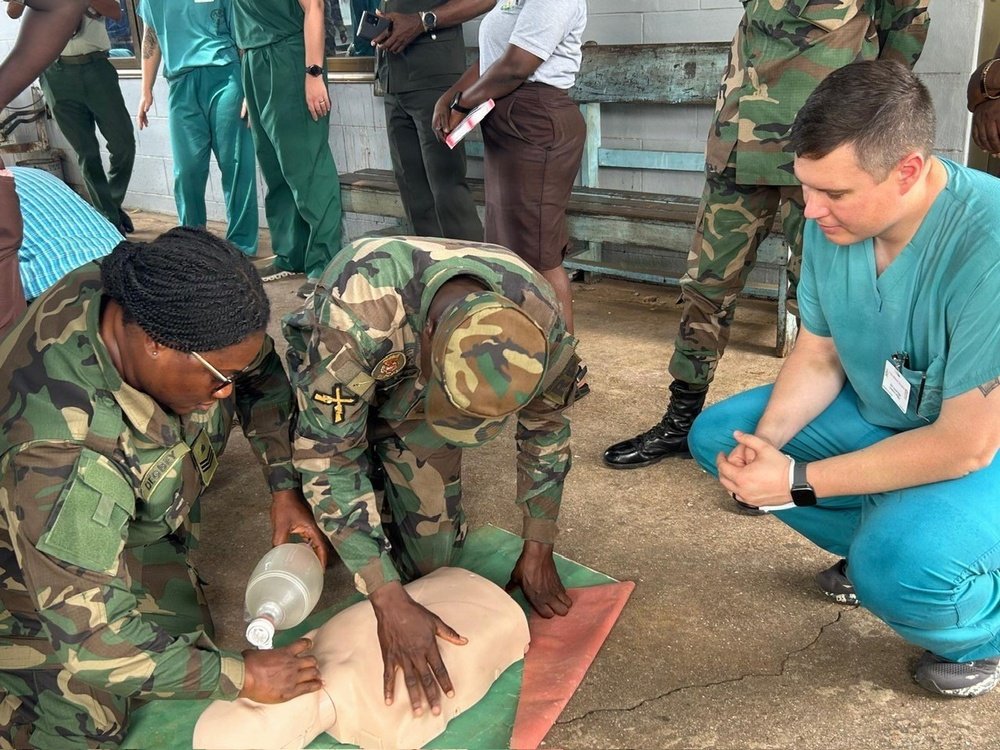
LANDSTUHL, Germany – Hospitals are often viewed primarily as places to treat the sick and injured. At Landstuhl Regional Medical Center (LRMC), the largest American hospital outside the United States, that mission remains central – but another critical effort extends far beyond its walls: the Global Health Engagement (GHE) program.
Col. Claude Burnett, director of LRMC’s Global Engagement Team, said the program about more than medicine.
“It's about building bridges, fostering trust, and strengthening alliances through the universal language of healing and partnership,” Burnett said. “These efforts strengthen both medical readiness and health diplomacy, while contributing to global health security by building partner-nation capacity.”
Through the program, U.S. medical personnel work alongside counterparts across Europe and Africa in collaborative exchanges designed to share knowledge and skills in both directions.
“These are not one-way teaching missions,” said Burnett. “They are partnerships.”
In Ghana, for example, LRMC teams engage directly with doctors, nurses, and combat medics, exchanging expertise on trauma care and the challenges of operating in resource-constrained environments.
The scope of the program is broad, ranging from medical readiness exercises (MEDREX) focused on trauma care in Ghana to engagements in Algeria addressing medical crisis management and healthcare system administration.
Burnett said one of the program’s most effective efforts has been its sustained MEDREX partnership in Ghana, which is aligned with both Ghanaian military medical priorities and U.S. combatant command objectives.
“From a strategic perspective, this type of engagement deepens institutional relationships and supports long-term partnerships,” Burnett said. “At the same time, it provides meaningful readiness value for LRMC personnel.”
He noted that the missions also present challenges, including complex logistics and need to navigate cultural and system-level differences across multiple organizations and environments.
“Engagements often require synchronizing personnel, equipment, travel, and timelines across different commands, sometimes in resource-constrained or geographically dispersed locations,” Burnett said.
LRMC prepares its teams for both the clinical and diplomatic aspects of these missions, ensuring they can operate effectively as medical professionals and trusted partners.
Success is no longer measured simply by the number of engagements or patient encounters, Burnett said. Instead, the focus is on aligning each mission with specific security cooperation objectives and partner-nation priorities to ensure long-term sustainability.
Master Sgt. Tatiana Mason, deputy commander for clinical services, said the program emphasizes lasting impact.
“While there are elements of familiarization, these engagements go beyond basic exposure,” said Mason. “The Ghana MEDREX is designed to be a collaborative training and knowledge exchange platform.”
She said it is a two-way partnership where both military and civilian participants contribute expertise, learn from one another, and enhance collective capability.
“Participants share lessons learned through a combination of formal and informal mechanisms,” said Mason. “Structured after-action reviews (AARs), case discussions, and hands-on scenario-based training allow individuals to translate combat trauma and complex emergency experiences into actionable knowledge.”
Mason said the experience not only enhances clinical proficiency, but also reinforces adaptability, cultural awareness, and teamwork; skills that are essential for success in both humanitarian missions and large-scale combat operations.
| Date Taken: |
03.25.2026 |
| Date Posted: |
05.07.2026 08:17 |
| Story ID: |
564633 |
| Location: |
LANDSTUHL, DE |
| Web Views: |
55 |
| Downloads: |
0 |
PUBLIC DOMAIN

This work, Beyond Healing: The Human Connection of LRMC's Global Health Engagements, by Bernhard Lashleyleidner, identified by DVIDS, must comply with the restrictions shown on https://www.dvidshub.net/about/copyright.