
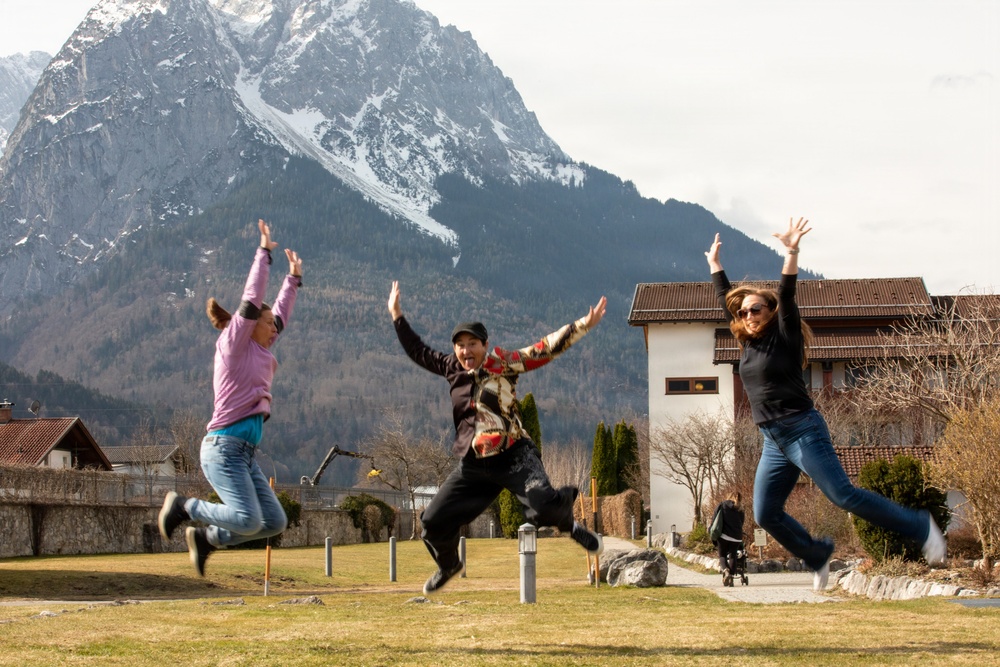
Photo By Sgt. 1st Class Brandon Nelson | Families of service members assigned to U.S. Special Operations Command Europe attend...... read more read more
 Subscribe
GARMISCH-PARTENKIRCHEN, Germany – It takes a community to raise a family, especially when that family moves around the globe, away from friends, relatives and familiar support systems.
In situations like this, the Preservation of the Force and Family, or POTFF, supports special operations forces and their families through the complexities of military life.
The mission of the POTFF program is to optimize and sustain SOF mission readiness, longevity, and performance through integrated and holistic human performance programs designed to strengthen the force and family.
“Special operations are very demanding,” Maj. Joel Hanna, POTFF director for 1st Battalion, 10th Special Forces Group (Airborne), said. “It's demanding of everybody. It's demanding of soldiers, it's demanding of command, it's demanding of the spouses and the kids.”
The overall special operations forces’ mission is exacting, and it takes a team of passionate professionals to engage and tackle the issues that come up on the home front. Hanna added that POTFF’s available services include community resources, behavioral health, marriage counseling, physical therapy, and social work.
With the established nature of the SOF community, there are specific challenges, issues, and complexities that arise.
When they do arise, it’s important that there is a level of trust.
“When you're making connections and bonds with people, you're immediately building trust,” Sarah Jennings, a POTFF and family readiness program specialist with U.S. Special Operations Command Europe, said. “We are building trust as a community from inside our walls out. We're strengthening the force as we move forward, whether we're here or at our next duty station or assignment.”
According to Capt. Joshua Luke Redmond, a chaplain with 1/10 SFG(A), the spiritual domain is one of POTFF’s five pillars, alongside the physical, psychological, social and family, and cognitive domains.
“As a chaplain, I am responsible for cultivating and facilitating the necessary things that go into the spiritual domain. The Army articulates that the essence of spirituality is having ‘identity, meaning and purpose,’” Redmond said. “We need to build a relational equity early, so that when somebody does inevitably face the challenges that are a part of life, they know who we are and what we can do to help.”
In POTFF, it’s all about the people.
Consistent with the first of five SOF Truths, that humans are more important than hardware, people are the comparative and competitive advantage for U.S. Special Operations Command and its components. Ensuring readiness, resilience, and well-being of SOF men and women and their families remains the number one priority. The unique nature of the SOF mission demands an extraordinarily talented workforce, capable of operating in remote and austere environments, working alongside national, interagency, and global partners.
With all programs in the military, there is a certain level of accountability and end states driven by results. The POTFF program is no different.
“Within POTFF, there is a much more subjective component to it. It's not as tangible,” Hanna said. “Any type of support for spouses, support for kids, during deployments or back when everybody is in garrison, it's really hard to objectively quantify all of that.”
This is a shared sentiment throughout the POTFF community.
Highlighting the difficulty in showing POTFF’s impact in concrete numbers, Kia Phillips, the 1/10 SFG(A) POTFF community resource coordinator, said it is hard to measure what does not happen, and what they stop from happening.
A strategic way they measure results is through feedback and messaging. A lot of direction and feedback comes from the troops’ spouses and families about their needs and concerns.
“I have seen a lot of growth and connection with our current families,” Phillips said. “I can say that I've seen spouses express appreciation and a feeling of connection within the community, within our unit and within the garrison community overall.”
The POTFF program builds this community through events, retreats, and training. Activities range from couples’ retreats to larger events for the entire family at a resort like the Armed Forces Recreational Center Edelweiss Lodge and Resort. These opportunities must have an educational component which, according to Phillips, is just as important as the rest and relaxation part.
“The only downfall to the retreats is we can’t take the entire command every time. We’re bound by funding,” Jennings said. “But we try to do at least three events a year and make sure a different group has an opportunity to participate.”
By focusing on goals like family support, integration of services, and resilience building, the program aims to create a supportive environment that enhances the overall quality of life for soldiers and their families, ultimately contributing to mission success and operational readiness. The efforts foster a positive atmosphere and tight-knit community that would not happen without the professionals in the POTFF program. Both military members and civilians alike come together and put the needs of people first. The needs of spouses and families need to be taken just as seriously as the troops’ operations, missions, and exercises.
“I understand why operations come first, of course, but we still have to remember the people, and they are people with daily struggles,” Phillips said. “Can we solve all those issues? No, but we can provide support and so it's just as important to have the financial support available so that we can be here for them.”
It takes some effort prioritizing the mission of the spouse, the family, and the children, but it goes a very long way in helping establish more sustainable relationships, Hanna said.
“I never realized how valuable that is and how much of an impact it is, and it has kind of opened my eyes to a lot of different things,” Hanna said. “We have brigades and battalions set up for sustainment, medical sustainment operations, logistical support, and all these different units dedicated to sustainment of mission efforts. I kind of look at POTFF as a big aspect of it. It's kind of like a sustainment support unit for spouses and families and children.”
| Date Taken: | 04.19.2026 |
| Date Posted: | 04.21.2026 06:53 |
| Story ID: | 563199 |
| Location: | GARMISCH-PARTENKIRCHEN, BAYERN, DE |
| Web Views: | 177 |
| Downloads: | 0 |

This work, Strengthening special ops by supporting families, by SFC Brandon Nelson, identified by DVIDS, must comply with the restrictions shown on https://www.dvidshub.net/about/copyright.


No keywords found.




