
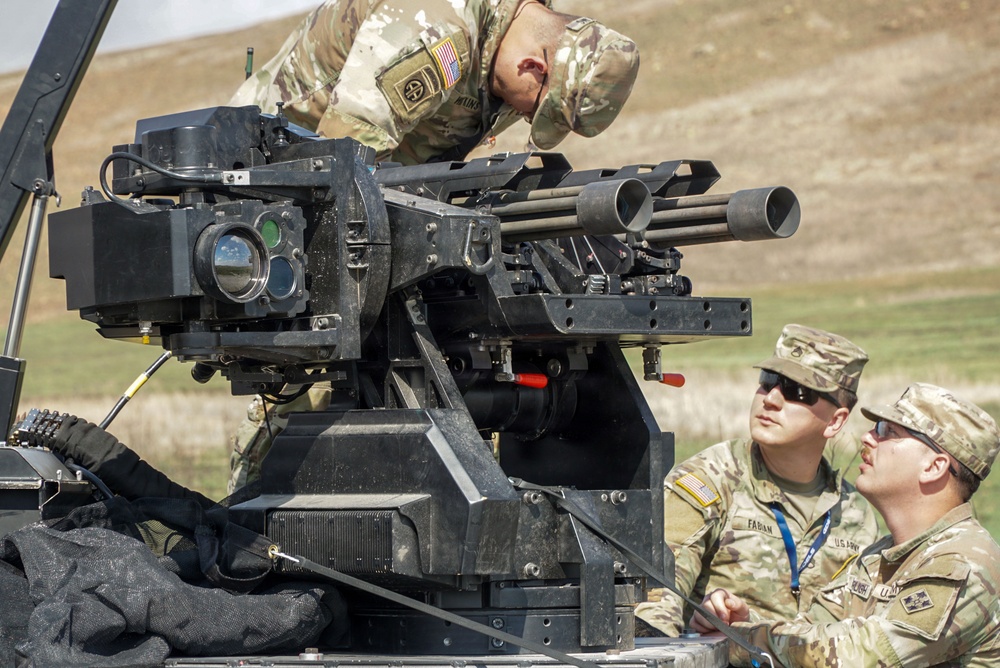
Photo By Michael Whetston | Regular Soldier feedback was an important part of the data collection plan during the...... read more read more
 Subscribe
FORT SILL, Okla. - The U.S. Army Futures and Concepts Command brought together two new Future Capability Directorates and the Denied, Degraded, Intermittent, and Limited Bandwidth Integrated Environment Supporting Experimentation & Learning team to execute the Cross-Domain Fires Concept Focused Warfighting Experiment, held Mar. 2 to 13. The blended, distributed field experiment assessed how well emerging formations and technologies can deliver synchronized fires and effects across domains in degraded, denied, intermittent, and limited environments in support of the Army Warfighting Concept.
The experiment connected three primary nodes: the Fires FCD at Fort Sill, Okla; the DIESEL team at White Sands Missile Range, N.M; and the Aviation FCD at Yuma Proving Ground, Ariz. Together, they explored how future formations sense, decide, and strike faster than a peer adversary using interoperable, data-driven systems. Fort Sill served as the command-and-control hub, where Fires FCD leaders and staff received targeting data from YPG. Analysts and commanders assessed the data, then directed simulated long-range precision fires to engage targets, using the event to evaluate division and corps fires future capability workbooks and to refine concepts for synchronizing and delivering cross-domain fires and effects across echelons.
“Cross-Domain Fires 26 gave the Army a unique venue to assess emerging cross-domain fires capabilities and capability gaps at echelon,” according to Col. Doug Simmons, director of the F-FCD Fires Experimentation Division. “Experiments like this are critical to informing emerging Army concepts and requirements by demonstrating how fires synchronize across land, air, maritime, space, and cyber domains to achieve overmatch.” At WSMR, the DIESEL team created a complex, contested digital environment that replicated jamming, signal interference, and limited bandwidth expected against a peer threat. The team employed experimental capabilities in benign and multi-complex degraded, denied, intermittent, and limited conditions to inform current and future Army requirements.
“Our experimentation events have been critical to advancing Army transformation efforts. Seven programs of record have utilized our DDIL environments to test and mature technologies that are now in the hands of Soldiers,” said Jason Joose, DIESEL deputy chief. “DIESEL directly complements and informs the Cross-Domain Fires Concept Focused Warfighting Experiment by providing a contested environment where we can test, refine, and integrate technologies that increases the delivery of precise and synchronized effects across domains. The lessons learned here directly enhance the Army’s ability to converge fires faster and with greater lethality.”
At YPG, live aviation assets such as air-launched effects acted as forward sensors. Their role was to penetrate a simulated contested area, locate and positively identify high-value targets, and generate critical targeting data. That real-world data was then passed to Fort Sill, providing a live proof point that the core concept of next-generation command and control works across domains and long distances by connecting dispersed units on a common network fabric.
"To effectively deliver cross-domain fires, Army Aviation assets sense and target to share data seamlessly across the network with ground and joint forces,” said Maj. Gen. Cain Baker, Director, Aviation Future Capability Directorate. “Our work at YPG is focused on leveraging increased autonomy to ensure our aviation platforms are not just flying, but are key nodes in a distributed, resilient, and lethal kill chain."
The aviation excursion illustrated the purpose of a concept-focused warfighting experiment: integrate live systems with human-in-the-loop efforts to reduce technology risk, identify inefficiencies, and ensure interoperability before scaling to larger formations.
The experiment delivered several notable firsts for Army modernization, including an AH-64E Apache launching a launched effect that networked directly with the Fires Center of Excellence; 1st Armored Division soldiers controlling three Cobalt unmanned aircraft systems from a single point, providing feedback on one-to-many control; an aircraft survivability equipment suite successfully detecting unmanned aircraft systems and off-boarding sensor data; and an industry partner demonstrating rapid development of automatic target recognition algorithms in the field.
"What we’re really demonstrating is an increase in the Apache's capability, extending its reach and significantly boosting reconnaissance for corps and division commanders,” said Baker. While the Apache's standoff with Hellfire is traditionally about six kilometers, by integrating Launched Effects, we have significantly increased that distance. This pushes the aircraft further from direct threats, which dramatically increases survivability and enhances lethality for the platform." No single location could have achieved these learning objectives alone. By connecting Fort Sill, WSMR, and YPG in a live, virtual, and constructive environment built around common scenarios and learning objectives, FCC used the CDF CFWE to examine formations, capabilities, and concepts that enable the Army, Joint, and combined forces to converge effects across all domains.
To address the required learning demands, the CDF CFWE was designed around the Fires concept focusing on Corps Fires and their ability to integrate non-kinetic and kinetic fires from one domain to another while integrating Science and Technology enablers. The experiment was designed by the Future Experimentation Directorate but encompassed expertise from all of FCC’s FCDs to design a realistic scenario which informed Army gaps and learning demands. Insights from this experiment will inform continued refinement and operationalization of the Army Warfighting Concept, and guide design and delivery of the future force. The findings also trace to the Future Study Program, future concept experiments, Joint Warfighting Assessments, and other FCC experimentation efforts, helping ensure lessons learned are integrated across the Army’s broader modernization enterprise.
| Date Taken: | 03.18.2026 |
| Date Posted: | 03.18.2026 13:32 |
| Story ID: | 560824 |
| Location: | US |
| Web Views: | 78 |
| Downloads: | 0 |

This work, CDF CFWE tackles DDIL, Interoperability to execute Fires, by David Miller, identified by DVIDS, must comply with the restrictions shown on https://www.dvidshub.net/about/copyright.


No keywords found.




