
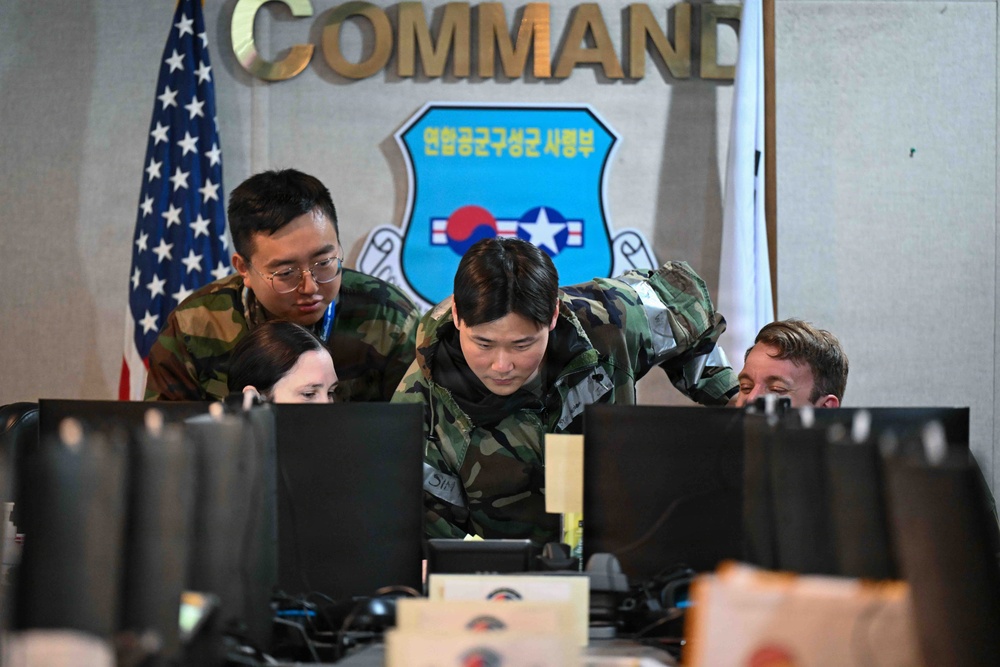
Photo By Senior Airman Emilee Darden | U.S. Air Force Staff Sgt. Byeongwoo Jung, center, Seventh Air Force joint plans...... read more read more
OSAN AIR BASE, Republic of Korea — Amidst the annual Freedom Shield exercise, the seamless flow of information between U.S. and Republic of Korea forces is paramount. This critical task falls to a specialized group of individuals from both nations: the Republic of Korea Armed Forces translators and the U.S. Joint Plans (PJ) language translators. These linguists are essential communication conduits, ensuring the combined forces operate as a single, cohesive unit defending the Korean Peninsula.
“To get my job you would have to fluently speak Korean and fluently, fully understand the Korean culture,” said U.S. Air Force Staff Sgt. Byeongwoo Jung, Seventh Air Force joint plans coordinator and interpreter.
Jung, fluent in both Korean and Japanese, said he came into this position through a string of luck. His path to becoming a PJ translator began with an officer recommendation who was impressed with Jung’s translation work at squadron events that regularly hosted ROK attendees. Afterwards he interviewed with the Seventh Air Force PJ leadership and was ultimately selected for the role.
Jung said translators are embedded in critical hubs like the Air Force Operations Center and are key liaisons between these sections and the Seventh Air Force. Working around the clock, they provide precise, rapid translation of complex military plans, operational messages and air tasking orders.This involves everything from translating intricate discussions to ensuring that military acronyms are understood by both sides.
The hardest part is making sure the translation means the same thing in both languages, which involves not just translating words but cultural contexts, said Jung. It is critical to mission completion that translators ensure messages are received clearly and with correct intent. Combined exercises like Freedom Shield strengthen the ROK-U.S. Alliance, and translators are key in fostering relationships and trust. Breaking down language barriers and cultural differences enables both nations' commanders and staff to work side-by-side, synchronizing efforts for critical real-time decisions.
“Our translators are a godsend,” said Maj. Cody Bohachek, Combined Air Component Command augmentee logistics officer for exercise Freedom Shield 26. “They are the heart of the operation.”
| Date Taken: | 03.18.2026 |
| Date Posted: | 03.18.2026 02:10 |
| Story ID: | 560785 |
| Location: | OSAN AIR BASE, KR |
| Web Views: | 110 |
| Downloads: | 0 |

This work, More Than Just Words: How Translators Shape the Future of Combined Military Operations, by SrA Emilee Darden, identified by DVIDS, must comply with the restrictions shown on https://www.dvidshub.net/about/copyright.

No keywords found.





