
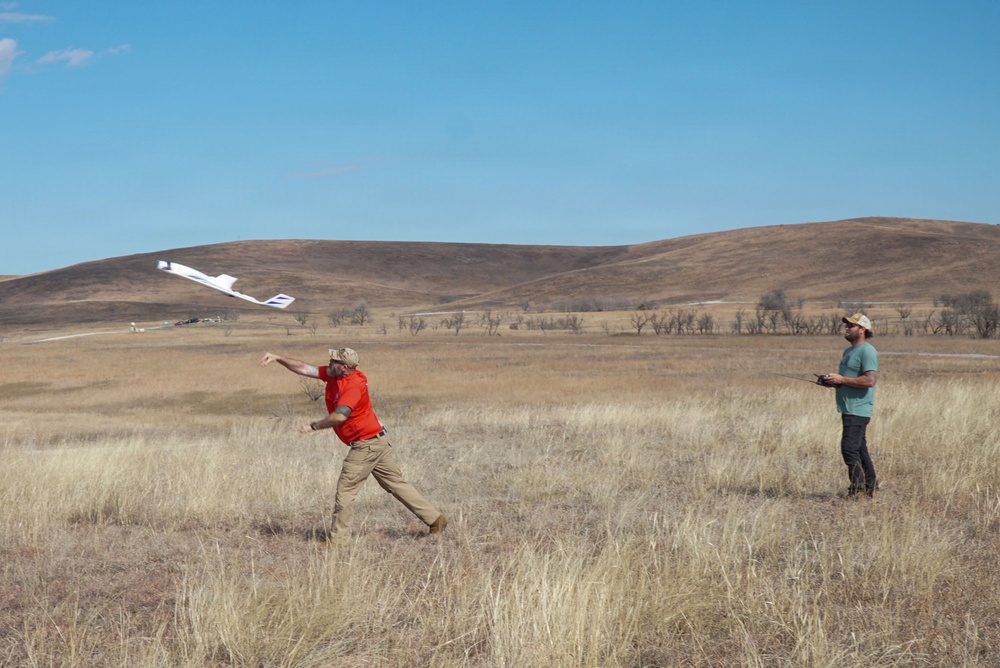
Photo By Michael Whetston | Having drones available provided real-time physical targets for sensors and effectors...... read more read more
 Subscribe
FORT SILL, Okla. – On behalf of the Futures and Concepts Command, the Fires Future Capability Directorate led the execution of the Cross Domain Fires 26 Concept Focused Warfighting Experiment in late February and early March at Fort Sill.
CDF 26 was an integrated and distributed, scaled field experiment led by the Fires FCD and supported with excursions by the DIESEL team at White Sands Missile Range, N.M. and the Aviation Future Capability Directorate at Yuma Proving Ground, Az.
The Fires FCD coordinates the modernization efforts for Integrated Offensive and Defensive Fires through development of Fires concepts, requirements, and experimentation to realize materiel solutions and future capabilities to enablecombined arms maneuver and continuous transformation.
“Cross Domain Fires 26 gave the Army a unique venue to assess emerging cross-domain fires capabilities and capability gaps at echelon,” stated Col. Doug Simmons, director of the F-FCD Fires Experimentation Division. “Experiments like this are critical to informing emerging Army concepts and requirements by demonstrating how fires synchronize across land, air, maritime, space, and cyber domains to achieve overmatch.”
Designed to assess emerging gaps and capabilities identified within the Army Warfighting Concept, Cross-Domain Fires Annex, and Future Capability Workbooks, experiment findings will be used to provide recommended Doctrine, Organization, Training, Materiel, Leadership & education, Personnel, Facilities, and Policy -- or DOTMLPF-P -- solutions for conceptual formations and capabilities of the Army of the future.
Based on a structured data collection plan, observer-analysts recorded data according to specific learning demands. Now, FCC will conduct an assessment with technology sponsors to align promising technologies against a specific/discrete warfighting capability gap. Analysts will develop and implement a comprehensive plan to assess the specific materiel capability’s potential as a solution.
To address the required learning demands, Cross Domain Fires experiment was designed around the Fires concept focusing on Corps Fires and their ability to integrate non-kinetic and kinetic fires from one domain to another while integrating Science and Technology enablers. The experiment was designed by the Future Experimentation Directorate but encompassed expertise from all of FCC’s FCDs to design a realistic scenario which informed Army gaps and learning demands.
Complementary and supporting efforts occurred at the distributed sites.
The Aviation FCD conducted live experimentation at YPG to replicate and assess the aerial capabilities essential for Multi-Domain Operations. The focus was on integrating command and control, or C2, with sensing, targeting, and effects delivery. This excursion provided essential data and learning demands back to the main effort at Fort Sill. This synchronization of task, terrain, technology, and timing directly advances key Army modernization priorities in support of the Army Transformation Initiative.
The Aviation Excursion provided the first major, live proof point that the core concept of Next Generation Command and Control, or NGC2, works across domains and vast distances. By successfully passing targeting data from an aviation asset at Yuma to a fires unit at Fort Sill, it demonstrated that the network fabric can connect disparate units to achieve a shared outcome.
The DIESEL team conducted the Degraded, Denied, Intermittent, Low-Bandwidth Integrated Environment Supporting Experimentation and Learning, also known as DIESEL, at WSMR as a complementary experiment. DIESEL 26 addressed requirements and capabilities that support cross-domain fires, non-kinetic effects, deep sensing, command and control, maneuver, and formation-based layered protection.
DIESEL 26 accomplished this mission by providing an operationally-realistic threat environment in which to observe and analyze the capability of a wide range of multi-domain technologies to perform in three vignettes: Target Discovery in an A2/AD environment, Convergence of Effects, and Formation-Based Layered Protection.
While not the sole focus of the overall experiment, emerging technologies played an important role in adding fidelity and realism to experiment execution and data collection. Part of the data collection effort included getting Soldier feedback on the use of these emerging technologies, as well as measuring the systems’ capability to successful pass data across the network in a way that increases the responsiveness and effectiveness of the kill chain.
Approximately 55 technologies participated in the experiment across Fort Sill and the distributed sites, either in a real time “live” status or with their capabilities portrayed in the simulation. Technology capabilities were employed to support the learning demands at each site. At Fort Sill, a specific integration cell ensured that role players in the fires cell were getting the data they needed to exercise the scenario and also to drive data collection.
Efforts such as CDF 26 also serve a risk reduction function in terms of providing industry and the Army an opportunity to improve connectivity, interoperability, and reliability for future experiments planned as part of the Army’s persistent experimentation effort.
| Date Taken: | 03.17.2026 |
| Date Posted: | 03.17.2026 11:08 |
| Story ID: | 560717 |
| Location: | FORT SILL, OKLAHOMA, US |
| Web Views: | 215 |
| Downloads: | 0 |

This work, CDF 26 Furthers Army Fires Transformation, by Michael Whetston, identified by DVIDS, must comply with the restrictions shown on https://www.dvidshub.net/about/copyright.


No keywords found.




