
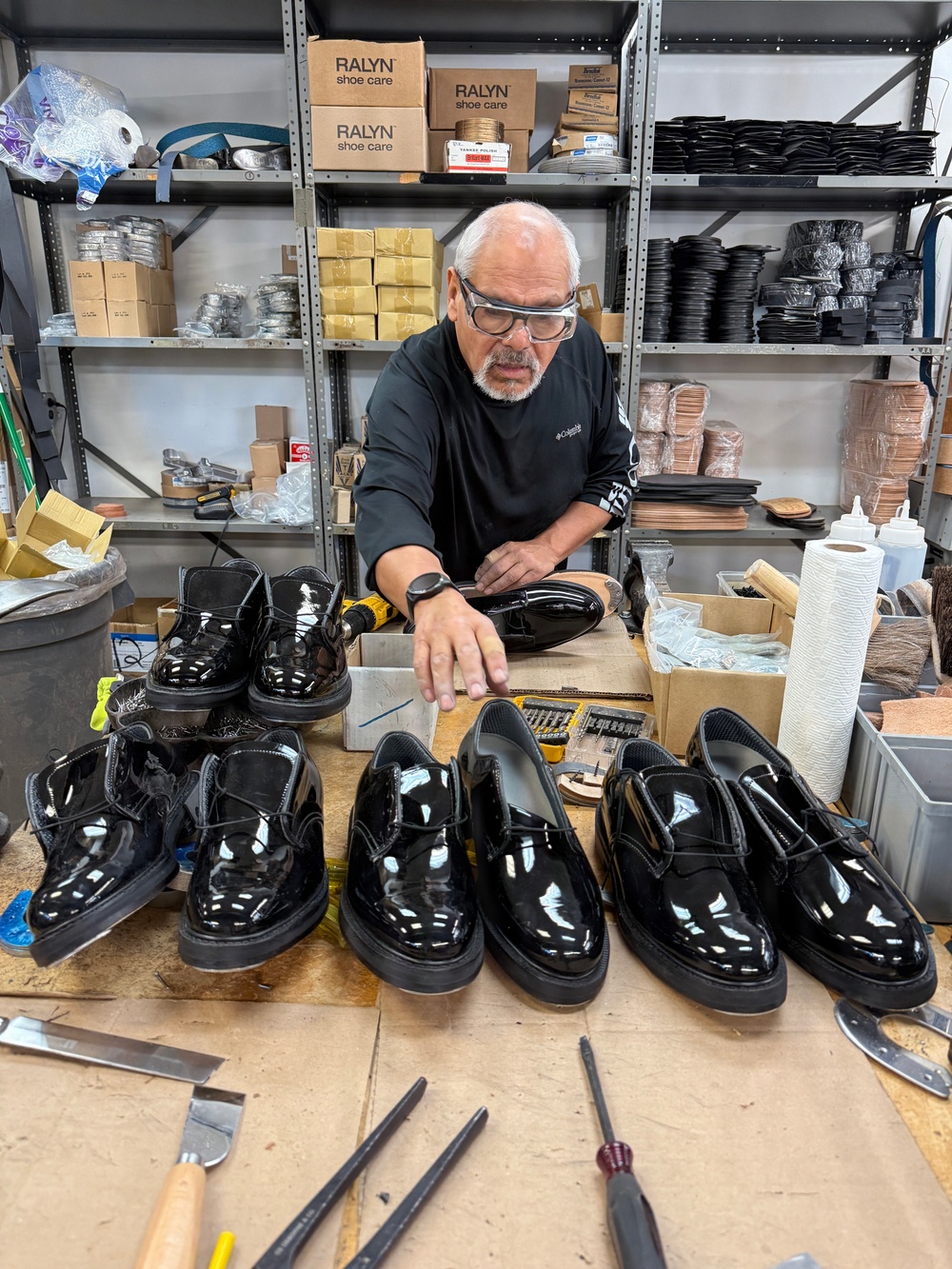
Photo By Nutan Chada | Tom Casarez, a cobbler assigned to the 406th Army Field Support Brigade’s Logistics...... read more read more
ROCK ISLAND ARSENAL, Ill. – Their footsteps speak: sharp taps, crisp heels, precision in motion. These aren’t standard‑issue shoes; they are shaped by the hands of Tom Casarez, the Army’s only cobbler, whose craft keeps Soldiers moving with the exactness their mission demands.
While he makes shoes for the 3rd U.S. Infantry Regiment, commonly known as “The Old Guard”, Casarez works under the 406th Army Field Support Brigade’s Logistics Readiness Center Joint Base Meyer-Henderson Hall, Virginia.
The LRC JBM-HH falls under the ASC, the headquarters responsible for synchronizing sustainment operations across the global enterprise.
Though Casarez works in a small shop, his craftmanship reflects the larger sustainment engine that Army Sustainment Command runs across the Army. By repairing, modifying and issuing footwear quickly he delivers upon ASC’s mission to deliver readiness through anticipatory logistics, expert maintenance, and rapid return-to-service.
“ASC’s mission is to deliver readiness, and my shop is where that massive, strategic mission becomes intensely personal,” said Casarez. He explained that Old Guard Soldiers measure readiness in millimeters and seconds. A Sentinel guarding the Tomb of the Unknown Soldier walks his post in a precise, symbolic sequence: 21 steps, a 21-second pause, and then a weapon shift that always places the rifle between the guard and any potential threat. This ritual repeats continuously throughout the guard’s shift and requires absolute perfection.
The Soldiers he equips carry out some of the Army’s most viable and symbolically important duties from guarding the Tomb of the Unknown Soldier, to conducting military funeral honors and representing the service at High-profile national events. Their mission blends symbolism, discipline and exacting standards – standards that depend on the precision and reliability of every step they take.
While The Old Guard is known for its ceremonial presence, the regiment depends on a foundation of sustainment and care behind the scenes. One of the most overlooked but vital contributors is the cobbler, whose craftmanship keeps Soldiers shoes serviceable and mission ready. By repairing, fitting and maintaining the footwear that carries the Soldiers through long hours of drill, funerals and guard shifts, the cobbler directly reinforces the unit’s readiness.
Casarez arrived at his job almost by accident when he began working at the shop as a volunteer and later hired as the cobbler. His training consisted of learning how to use the machines, access to shoe diagrams on what they are supposed to look like and how a shoe goes together, and of course the finished shoes.
“From there I figured it out, I had to quick,” said Casarez. “I took it as a challenge to see if I could do it. Before I got here, I knew three things about shoes; I buy them, I wear them and other people wear them, that was it.” Casarez said prior to being hired the regiment was having a lot of problems, because the person before him had retired. The most common issue Soldiers had before he arrived was time.
Casarez remembered one Soldier who came to see him. The Soldier had a major ceremony coming up and his taps and horseshoes, precision-fitted metal plates that shape both sound and stability, were worn down from walking and standing. He didn’t want to get new shoes, as he didn’t have time to break them in and the upper part of the shoe fit like a glove.
Before Casarez arrived, the Soldier would have had to either wear worn down shoes, or wear brand new shoes, increasing the likelihood of hotspots or blisters. Casarez had the old metal plates removed and new ones installed on the Soldier’s shoes in about 15 minutes.
This is the essence of the cobbler’s role; provide an immediate solution to a problem that preserves a Soldier’s confidence and shows them a bit of old-world craftsmanship.
“Prior to Mr. Casarez’s arrival we had a significant backlog on fielding ceremonial shoes,” said Maj. John Strickland, 3rd U.S. Inf. Reg. “He promptly put us back on track, or on the mark as we often say around here.”
Unlike most Soldiers who wear rubber-soled synthetic, high-gloss black shoes, Old Guard Soldiers wear shoes that the cobbler specifically modifies.
When Casarez gets a new pair of shoes he removes the plastic heel and sands the bottom and replaces it with a brown leather sole and heel. He installs a steel plate, called a “clicker” by The Old Guard, inside the heel, and attaches a larger, horseshoe-shaped piece to the base. They create a sharp, deliberate sound with every step emphasizing precision and discipline, while protecting the heel and toe from wear. Casarez keeps the Soldiers moving with almost no downtime. If a heel or horseshoe wears down, he can repair or replace it within minutes, returning the Soldier to duty immediately and ensuring footwear is never a point of failure.
For Casarez crafting these shoes directly supports The Old Guard’s ceremonial mission.
“My most critical contribution is ensuring foundational readiness from the moment a Soldier joins the unit,” said Casarez. He maintains a ready inventory of shoes in all sizes so new Soldiers can receive a proper fit immediately and begin training on day one. He continues that readiness throughout a Soldier’s time in the regiment by providing on-the-spot repairs and replacing shoes the moment they become unserviceable.
Shoes that fit poorly can distract a Soldier, and that distraction intensifies after hours of standing or marching.
“For a Soldier who’s entire being must be focused on flawlessness, that constant physical annoyance is a compromise to their concentration,” said Casarez. “My job is to remove that distraction. By delivering what ASC calls “materiel readiness” at its most crucial point, the individual footstep, I ensure the Soldier can focus completely on their solemn duty.”
His inventory management mirrors ASC’s enterprise approach to having the right materiel at the right time, ensuring new Soldiers can be fitted and trained immediately. His on-the-spot repairs reflect ASC’s mission of maintaining readiness. In a regiment where a single misstep can compromise its no-fail mission, Casarez provides the same effect ASC delivers worldwide; quiet, reliable sustainment that keeps Soldiers ready, protected, and able to execute without interruption.
The readiness isn’t just philosophical; it is engineered into every sole and heel he builds. Casarez compares his work to a pit crew chief, focused on tuning footwear for endurance and performance. He engineers soles and heels to absorb shock on unforgiving surfaces like marble and pavement, tailoring each pair to the Soldier’s mission.
Casarez calls the work the greatest honor of his life. He sees the Tomb of the Unknown Soldier as a symbol of the nation’s sacrifice, and he views every Old Guard Soldier as carrying a piece of that responsibility. His role is quiet and unseen, but he knows its impact. Even with eyes closed during the Changing of the Guard, he says, you can hear the discipline, the unified click of heels, the sharp strike of steel on stone. That sound, he adds, is respect made audible, and he takes pride in knowing his craftsmanship helps make it possible.
| Date Taken: | 03.16.2026 |
| Date Posted: | 03.16.2026 16:29 |
| Story ID: | 560665 |
| Location: | ROCK ISLAND ARSENAL, ILLINOIS, US |
| Web Views: | 65 |
| Downloads: | 0 |

This work, Delivering readiness one pair at a time, by Corinna Baltos, identified by DVIDS, must comply with the restrictions shown on https://www.dvidshub.net/about/copyright.


No keywords found.





