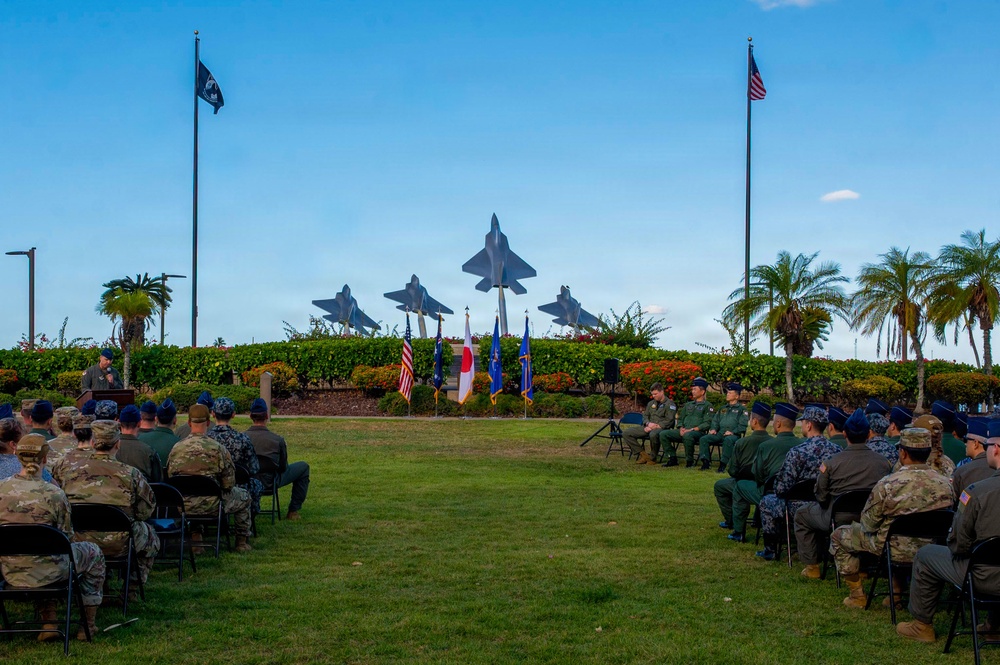
Photo By Staff Sgt. Elizabeth Taranto | U.S. Air Force Col. Brett Cochran, 613th Air Operations Center commander, addresses participants during AOC-AFFOR Exercise and Air Mobility Summit 25-2 opening ceremony at Joint Base Pearl Harbor-Hickam, Hawaii, Sept. 15, 2025. AMS 25-2 fostered information sharing, process improvement and stronger interoperability among Allied air operations centers. (U.S. Air Force Photo by TSgt Elizabeth Taranto) see less
| View Image Page
For the first time, the 613th Air Operations Center hosted AOC-AFFOR Exercise and Air Mobility Summit 25-2 at Joint Base Pearl Harbor-Hickam, Sept. 15-17, strengthening trilateral interoperability among the U.S. Air Force, Japan Air Self-Defense Force and Royal Australian Air Force.
The program addressed the need for seamless integration among Allied forces and provided opportunities to exchange ideas, improve processes and promote information sharing across partner nations.
“With this AOC Exchange, our actions speak louder than words. We’re not just flying together, we’re operating together — planning, executing and problem solving as one,” said Col. Brett Cochran, 613th AOC commander. “Our operations centers are linked, our tactics are aligned, and our warfighters are trained as a combined force. That’s what real readiness looks like.”
Participants engaged in activities designed to strengthen collective capabilities in a shared environment.
“This exchange is really important to me, not just for the relationships that we form, but the way in which we seek practical, implementable solutions to the problems we face,” said Group Capt. Adrian Kiely, RAAF AOC commander. “Ultimately, we have a key role in our world and our region and the way it looks, for the next 20 to 30 years and beyond.”
While the first trilateral exchange among the U.S., Japan and Australia occurred at Yokota Air Base, Japan, in March 2025, AAE/AMS 25-1 marked a significant step forward in solidifying this partnership.
“Today the U.S., Australia and Japan represent a powerful trilateral force in the Indo-Pacific,” Cochran said. “We are three nations, three services, with a common goal of maintaining peace, stability and freedom in a region that is critical to global security.”
Building upon this foundation, the intended outcome of AAE/AMS 25-2 was clear: strengthening partnerships, promoting information sharing and improving interoperability to prepare for future challenges in the Indo-Pacific. While previous iterations focused on bilateral cooperation, the inclusion of the RAAF signals a commitment to expanding and reinforcing the network of allies working together for regional stability.
“This year, we have a great participant from Australia, who will advise us from a different point of view and strengthen our trilateral relationship,” said Col. Kohei Kurachi, JASDF ADC AOC commander. “Creating strong relationships is not only one of the main topics of this exchange, but also a message to surrounding countries across the Indo-Pacific region.”
As the U.S., Japan and Australia continue to expand trilateral exchanges, AAE/AMS 25-2 underscored their commitment to a free and open Indo-Pacific.

 Subscribe






