
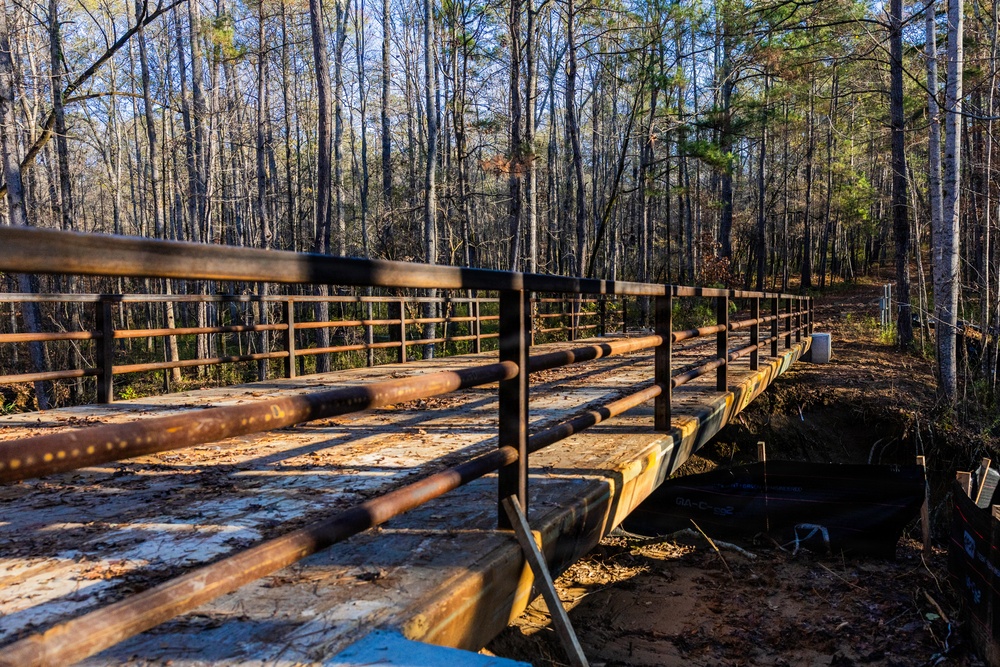
Photo By Joey Rhodes II | A new bridge made from two retired railroad flatcars connects two training areas at...... read more read more
 Subscribe
FORT BENNING, Ga. — The Fort Benning Directorate of Public Works, in partnership with the University of Georgia and the City of Smiths Station, Ala., completed the construction of an innovative bridge made from recycled railroad flatcars at Garnsey Range, Jan. 16, 2026. The unique bridge concept saved the Army nearly $900,000 while enhancing installation readiness.
The project addressed a recurring culvert washout on an access road for the range’s Infantry Platoon Battle Course, a critical facility where Infantry Soldiers conduct live-fire training to improve Soldier lethality. Since 2023, persistent washouts hindered inter-range access for range maintenance and restricted Soldier movement between training areas.
“I remembered coming across a recycled railcar bridge that was used on a bike trail project. I put that idea in my back pocket for a rainy day, never thinking I would get to see it on a military installation,” said Daniel Wyatt, UGA liaison. “When I was working on the culvert problem, I looked into the carrying capacity of these flatcar structures, and started thinking, ‘This could work. This could be a solution.’”
A conventional concrete culvert replacement was projected to cost more than $1.2 million. Seeking a more cost-effective and lasting solution, DPW engineers reached out to Wyatt, who works with Fort Benning through an intergovernmental support agreement (IGSA).
This formal partnership provides Fort Benning direct access to UGA’s network of academic experts to enhance installation resilience. The IGSA enabled Wyatt to analyze the site’s drainage basin, evaluate a range of conventional designs, and ultimately suggest a more creative and cost-effective solution.
The unconventional pitch was met with initial skepticism.
“I was the first one to say, ‘That’s not going to work,’” admitted Andrew Wilson, the lead DPW civil engineer for the project.
Despite initial skepticism, the team conducted further research and developed a conceptual design with a detailed cost estimate. The recycled railcar bridge emerged as a significantly more affordable and feasible option, and DPW approved the model as the most effective solution.
“That’s why we have that partnership with UGA,” Wilson noted. “They bring a perspective to the table that we don't typically think about.”
The bridge construction was completed through a separate DPW stormwater management IGSA with the City of Smiths Station, which provides ongoing support for modernizing Fort Benning’s infrastructure.
Engineers designed the bridge to support heavy military vehicles, ensuring its long-term reliability for any training scenario.
“For the savings and shorter installation time, this is a great solution,” said Wilson.
This project demonstrates how Fort Benning, through inter-agency collaboration, delivers innovative solutions essential to producing a lethal, globally ready force prepared to fight and win.
| Date Taken: | 02.18.2026 |
| Date Posted: | 02.18.2026 17:10 |
| Story ID: | 558331 |
| Location: | US |
| Web Views: | 72 |
| Downloads: | 0 |

This work, Fort Benning engineers, UGA, Smiths Station bridge gap to boost warfighter readiness, by Maddy Gonzalez, identified by DVIDS, must comply with the restrictions shown on https://www.dvidshub.net/about/copyright.


No keywords found.




