
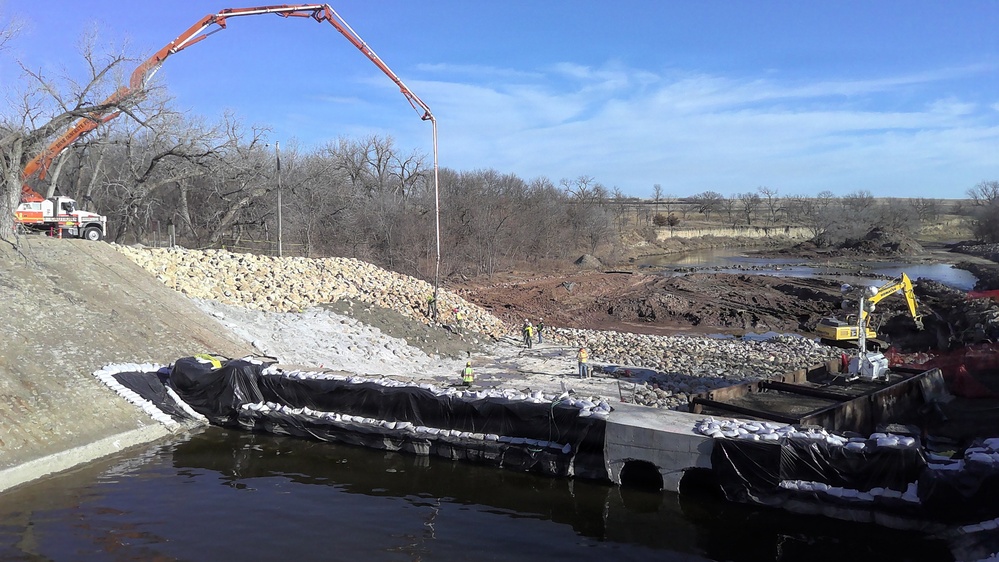
Photo By Christine Reinhardt | Progress continues on the Kanopolis Lake outlet channel repair project on Feb. 9,...... read more read more
If your roof had a leak, most homeowners would be quick to repair it. But if there was an underlying issue with the roof itself, most people would probably agree it would be wise to address the larger issue instead of continuing to make short-term fixes. Only making small repairs would likely add up to a significant cost over time without fixing the root problem.
This is the analogy Ben Johnson, hydraulic engineer and technical lead with the Kansas City District, U.S. Army Corps of Engineers, used to describe the outlet channel repair project at Kanopolis Lake. During both regular water releases and flood events, water from Kanopolis Lake is released through the outlet channel where it flows downstream into the Smoky Hill River. However, due to the geology of the area and the force of the released water, erosion has occurred in the outlet channel since the Great Flood of 1951.
“This project is unique to Kanopolis [Lake] because the way [the dam and reservoir were] built, it was assumed the integrity of some geology formations would remain, but they didn’t,” said Johnson. “If we don’t deal with the problem, it’s going to become a bigger problem that will have a bigger consequence and a much higher price to fix.”
Since construction was completed in 1948, the Kanopolis Lake outlet channel has required a series of repairs to address the erosion problem. However, no significant work has been done to fix the underlying issue the current project aims to solve.
“There hasn’t been a major repair in the outlet since its construction,” said Travis Blinkiewicz, contracting officer representative for the project. “All the repairs that have occurred have been Band-Aids, if you will. This is full surgery. We’re essentially going in and redoing everything in the outlet channel.”
According to Johnson, the project is focused on two main issues: damage to the channel’s grouted riprap as well as the underlying reason for the damage. The project is not only replacing the riprap throughout the channel but is also designed to ensure water flows smoothly from the dam into the river, while absorbing the water’s powerful force. The project is designed with the hope of preventing future riprap damage and erosion along the channel.
“We’ve had releases coming out of the dam that basically tear up a bunch of stuff. The question is, ‘how do we smooth that out?’,” said Johnson. “The solution is building a bowl-shaped feature so water plunges into it … then the water will transition in a way that doesn’t tear up a bunch of stuff.”
Without intentional intervention, not only will damage to the outlet channel continue to escalate, but the cost to repair that damage will also rise. The project team’s goal is to minimize future repair costs by intervening before more severe damage occurs.
“This project is roughly $6 million, and I wouldn’t be surprised if it becomes a $60 million problem if we don’t fix it,” said Johnson. “The erosion problem would creep upstream where there are a lot of really important components of the dam.”
While a dam safety issue was unlikely, the risk of weakened performance by not addressing the root problem posed a threat to the operation and maintenance of the outlet channel. This risk spurred the Kansas City District to come up with a solution.
Unique from start to finish
The Kansas City District is no stranger to riprap replacement and outlet channel repair projects at its 18 lake projects. But the outlet channel repair project at Kanopolis Lake is unique for a few reasons. First, its outlet channel is founded on relatively low-strength bedrock called shale, which is less resilient than bedrock found at other lake projects.
At other lakes, the riverbed is on stronger bedrock but at Kanopolis Lake, the riverbed is “not strong enough to withstand discharges,” said Blinkiewicz. “The entire floor of the riverbed in the outlet is being replaced with grouted riprap.”
Second, because the project is replacing riprap throughout the entire outlet channel, the contractor was responsible for creating a system to divert water. According to Blinkiewicz, although flood season typically starts in the spring, water still needs to be released during construction.
“The contractor was tasked with creating a water diversion system that catches the outflows and basically diverts it around the construction site,” said Blinkiewicz.
Third, the design of the project was unique and required some innovation on the part of the design team. “We designed the project with some really interesting geometry that isn’t in as much conflict with Mother Nature,” said Johnson. “We’ve already seen where the erosion is concentrated, so we are borrowing lessons learned from nature.”
Lastly and according to Johnson, not only was the design unique but the team was unique, too. Collaborating with experts from outside the district allowed the design team to tap into the most experienced minds in USACE. Working with individuals from the Risk Management Center and one of USACE’s Dam Safety Production Centers, the team was able to produce a truly innovative design for the project.
“The planning, the design and the construction phases – the amount of people that were involved, incorporating their wisdom and trying not to repeat mistakes from the past is really what I’m proud of,” said Johnson. “It’s fun to present a problem to a bunch of different kinds of people with a lot of different backgrounds.”
Construction began in October 2025, and the in-channel portion of the project is on track to be completed in March 2026, just in time for the start of flood season. For Johnson, the innovative design and collaboration on the project – from start to finish – will ensure communities downstream of Kanopolis Lake stay safe even during high releases.
“It’s currently a maintenance problem; it’s not a dam safety problem. The key message is that we’re going to keep it that way because if we don’t, it will probably become a dam safety issue down the road,” said Johnson. “There’s a lot of collaboration and I think that’s a huge reason why we have optimism for this project’s success.”
| Date Taken: | 02.09.2026 |
| Date Posted: | 02.09.2026 15:37 |
| Story ID: | 557776 |
| Location: | US |
| Web Views: | 45 |
| Downloads: | 0 |

This work, Borrowing lessons from Mother Nature, outlet channel gets first major repair in over 70 years, by Christine Reinhardt, identified by DVIDS, must comply with the restrictions shown on https://www.dvidshub.net/about/copyright.


No keywords found.





