
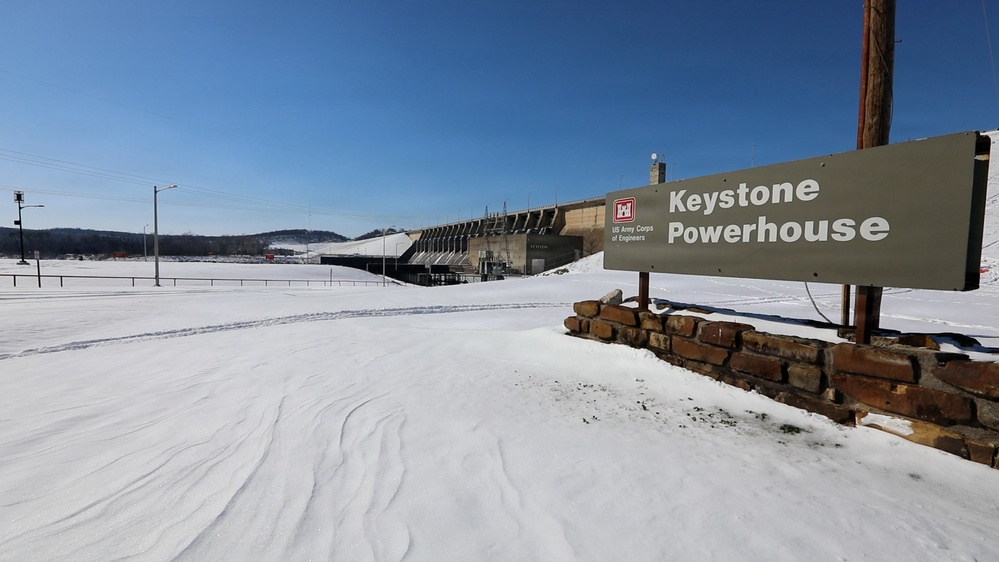
Photo By Brannen Parrish | The Keystone Dam Powerhouse generates hydroelectric power to support peak power...... read more read more
Tulsa, Okla.-- When temperatures were at their lowest in Oklahoma, Texas and Kansas, U.S. Army Corps of Engineers, Tulsa District hydroelectric dams generated enough electricity to supply nearly 600,000 users each day from Jan. 24-26.
Combined, Tulsa District’s eight powerhouses generated 20.46 Gigawatt hours of electricity or 20,460,000 kilowatt hours from Jan. 24-26. That’s enough electricity to power more than 231,000 households per day for three days.
Denison Dam Powerhouse, in Denison, Texas, generated 5.595 Gigawatt hours during the date range, the most of any Tulsa District powerhouse.
The Keystone Dam Powerhouse near Sand Springs, Okla., generated 1.156 Gigawatt hours.
“Hydropower generation really is a point of pride for the people who maintain the facilities, and the benefit that the hydropower provides back to the public, the rural cooperatives and small municipalities,” said Tom Henry, superintendent, Keystone Dam Powerhouse, USACE.
Ensuring units are properly maintained and available when the grid needs it.
“When you want to turn your lights on, or turn your heaters on, the power is there and ready to go. And as you walk through the plants, you can see that pride in the way the crews maintain the facilities,” said Henry, who has worked at all eight Tulsa District powerhouses during a career that spans nearly three and a half decades. And during the winter storm, users needed it.
According to data from the National Weather Service, temperatures fell to as low as 7 degrees in Oklahoma City, Jan. 24, and dropped to 3 degrees below zero, Jan. 25. The town of Kenton, Okla., fell to minus 12 degrees, Jan. 26, and set a state record for the lowest temperature for that date.
Portions of Tulsa District’s area of responsibility recorded nearly 100 consecutive hours at or below freezing temperatures during the storm.
“What was so significant about the event was the amount of sleet and snow that fell over such a large area, and the fact that the temperatures stayed cold so long,” said Taft Price, forecaster and former television meteorologist in Tulsa District’s Hydrology and Hydraulics Branch. “Some areas of the Tulsa District received more snow during the winter storm than the average annual snowfall for their region.”
Tulsa District’s powerhouses support electricity needs by generating peak power during periods of high load demand.
Coal power plants can efficiently produce steady state electricity to meet daily needs over long periods, but when demand increases beyond the plants production level, activating another coal powered generator takes a lot of time.
“During extreme weather, demand for electricity surges at the very moment reliability matters most. Peak power refers to the highest level of electricity demand at a specific point in time—and it comes at a very high cost,” said Nicki Fuller, general manager and chief executive officer, Oklahoma Association of Electric Cooperatives.
The OAEC’s member institutions and cooperatives maintain more than 118,000 miles of distribution lines in all 77 Oklahoma counties, and more than 640,000 electric meters in Oklahoma and surrounding states.
“During extreme winter cold and summer heat, peak power helps determine how the system is built, what it costs to operate, and how reliably electricity is delivered. Oklahoma’s rural electric cooperatives work every day to meet that challenge, bridging supply gaps and ensuring safe, reliable, and affordable power for the members who depend on us,” said Fuller.
The Southwestern Power Administration, one of four Power Marketing Administrations under the Department of Energy, markets and delivers USACE-generated hydroelectricity to electric cooperatives, municipalities and federal customers in six states.
And USACE powerhouse controllers can activate hydropower units quickly to meet demand and adjust power generation as necessary.
“The real strength of hydropower is how quickly we can meet load demand and adjust to changing demand,” said Nick Hicks, senior controller, Fort Gibson Powerhouse, USACE. “If SWPA calls and says we need, 24 megawatts, we can have units online in 15 minutes, and adjust generation as demand increases or decreases. In an emergency, we can have units operating even faster.”
During the January 2026 Winter Storm, Tulsa District Powerhouses did just that.
Tulsa District Powerhouse Generation
| Powerhouse | Total Generation Jan. 24-26 |
|---|---|
| Broken Bow | 3.707 Gigawatt Hours |
| Denison | 5.595 Gigawatt Hours |
| Eufaula | 4.579 Gigawatt Hours |
| Robert S. Kerr | 3.334 Gigawatt Hours |
| Webbers Falls | .547 Gigawatt Hours |
| Keystone | 1.156 Gigawatt Hours |
| Tenkiller | .875 Gigawatt Hours |
| Fort Gibson | .667 Gigawatt Hours |
| TOTAL: | 20.46 Gigawatt Hours |
| Date Taken: | 02.09.2026 |
| Date Posted: | 02.09.2026 14:16 |
| Story ID: | 557763 |
| Location: | OKLAHOMA, US |
| Web Views: | 393 |
| Downloads: | 0 |

This work, When demand peaks; USACE powers, by Brannen Parrish, identified by DVIDS, must comply with the restrictions shown on https://www.dvidshub.net/about/copyright.


No keywords found.





