
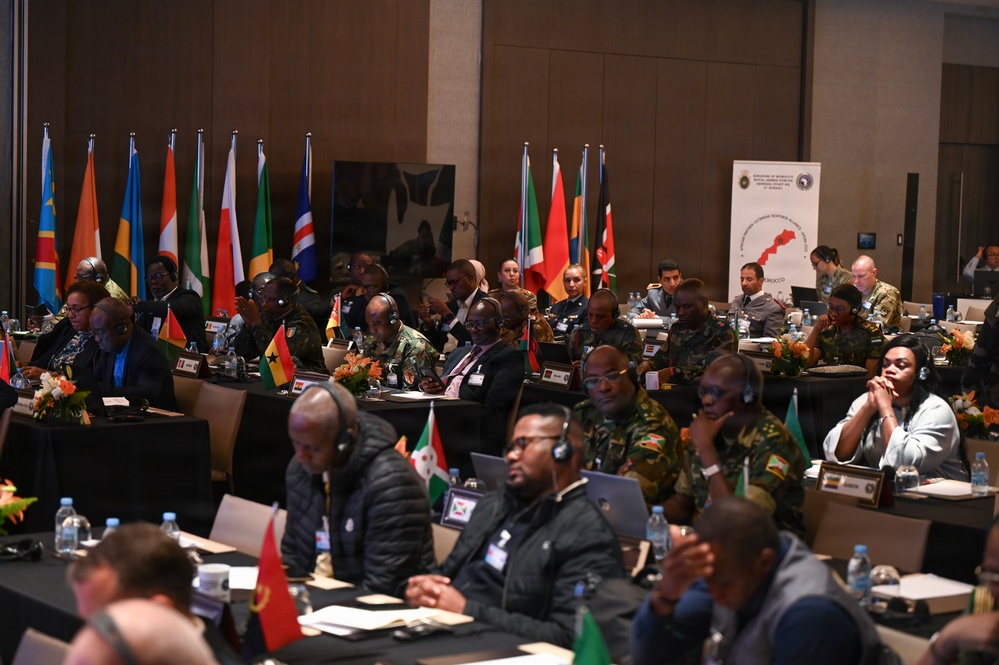
Photo By Capt. Benjamin Aronson | Attendees listen to an executive board brief during the African Partner Outbreak...... read more read more
 Subscribe
RABAT, MOROCCO – This past December, representatives of ministries of health and defense from 30 African nations and the U.S. came together in Rabat, Morocco, for the 11th African Partnership Outbreak Response Alliance Workshop, focusing on strengthening health security by operationalizing civil-military collaboration in outbreak preparedness and response.
APORA was formed in 2014 as a response to the Africa Ebola outbreak and began with only 12 partner nations as a means to increase support, humanitarian assistance, and disaster relief in response to public health emergencies across the continent. Since then, the African-led, U.S.-enabled, alliance has grown to include 38 partner nations across the continent with the Royal Armed Forces of Morocco hosting and organizing this iteration of the workshop for the first time.
“We are here building on the momentum born out of the 10th anniversary of APORA, recognizing our shared and critical objectives, bolstering regional capacity to effectively respond to outbreaks and disasters,” said U.S. Air Force Col. Thomas Stamp, U.S. Air Forces in Europe - Air Forces Africa command surgeon. “The strength of our militaries, together with our public health expertise, is pivotal in achieving this vital goal.”
The workshop aimed to further increase capacity building and promote training of defense personnel in the prevention, detection, and response of emerging infectious diseases; identify best practices; assess partner nation military medical capabilities to assist other nations; and document official cooperation agreements between ministries of health and defense.
Senior leadership from the Moroccan Royal Armed Forces, to include from the Mohammed V Military Teaching Hospital, all agreed that Africa needs a resilient, proactive health system built upon a partnership between civilian and military entities.
“These agreements between ministries of defense and ministries of health are made to build capability and capacity in the healthcare systems of these nations so in the next five to ten years, they’ll be mostly self-reliant and self-supporting,” said U.S. Army Col. Michael Cohen, U.S. Africa Command command surgeon.
This workshop gave African delegates a unique forum to exchange their practice-changing knowledge in combatting infectious disease threats. As a continent-wide alliance, delegates were able to benefit from the vast breadth of experience available in APORA.
Attendees received status updates from medical experts on partner nation civilian-military relations for outbreak response, case studies on how past epidemics were handled, and a hands-on demonstration of the Isolation System for Treatment and Agile Response for High Risk Infections (ISTARI) device – an FDA-cleared device designed to isolate patients infected with dangerous pathogens in low-resource environments.
Across its many members, APORA has made strides with partner nations to further enhance the cooperation between civil organizations, such as the Africa CDC, and the military as recognition grows of the criticality for regional cooperation to resolve threats.
"By joining forces, sharing data and experiences, and coordinating actions on the ground, we are building the health security of Africa's future,” said Cameroon Defence Force Col. Julius Nvobegahay, APORA president.
The drive to include the military in outbreak response comes from the capabilities the military can provide in reinforcing a timely response capacity through logistics, additional medical personnel and resources, and health intelligence to create a whole of government approach for a country.
“We must recognize that disease outbreaks are not just public health emergencies, but also significant security threats,” said Stamp. “An uncontrolled epidemic can destabilize communities, cripple economies, strain our resources and even undermine national security.”
The role of national security, both in the homeland and with African partner nations, has been a key area of focus for both the USAFRICOM and USAFE-AFAFRICA Command Surgeon offices.
“When we [USAFRICOM] look at outbreaks, my first question is ‘how does this impact national security?’” said Cohen. “The way people travel these days, these diseases will move.”
Whether assessing risk of diseases spreading to personnel currently in Africa or impacting those planning to travel to the continent in the future, the nature of international travel means diseases do not adhere to borders and represent a potential risk to personnel and operations.
APORA looks to continue to grow its membership and build regional cooperation both within and between countries through continual engagements throughout the next year.
“Public health threats are as real as conventional security challenges,” said Stamp. “By investing in APORA, we are investing in effective prevention, early detection and rapid response, which ultimately enhances our ability to protect our nations, our neighbors and our collective stability.”
| Date Taken: | 01.13.2026 |
| Date Posted: | 01.15.2026 03:20 |
| Story ID: | 556223 |
| Location: | RABAT, MA |
| Web Views: | 171 |
| Downloads: | 1 |

This work, APORA 2025: Forging African health security through civil-military cooperation, by Capt. Benjamin Aronson, identified by DVIDS, must comply with the restrictions shown on https://www.dvidshub.net/about/copyright.


No keywords found.




