
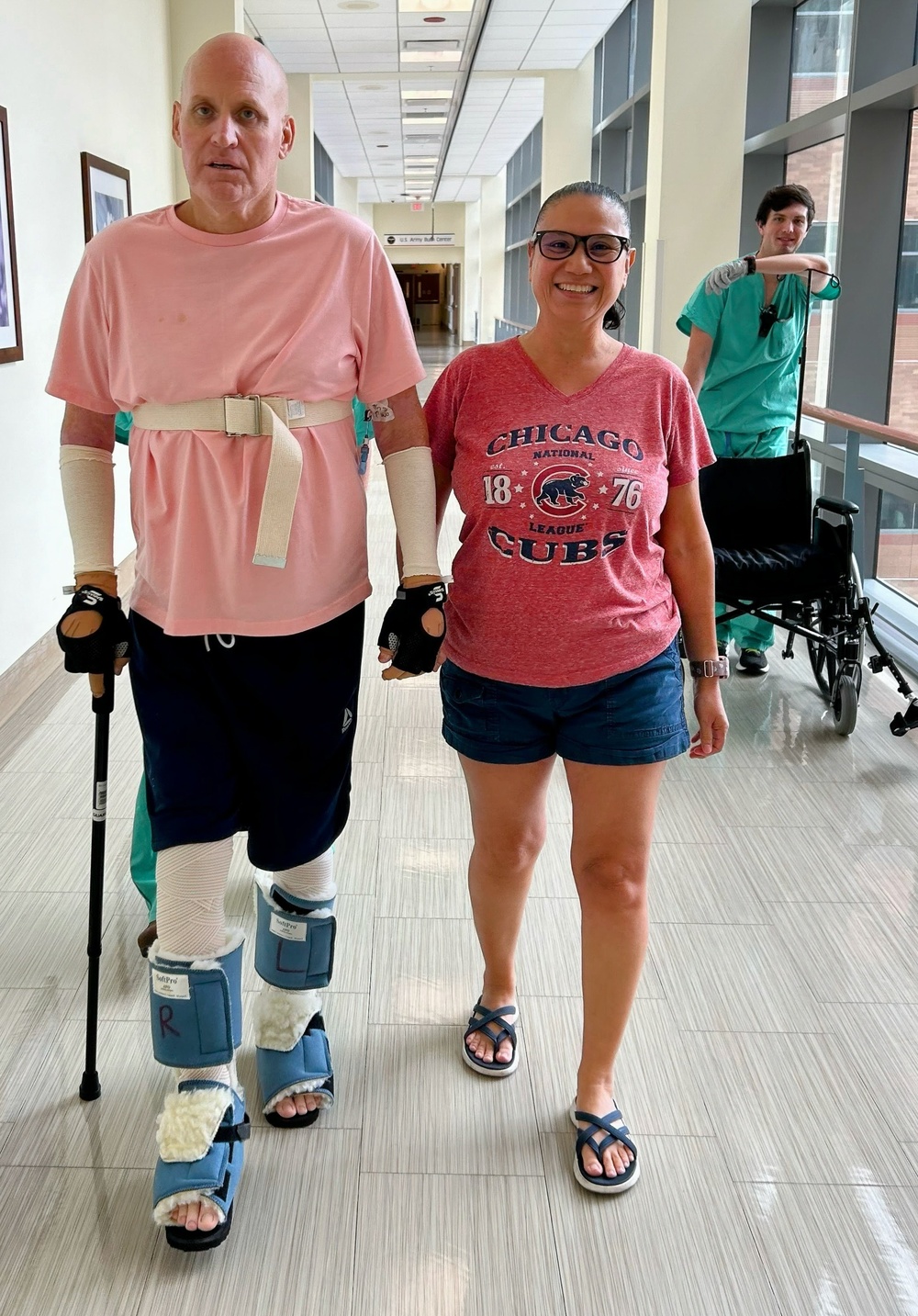
Courtesy Photo | Retired Army Master Sgt. Chris Hiatt walks with his wife, Angela Hiatt, at the U.S....... read more read more
 Subscribe
JOINT BASE SAN ANTONIO-FORT SAM HOUSTON, Texas -- Brooke Army Medical Center provides emergent and rehabilitative services for San Antonio and the south Texas community to ensure patients receive safe, quality care.
LIFESAVING TRAUMA CARE
BAMC’s Level I Trauma Center is the only Level I Trauma Center in the Department of War. It serves San Antonio and the surrounding region, caring for more than 6,000 military and civilian trauma patients each year, including 750 burn patients, from an area that stretches across 22 counties in Southwest Texas encompassing more than 2.8 million people.
“For more than 28 years BAMC has been taking care of high acuity injured patients from the community,” said Dr. Timothy Nunez, chief of trauma and surgical critical care at BAMC. “Over 50,000 patients have been brought to BAMC for care of their injuries.”
About 85 percent of BAMC’s trauma admissions are community members without military affiliation. BAMC can accept civilian trauma patients for care through the Secretary of the Army Designee Program and related special authorities.
“One of the most important roles military medical personnel have is to be ready to take care of the warfighter,” Nunez said. “We take care of injured patients every day to remain experts in the management of the injured. The Joint Trauma System whose mission is critical to improving battlefield medicine was based heavily on the experience of senior military surgeons who practiced at BAMC and in the Southwest Texas Regional Advisory Council.”
“Advancements in the care of military members wounded in combat have improved because of the role BAMC has had in this community,” he added.
Nunez highlighted the importance of having the U.S. Army Institute of Surgical Research Burn Center, Undersea and Hyperbaric Medicine Clinic, and the Center for the Intrepid within the BAMC footprint.
“BAMC has the capability to take care of the most severely injured patients,” he said. “Having all of these entities that are busy clinical operations ready to take care of any wounded service member is a huge benefit to our warfighters. I would also add our ECMO (Extracorporeal Membrane Oxygenation) capabilities to a huge strength for the overall ability of us to take care of patients.”
ECMO is a life-saving medical technology that provides temporary support for the heart and/or lungs when they are unable to function adequately. Blood is pumped outside of the body to a heart-lung machine. The machine removes carbon dioxide and sends oxygen-rich blood back to the body. This allows the heart and lungs to rest and heal.
BAMC has the only ECMO center in the Department of War and remains one of the few centers with global air transportable ECMO capability.
BURN CENTER
The USAISR Burn Center is the Department of War’s only American Burn Association Verified Burn Center and the sole verified burn center serving the South Texas community.
“The USAISR Burn Center, staffed by nearly 300 multidisciplinary burn care specialists, works in partnership with BAMC’s trauma and medical teams to deliver world-class, innovative care for the Department of War and the South Texas community,” said Army Col. Shaun Brown, USAISR commander. “Having both burn and trauma expertise in one location ensures patients receive comprehensive, coordinated care close to home, supporting the best possible recovery outcomes.”
“Additionally, the co-location strengthens academic collaboration with BAMC, expanding training opportunities for DoW personnel and local medical programs, and advancing the future of military and civilian medicine,” he added.
Army veteran Chris Hiatt was brought to BAMC after his small plane crashed and caught fire. More than 28% of his body received third degree burns.
“The recovery from the burns has been the hardest thing I’ve ever done in my life,” Hiatt said. “The ISR team from A to Z, it’s phenomenal. They gave me my life back.”
Army Cpl. Kederick Brooks was burned over 50% of his body and lost his right arm and right leg in the motor vehicle crash. After a lengthy hospital stay and multiple surgeries, he was assigned to the Joint Base San Antonio Soldier Recovery Unit to receive rehabilitative care at the Center for the Intrepid.
The SRU is a program under the Army Recovery Care Program that provides complex case management for wounded, ill, and injured soldiers. SRUs offer comprehensive support and care to help Soldiers heal and either return to duty or transition to civilian life.
CENTER FOR THE INTREPID
“The CFI is the only advanced rehabilitation center in the DoW and is co-located with the DoW’s only Level I Trauma Center and Burn Center,” explained Dr. Alison Wiesenthal, chief of the Department of Rehabilitation at BAMC. “This offers our patients seamless care transitions where they can go directly from their inpatient stay to high quality multidisciplinary rehabilitation services.”
Wiesenthal explained the benefits of having a surgeon as the director of the CFI.
“Our director of the CFI, (Air Force) Maj. (Raymand) Kessler, will do your surgery at BAMC and will check on you during your physical therapy session at the CFI,” she said. “How awesome is that? Your prosthetist can circle in with your burn team if your wound needs evaluation.”
Brooks has been going to the CFI for rehabilitation care for more than two years.
“The prosthetics production process can be lengthy,” Wiesenthal said. “Because we are co-located with BAMC and the ISR Burn Center, we can start building a patient’s prosthetics before they leave the hospital.”
Brooks praised his occupational therapists and physical therapists as well as the therapists and counselors at the CFI.
“Those people are amazing,” he said. “I hold them near and dear to my heart. On the days when I was low mentally, they were able to lift my spirits.”
“The CFI is where cutting-edge technology meets unmatched compassion, renowned for its holistic approach to amputee care,” Wiesenthal said. “Blending physical therapy, behavioral health, pain management, occupational, and recreational therapy, we prioritize the goals of the individual.”
Brooks is a testament to that. “Every goal I set for myself, I automatically crush,” he said. “The three goals I set for myself were to learn how to cook again; how to play the piano again; and to start driving again. I did all three.”
“CFI isn’t just a facility—it’s a beacon of hope,” Wiesenthal said. “By merging innovation with humanity, it ensures wounded warriors don’t just survive but thrive.”
HYPERBARIC MEDICINE
BAMC opened the Undersea and Hyperbaric Medicine Clinic in 2017 to offer 24/7 care using oxygen therapy to treat a wide range of illnesses and injuries including decompression illness, carbon monoxide intoxication, gangrene, radiation injuries and compromised flaps or grafts.
According to the Undersea & Hyperbaric Medical Society, hyperbaric oxygen is an intervention in which an individual breathes nearly 100 percent oxygen while inside a hyperbaric chamber that is pressurized to greater than sea level pressure.
The clinic houses a multi-person chamber to accommodate up to six patients at one time, and a single chamber to house one patient at a time.
Retired Master Chief David Phillips received severe frostbite while climbing Mount Everest earlier this year. He began treatment at the ISR Burn Center and was referred to the Undersea and Hyperbaric Medicine Clinic to help expedite the healing process.
Phillips said he was in a lot of pain when he first began treatment.
“My pain was reduced to almost zero and I also see things are healing much faster,” he said.
Hiatt agrees. He also received oxygen therapy after some of his surgeries.
“I think it helped me heal much faster,” he said.
BAMC is one of only two military medical facilities that offer hyperbaric medicine within the DoW.
“BAMC is the leading military medical treatment facility in the Department of War because we have all of these capabilities and expertise located within our campus,” said Army Col. Kevin Kelly, BAMC commander. “This enables us to provide the best, most comprehensive care to our warfighters, their families and our civilian trauma patients.”
| Date Taken: | 12.15.2025 |
| Date Posted: | 12.16.2025 16:14 |
| Story ID: | 554463 |
| Location: | FORT SAM HOUSTON, TEXAS, US |
| Web Views: | 277 |
| Downloads: | 0 |

This work, BAMC provides comprehensive care for military, civilian patients, by Lori Newman, identified by DVIDS, must comply with the restrictions shown on https://www.dvidshub.net/about/copyright.


No keywords found.




