Students and researchers at the Naval Postgraduate School (NPS) are playing a lead role in operationalizing advanced manufacturing (AM) techniques and technologies, and the critical warfighting advantages they enable.
Powered by the institution’s Consortium for Advanced Manufacturing Research and Education, or CAMRE, and its forward-thinking partnerships with the Marine Innovation Unit and FleetWerx, the NPS-led CAMRE team executed a prolific display of what’s possible with Distributed Advanced Manufacturing during the recent Trident Warrior 25 exercise in Southern California.
“I participated in TW24 and TW25, and in both exercises, advanced manufacturing was able to address materiel deficiencies facing the Navy and DOD with a flexibility and speed that I have not seen matched through the typical process,” said U.S. Navy Lt. Charles Wallace, a mechanical engineering student at NPS working with the CAMRE team.
“The number one asset of the U.S. military is our human capital, and AM allows the creativity and innovation of our Sailors and Marines to be utilized to address critical supply chain issues,” Wallace added. “AM is an enabling technology that delivers the tools of manufacturing into the hands of those most motivated to employ them for the Navy and the DOD.”
The benefits of advanced manufacturing on readiness and warfighting capacity are undeniable, says U.S. Navy Capt. Jeremy Gray, NPS surface warfare chair, and have been demonstrated many times, he adds, through applied research and experimentation by NPS at the school’s labs and working with the fleet.
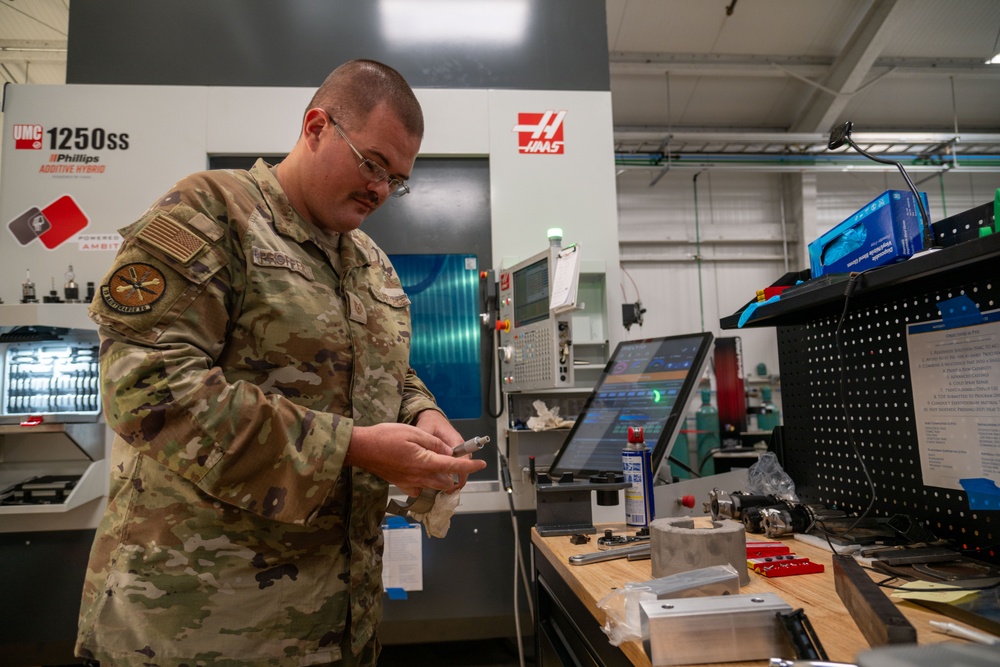
“Traditionally, if we have a system in the Navy that breaks, of course it would have to be repaired. If that part’s not readily available, you may have to go back to a manufacturer and create a new one,” said Gray during a recent interview. “This technology, in the form of 3D printing or CNC [computer numerical control] milling, allows us to manufacture parts on site at the demand of the user.”
The NPS Trident Warrior team also included students, faculty and service members on the NPS campus, producing parts and testing designs with their industry partners directly involved. U.S. Navy Lt. Jennifer Fairbrother, a submarine officer and September 2025 NPS graduate, supervised the team and help conduct hands-on training for the visiting service members producing real-world parts for ships in San Diego, including parts for a shipboard Close-in Weapon System used for defense against incoming threats.
Wallace, who supported the team in San Diego from one the U.S. Navy ships engaged in the exercise, said his NPS thesis research is directly related to the work NPS and CAMRE are delivering to the fleet. As a former Nuclear Power Training Unit (NPTU) instructor, he saw first-hand the expense in both materiel and man-hours needed to keep an aging asset in good working order.
“My thesis research explores replacing existing heat exchangers on naval vessels with an AM triply periodic minimal surface (TPMS) heat exchanger,” Wallace said. “Aided by the advent of AM practices, it has become not only possible but reasonable to produce complex geometry heat exchangers that optimize surface to volume ratio to improve thermal performance.”
AM is not only for the production of parts rapidly delivered to the point of need, Wallace says. It can also enable the production of use-specific parts that get naval assets back out to the fleet, faster.
“By employing AM practices, the goal is to produce a heat exchanger that can fit through a hatch, simplifying maintenance and negating the need for a hull cut in the event a replacement is necessary,” Wallace explains. “The possibility of improving plant performance by replacing existing parts with an optimized part produced using AM is very near and dear to my heart.”
“TW24 and TW25 were both vital experiences for giving me exposure to the reverse engineering process from problem identification all the way through final installation and testing,” he continued. “I have used all these lessons learned while preparing the design concept for my thesis.”
TW25 is the latest manifestation of a three-year collaboration between NPS’ CAMRE and the Marine Innovation Unit (MIU), with the two organizations working together to strategically integrate advanced manufacturing technologies into expeditionary and contested logistics, where machinists and equipment are not geographically located at the point of need. During TW25, MIU provided reverse engineering, part design, parts research, and manufacturing support.
“The Marine Innovation Unit has been instrumental to the success of CAMRE during these exercises. They bring technical expertise from their civilian employment and have seamlessly integrated with our expert faculty and active-duty student warfighters to help NPS operationalize advanced manufacturing. This unit’s involvement is vital to our advancements going forward,” said Chris Curran, CAMRE program manager.
Working from spaces at Fleet Readiness Center Southwest (FRC-SW), a team of nine MIU Marines with backgrounds in manufacturing, engineering, and project management focused on streamlining the process of fulfilling manufacturing requests from supported units. Through TW25, Marines tested a system of receiving and assigning production requests, then subsequently tracking the design, delivery and functions check of those parts. The exercise also served as an opportunity to evaluate the latest commercially-available AM machines to be considered for adoption and procurement by the Department of War.
“We are creating Uber for manufacturing, delivered with the efficiency of Amazon across the globe, for nuclear-grade propulsion parts, in highly contested environments,” said U.S. Marine Corps Reserves Lt. Col. Michael Radigan, a lead organizer of the team’s TW25 efforts. “This was the largest advanced manufacturing event the Department of War has done in its history, and we are writing the tactics, techniques and procedures that will operationalize these capabilities into unmatched combat power for the joint force.”
The team engaged directly with FRC-SW, submarine units, USS Cape St. George (CG-71), USS Germantown (LSD-42), Special Boat Team 12, and F-18/F-16 depot-level repair facilities to identify parts suitable for production using advanced manufacturing. Requests were submitted through a QR-code-linked submission form which automatically uploaded data to the Joint Advanced Manufacturing System (JAMS) — a system that MIU designed and deployed.
Over the course of the two-week exercise, the CAMRE/MIU team helped field more than 180 unique part requests. The team crafted an exhaustive due diligence process to gather all required information to produce accurate computer-aided design (CAD) models for additive manufacturing. And in some cases, this design work was accomplished by the team working remotely hundreds or thousands of miles away.
The research team’s efforts successfully demonstrated the potential for the MIU Advanced Manufacturing Section to serve as a centralized reverse engineering and design capability for the Marine Corps – a concept currently being explored through the Marine Corps Reverse Engineering and Design Cell (MCREDC).
As MIU continues developing the MCREDC concept, the NPS CAMRE team is eyeing future joint exercises to further refine expeditionary and distributed advanced manufacturing concepts, supporting student and faculty research that delivers new capabilities to the U.S. Navy and Joint Force.
| Date Taken: |
09.30.2025 |
| Date Posted: |
09.30.2025 17:42 |
| Story ID: |
549777 |
| Location: |
MONTEREY, CALIFORNIA, US |
| Web Views: |
120 |
| Downloads: |
0 |
PUBLIC DOMAIN

This work, NPS Students, Researchers and Partners Operationalize Advanced Manufacturing at Trident Warrior 25, must comply with the restrictions shown on https://www.dvidshub.net/about/copyright.

 Subscribe






