
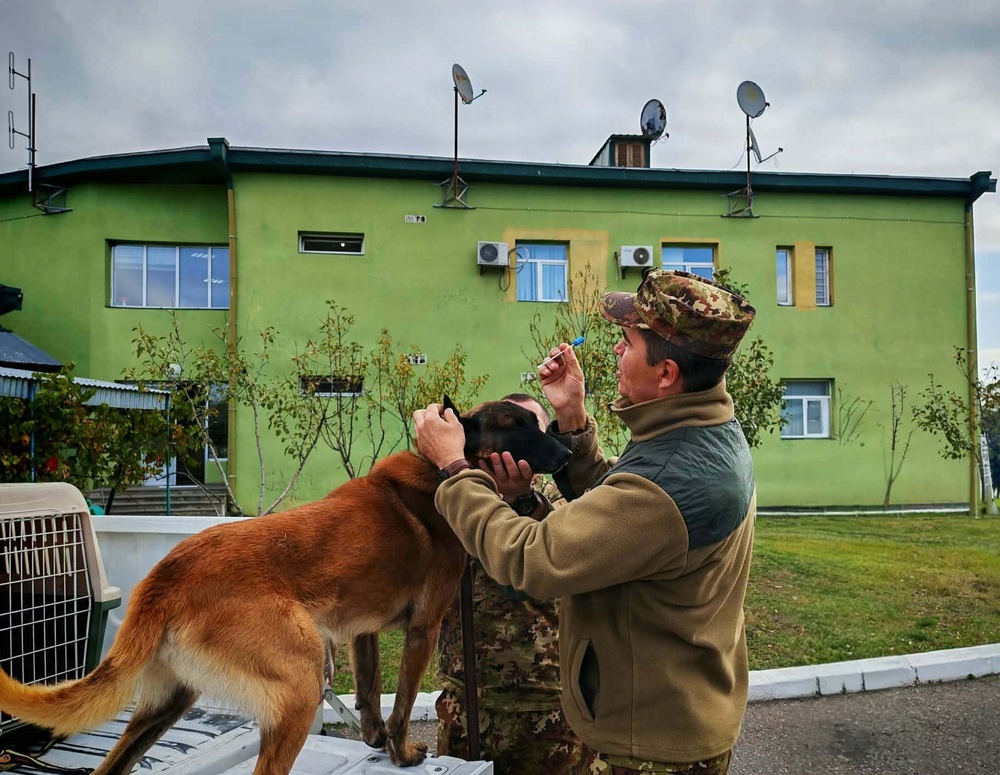
AKHALTSIKHE, GEORGIA – In a pioneering collaboration, military working dogs (MWDs) are being monitored as sentinels for the growing threat of antimicrobial resistance (AMR) along Georgia's strategic border. A joint mission between the Walter Reed Army Institute of Research – Europe-Middle East (WRAIR-EME) and the Ministry of Internal Affairs – Border Police Canine Services (MIA-BP) of Georgia expanded critical AMR surveillance to the Akhaltsikhe region from October 16-17, 2025.
The initiative focused on border checkpoints at the Turkish-Georgian and Armenian-Georgian crossings, a vital corridor that had not previously been studied for AMR threats. Because MWDs work in close contact with handlers and the environment, they can serve as early-warning indicators for the presence of dangerous, multidrug-resistant (MDR) pathogens before they impact military personnel or local communities.
During the two-day mission, scientific teams collected samples from border dogs. The surveillance targeted a group of priority pathogens known as ESKAPE-E (Enterococcus faecium, Staphylococcus aureus, Klebsiella pneumoniae, Acinetobacter baumannii, Pseudomonas aeruginosa, Enterobacter species & Escherichia coli), which are notorious for their ability to "escape" the effects of common antibiotics.
Initial laboratory analyses, performed at the WRAIR-EME facility in Tbilisi, have already confirmed the presence of MDR organisms among the canine units. This finding underscores the importance of proactive, region-specific monitoring to understand and mitigate operational risks.
"This surveillance is crucial. It addresses a significant gap in our understanding of pathogen diversity and resistance patterns in this high-altitude, cross-border environment," stated a project representative. "By monitoring these sentinel animals, we can gather essential baseline data for southern Georgia and develop proactive interventions to protect both animal and human health."
Building on the success of this mission, WRAIR-EME and the Georgian MIA-BP plan to expand their surveillance to additional border regions. The data gathered will be shared through multinational biosurveillance networks, enhancing regional situational awareness and reinforcing force health protection. The partners will also develop mission-specific biosecurity measures to reduce exposure risks for both MWDs and their handlers, ensuring the continued effectiveness of critical border security operations.
| Date Taken: | 10.15.2025 |
| Date Posted: | 02.05.2026 21:33 |
| Photo ID: | 9499732 |
| VIRIN: | 251016-A-A1902-1001 |
| Resolution: | 1823x1413 |
| Size: | 408.51 KB |
| Location: | TBILISI, GE |
| Web Views: | 49 |
| Downloads: | 0 |

This work, Border Dogs on the Frontline: U.S. and Georgian Partners Monitor "Superbug" Threats [Image 6 of 6], by CPT Daniel Kankam, identified by DVIDS, must comply with the restrictions shown on https://www.dvidshub.net/about/copyright.


No keywords found.





