
Courtesy Photo | U.S. Army Acquisition Support Center | 11.29.2018
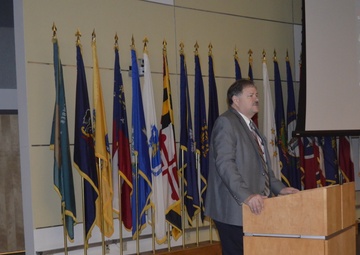
Dr. George Ludwig, USAMRMC’s principal assistant for research and technology, welcomes workshop attendees. (Photo by USAMRMC Public Affairs)...
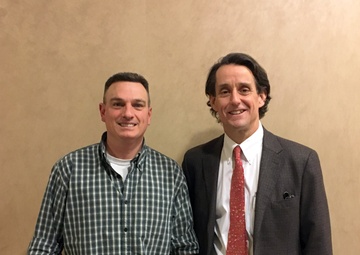
Photo by Erin Bolling | Medical Research and Development Command | 01.08.2018
Mr. Jason Savell and Dr. David Harrington, were peer reviewers for the Congressionally Directed Medical Research Programs' Military Burn Research Program, and unknowingly shared a part of their past, 24 years ago....

Courtesy Photo | U.S. Army Acquisition Support Center | 01.01.2018
A readout of lactate levels over time as measured by a continuous lactate monitor over a period of cycling. Lactic acid levels rise during episodes of critical illness and internal bleeding, which may not be visible to the naked eye. (Image courtesy of UC Irvine)...

Courtesy Photo | U.S. Army Acquisition Support Center | 01.01.2018
The Army believes the continuous lactate monitor could play a key role in future battlefield medicine. This prototype features a wearable, subcutaneous microsensor designed to detect critical illness and internal bleeding. (Photo courtesy of UC Irvine)...
Courtesy Photo | U.S. Army Acquisition Support Center | 01.01.2018
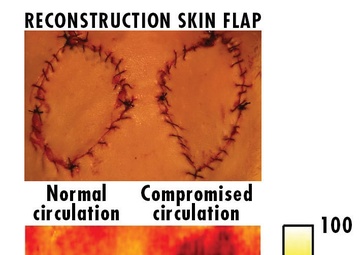
SFDI surgical camera images show reconstruction skin flaps with normal circulation, upper left, and compromised circulation, upper right. SFDI images enable physicians to make early and accurate assessments of tissue viability for burn and wound management, reconstructive surgery and progressive monitoring of grafts and wound healing. (Photos courtesy of UC Irvine)...
Courtesy Photo | U.S. Army Acquisition Support Center | 01.01.2018
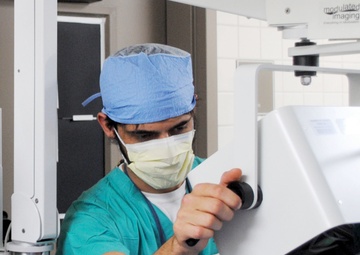
A clinician operates an SFDI unit, which is being developed and commercialized by California-based Modulated Imaging Inc. SFDI uses the principles of diffuse optical spectroscopy to determine whether burned tissue is suitable for reconstructive surgery. (Photo courtesy of UC Irvine)...

Courtesy Photo | U.S. Army Acquisition Support Center | 01.01.2018
The images produced by an SFDI surgical camera show parameters such as oxygen saturation, water content and total hemoglobin. Despite advances in technology, burns remain difficult to treat, and CCCRP is exploring new ways to speed healing and reduce infection. (Photos courtesy of UC Irvine)...
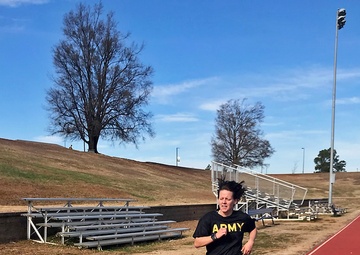
Photo by Staff Sgt. Elvis Umanzor | 49th Public Affairs Detachment | 12.19.2017
Sgt. Paige Behringer, a public affairs journalist assigned to the 49th Public Affairs Detachment, Headquarters and Headquarters Battalion, 82nd Airborne Division, crosses the finish line during an Army Physical Fitness test, Dec. 19, 2017, at Fort Bragg, N.C. Behringer suffered a mild traumatic brain injury on July 28, 2017 and earned a passing 270 APFT score almost five months after her......




