

Photo by Douglas Holl | Defense Health Agency | 08.22.2025
Eating colorful, antioxidant-rich foods can support breast cancer prevention. Eating pink may help remind individuals that foods high in antioxidants, fiber, and phytonutrients come in pink, red, and purple colors. (DHA Public Health graphic illustration by Rachel Stershic)...
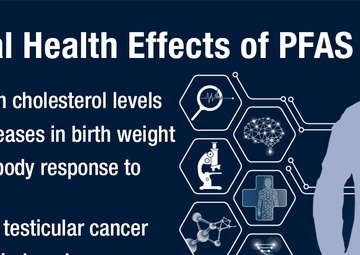
Photo by Douglas Holl | Defense Health Agency | 10.09.2024
Exposure to per-and polyfluoroalkyl substances, or PFAS, is associated with a wide range of toxicity concerns, although there is often a lack of consensus on the associated health effects—particularly for low-level exposures. Defense Health Agency-Public Health toxicologists are working with Veterans Health Administration experts to leverage ongoing PFAS screening for Department of Defense......
Courtesy Photo | Defense Health Agency | 07.15.2024
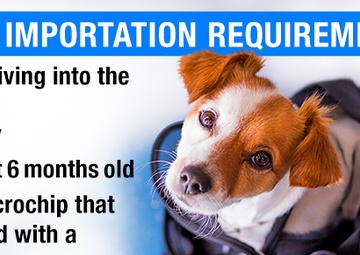
Service members and their families returning to the United States from overseas duty assignments must comply with updated dog importation requirements effective Aug. 1, 2024. Defense Health Agency veterinary experts say preventing infected dogs from entering the United States is a public health priority. (Defense Health Agency-Public Health graphic illustration by Joyce Kopatch)...

Photo by Douglas Holl | Defense Health Agency | 06.11.2024
The military’s Authorized Protective Eyewear List, commonly referred to as the APEL, ensures that military protective eyewear meets necessary ballistic impact criteria. The list of approved commercial eyewear is updated every two years to allow for new developments in technology and user requirements. Check out the newest list at......

Photo by Douglas Holl | Defense Health Agency | 05.14.2024
Robyn Nadolny (left), chief of the Defense Health Agency-Public Health vector-borne disease branch, works with U.S. Army Spc. Taylor Cremeans to identify a tick for the MilTICK program. MilTICK SURE Path uses MilTICK specimens already submitted, and subjects them to additional testing for rare pathogens at the end of each calendar year. The SURE Path program allows the VBD team to better......

Courtesy Photo | Defense Health Agency | 05.14.2024
Some diseases are transmitted by insects such as mosquitos, ticks, and flies. These bugs are known as “vectors” as they can carry and transmit viruses, bacteria, or parasites that cause vector-borne disease, or VBD. A primary difference between preventing human transmitted infectious disease and preventing VBDs is to avoid the biting nuisances that carry the disease-causing germs. (Defense......




