
Photo by U.S. Naval Research Laboratory | U.S. Naval Research Laboratory | 03.13.2024
U.S. Naval Research Laboratory scientists unveil the Cascaded Variational Quantum Eigensolver (CVQE) algorithm expected to become a powerful tool to investigate the physical properties in electronic systems for disruptive Defense technologies. (U.S. Navy photo)...
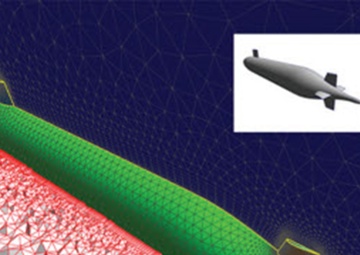
Photo by U.S. Naval Research Laboratory | U.S. Naval Research Laboratory | 03.04.2024
Research led by U.S. Naval Research Laboratory Acoustics Division Theoretical and Numerical Techniques Section Head Saikat Dey, Ph.D., incorporated in Capstone software, enables generation of meshes to resolve boundary-layers, seen in red, for high-fidelity simulations of complex flow-fields around aircrafts, helicopters and submarines as well as the performance of radio-frequency (RF)......
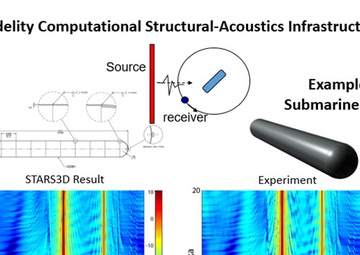
Photo by U.S. Naval Research Laboratory | U.S. Naval Research Laboratory | 03.04.2024
Algorithms and numerical techniques developed by U.S. Naval Research Laboratory Acoustics Division Theoretical and Numerical Techniques Section Head Saikat Dey, Ph.D., are being used to study structural-acoustic response of underwater platforms to address critical Navy needs by optimizing undersea-warfare systems like sonar. (Image provided by U.S. Naval Research Laboratory)...
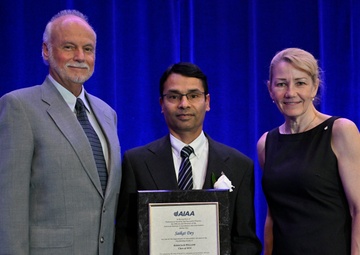
Photo by Daniel Parry | U.S. Naval Research Laboratory | 01.10.2024
U.S. Naval Research Laboratory (NRL) Acoustics Division’s Theoretical and Numerical Techniques Section Head Saikat Dey, Ph.D., named American Institute of Aeronautics and Astronautics (AIAA) Associate Fellow by President of AIAA and Sandia National Laboratories Deputy Laboratories Director for Nuclear Deterrence and Chief Technology Officer Dr. Laura McGill (right) and 2024 AIAA Selection......
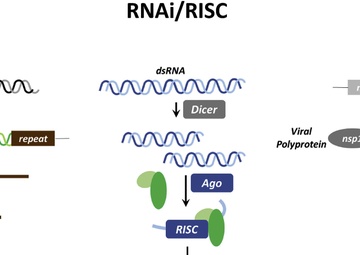
Photo by Daniel Parry | U.S. Naval Research Laboratory | 08.22.2019
DNA, RNA, Protein? Three mechanisms of silencing that are guided by a short sequence. In each case a short sequence is used to identify a larger target sequence; these mechanisms are analogous to “search and delete” programs that utilize a “keyword” that have been written in three different languages. Each system has an enzyme that recognizes the match between the short sequence and......

Photo by David McNally | U.S. Army Combat Capabilities Development Command - Army Research Laboratory | 10.15.2018
The team of Army scientists find a technique for determining the direction of arrival of a radio frequency signal source, which is a fundamental enabler of localization. (Photo Credit: U.S. Army illustration)...
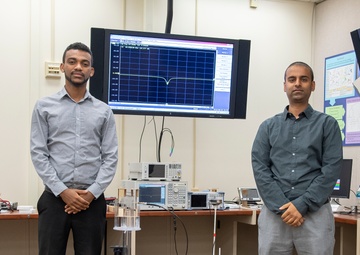
Photo by Jhi Scott | U.S. Army Combat Capabilities Development Command - Army Research Laboratory | 09.24.2018
U.S. Army Research Laboratory scientists Dr. Fikadu Dagefu (left) and Gunjan Verma (right) pose with one of the robots used to validate a new algorithm they developed, which enables localization of humans and robots indoors or in areas with many obstacles where GPS signals are likely to be unavailable....
Photo by Wesley Elliott | U.S. Army Medical Command | 05.24.2017
Dr. Kevin O'Brien, a Research Psychologist in the Warfighter Performance Group (WPG) at the U.S. Army Aeromedical Research Laboratory (USAARL), was awarded the first “AMSUS Innovator Award” on Dec. 6, at the Virtual 129th AMSUS Annual Meeting. (U.S. Army Photo)...




