SAFETY AWARENESS DISPATCH

The Safety Awareness team creates concise, readable (and sometimes funny) safety lessons to help Sailors, Marines and civilian employees (and their families) avoid repeating a mishap. Our goal is to make people think! We do our best to tell a story that people will remember – that they’ll recall when going through their normal day – that empowers them to identify hazards, accept “ownership” and responsibility for those hazards (in their community, command, and home), and take action.
Downloads: 242
Hits: 242
Safety Awareness Dispatch
SA 26-01 Aviation Ground Mishaps
Preventing and mitigating Aviation Ground Mishaps (AGMs) remains an enduring priority for the... read more
Safety Awareness Dispatch
SA 26-01 Aviation Ground Mishaps
Preventing and mitigating Aviation Ground Mishaps (AGMs) remains an enduring priority for the fleet with the air boss and leaders across the Naval Aviation Enterprise, actively engaged in leading efforts to reduce these incidents. We’ve averaged one or two Class A-E reported mishaps every single day over the past six years, costing over $630,000,000. That doesn’t
even touch on the impact to readiness from taking a Sailor or Marine off the playing field for injury and in some cases death. AGMs encompass a wide range of activities, and we need to effectively manage the risk in every activity. These efforts rely heavily upon deckplate leadership, procedural compliance and our greatest asset – our people. Read the examples and apply the lessons learned to your own work—today.
less
Downloads: 255
Hits: 255
Safety Awareness Dispatch
SA 26-13 Tactical Vehicle Mishaps III
The U.S. military has a broad assortment of tactical vehicles at its disposal to fill a... read more
Safety Awareness Dispatch
SA 26-13 Tactical Vehicle Mishaps III
The U.S. military has a broad assortment of tactical vehicles at its disposal to fill a variety of mission sets. These vehicles range from massive transportation vehicles like the Logistics Vehicle System Replacement (LVSR) to the smaller mobile Utility Task Vehicles (UTV). Whatever these vehicle sizes, capabilities or uses, one thing remains common between them all, our ability to cause mishaps with them. The following preventable mishaps occurred because personnel didn’t respect the risks in tactical vehicle operations.
less
Downloads: 239
Hits: 239
Safety Awareness Dispatch
SA 26-05 Shipboard Fire Mishap Prevention
Benjamin Franklin once said, “Nothing can be said to be certain, except death and... read more
Safety Awareness Dispatch
SA 26-05 Shipboard Fire Mishap Prevention
Benjamin Franklin once said, “Nothing can be said to be certain, except death and taxes.” The Navy has a few similar areas of certainty of its own, with shipboard fires being one our Sailors face on an unfortunately regular basis. It’s not a matter of if there’s going to be a fire; it’s when. The most important part of facing shipboard fires is knowing how to prevent them from starting in the first place and, when they do occur, making sure we’re proficient in the skills needed to fight the fire and protect life and equipment.
After reviewing reported shipboard fire mishaps over the past few years, we see recurring themes in how the fire started: 1) Hot work getting out of hand, 2) Kinetic friction (mechanical parts rubbing together at speed), or 3) Electrical shorts creating sparks that cause a fire. However, the examples below show how it’s the actions and decisions people make beforehand that contribute to whether or not a fire occurs at all.
less
Downloads: 257
Hits: 257
Safety Awareness Dispatch
SA 26-06 Water-Related Training Fatalities
Among the many high-risk training activities performed by the Navy and Marine Corps,... read more
Safety Awareness Dispatch
SA 26-06 Water-Related Training Fatalities
Among the many high-risk training activities performed by the Navy and Marine Corps, one might overlook water training as a high-hazard event. That would be a mistake. Of the 159 on-duty fatal mishap events over the past ten years, seven were water-training events. That number may seem low, but when you consider the limited amount of water training conducted compared to live-fire training, vehicle operations or flight time, that number starts to look a lot bigger. Regardless of how you look at the numbers, one thing that must be accepted is water training is inherently high-risk and proper risk mitigations must be planned out. The following are some cases where planning was not effective, and service members paid the price.
less
Downloads: 243
Hits: 243
Safety Awareness Dispatch
SA 26-07 Disregarding Shipboard Alarms
Today’s topic of discussion covers disregarding shipboard alarms. Before we dive into... read more
Safety Awareness Dispatch
SA 26-07 Disregarding Shipboard Alarms
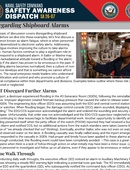
Today’s topic of discussion covers disregarding shipboard alarms. Before we dive into these examples, let’s first discuss a phenomenon known as alarm fatigue, which is when personnel become desensitized to electronic safety alerts. Addressing alarm fatigue involves improving the culture to take alarms seriously. Human factors continue to play a significant role in how we respond to a shipboard alarm. A Sailor or Marine may display a lackadaisical attitude toward a flooding or fire alarm, especially if the alarm has proven to be erroneous in the past. If disregarding alarms becomes normalized, then a culture of noncompliance develops and that is something we cannot afford to happen. The naval enterprise needs leaders who understand risk identification and control and who promote a culture of procedural compliance within their departments and divisions. Examples below outline where these risk controls were ignored or neglected.
less
Downloads: 234
Hits: 234
Safety Awareness Dispatch
SA 26-08 Aviation Maintenance Injuries
The successful completion of thousands of daily aircraft maintenance tasks is a testament... read more
Safety Awareness Dispatch
SA 26-08 Aviation Maintenance Injuries
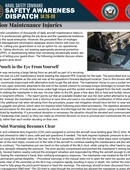
The successful completion of thousands of daily aircraft maintenance tasks is a testament to professionals getting the job done and the operational resilience they bring to the naval enterprise. However, the persistent flow of mishaps into the Risk Management Information database shows there’s still room for improvement. Letting your guard down is not an option for our operational environment. Taking shortcuts, not wearing appropriate personal protective equipment (PPE), or daydreaming rather than remaining situationally aware, are all examples of letting your guard down. The following incidents discuss where the team’s guard came down.
less







