In the summer of 1900, foreign diplomats living in Beijing’s Legation Quarter were besieged by Chinese imperial soldiers and “Boxers,” members of a... read more
In the summer of 1900, foreign diplomats living in Beijing’s Legation Quarter were besieged by Chinese imperial soldiers and “Boxers,” members of a secret society determined to rid China of foreign influence. Defending the Legation Quarter was a small international guard that included 56 American sailors and marines. To survive, the Americans communicated with their foreign allies via hand signals, improvised as food supplies and artillery dwindled, and fought fiercely despite nearly impossible odds. But they could not hold out forever. Relief of the Legation Quarter required additional U.S. sailors, marines, and soldiers to join an international coalition and face the significantly larger force of imperial soldiers and Boxers. The conflict was the U.S. military’s first taste of coalition warfare on a global stage and its first time meeting China on the battlefield. This monograph tracks the critical role of the U.S. Navy and Marine Corps in the defense of the Legation Quarter and in the campaign that led to its relief.
less
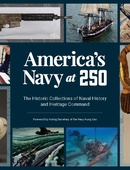
America's Navy at 250: The Historic Collections of Naval History and Heritage Command honors the Navy and Nation 250 by showcasing 250 artifacts, artworks,... read more
America's Navy at 250: The Historic Collections of Naval History and Heritage Command honors the Navy and Nation 250 by showcasing 250 artifacts, artworks, and submerged cultural resources from the Navy's collections. From the sword of John Paul Jones to the desks constructed from the wood of USS Constitution for the Secretary of the Navy and the Vice President of the United States, each selection tells a story that brings 250 years of American naval history to life. Featuring a foreword by Acting Secretary of the Navy Hung Cao.
less
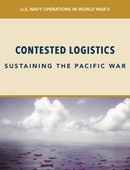
Before World War II, the US Navy relied on an ad hoc system to manage logistical support for its ships. The scale and geography of the war in the Pacific... read more
Before World War II, the US Navy relied on an ad hoc system to manage logistical support for its ships. The scale and geography of the war in the Pacific nullified earlier ways of acquiring and distributing sufficient materiel. This book explores the ways in which the Navy conceptualized and implemented overseas logistics from the age of sail through the Pacific War. These processes, both in their planned form and actual operation, reveal two significant themes: (1) logistics is line work; and (2) preparation and planning ahead of time are critical for the successful execution of operations, without which the Navy struggled to supply forward-deployed personnel.
less
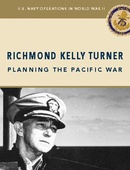
The significance of individual agency is often lost in the telling of large-scale historical events. Richmond Kelly Turner is one of those rare individuals... read more
The significance of individual agency is often lost in the telling of large-scale historical events. Richmond Kelly Turner is one of those rare individuals to stand out in the historical narrative of World War II. He played a pivotal role in planning and executing the war in the Pacific Theater during World War II. As the Director of the War Plans Division for the Chief of Naval Operations from 1940 to 1941, Captain Turner was instrumental in developing a joint estimate to guide planning for a two-ocean war. Following his promotion in 1941, Rear Admiral Turner took an active role in planning amphibious operations in the Pacific beginning in June 1942. He conducted six consecutive, successful operations against enemy positions in the Pacific theater between 1943 and 1945. Every success and every failure in Turner’s planning served to formulate an updated doctrine for amphibious assault operations. This book identifies ten lessons learned for effective planning from his experiences during the conflict. Rear Admiral Tom Williams, the current director of Plans, Policy and Integration, Office of the Chief of Naval Operations, contributed the foreword to this publication.
less
For more than 250 years, the U.S. Navy has played a pivotal role in national security and prosperity. On Course Through History: The U.S. Navy at 250... read more
For more than 250 years, the U.S. Navy has played a pivotal role in national security and prosperity. On Course Through History: The U.S. Navy at 250 presents the history of America’s sea service with an emphasis on the evolution of the Navy’s professional communities. Readers will find chapters on surface warfare, undersea warfare, naval aviation, special warfare, intelligence and information warfare, diving, medicine, civil engineering, the Supply Corps, the U.S. Navy Reserve, and the Judge Advocate General’s Corps. Every American sailor is a warfighter, and collectively they can draw upon the Navy's rich legacy for insight and inspiration as they uphold its honorable tradition of defending the nation.
less
The US Navy continuously looks to history for lessons that can improve its warfighting edge in all domains. As the official custodian of US Navy history,... read more
The US Navy continuously looks to history for lessons that can improve its warfighting edge in all domains. As the official custodian of US Navy history, the Naval History and Heritage Command collects, maintains, analyzes, and disseminates this resource. To showcase this capability, Priming the Warfighter features 18 articles, essays, and white papers produced by the command that leverage episodes from the past 250 years of Navy history in the pursuit of better appreciation of and solutions for current problems. It is ultimately through these shared experiences that history acts a force multiplier and contributes to the Navy and Marine Corps mission of projecting peace and strength throughout the world.
less