FORT RILEY, Kan - The last place any soldier wants to be is inside enemy controlled territory with little resources and no direct access to support. For Army aviators and crew chiefs, that situation is a possibility they face during every flight of a deployment.
Helicopter pilots and crew chiefs know they risk finding themselves in unfriendly areas on each mission, so they often train on skills they may need to evade enemy forces.
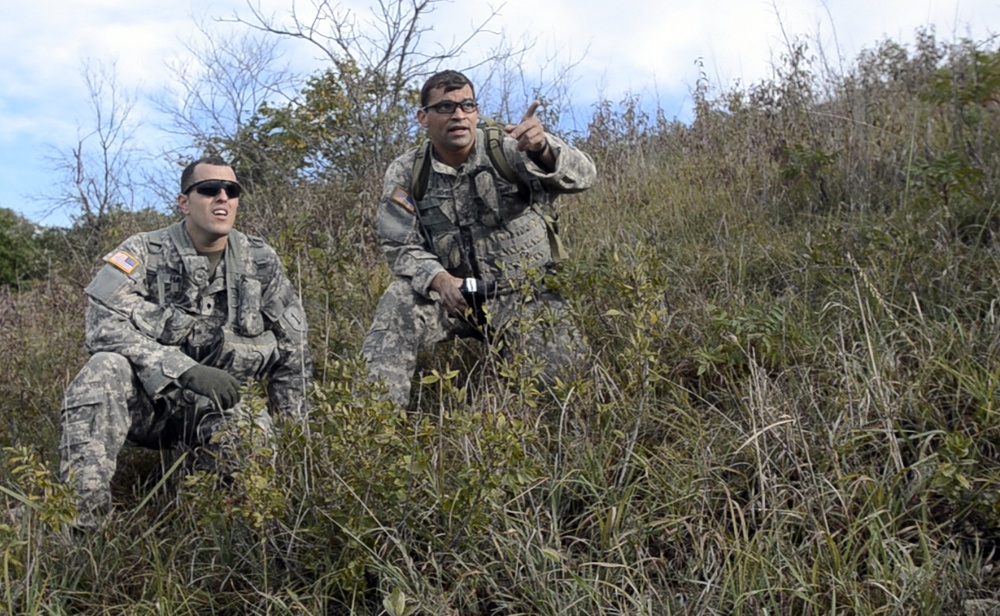
Soldiers from the 2nd General Support Aviation Battalion, 1st Aviation Regiment, 1st Combat Aviation Brigade, 1st Infantry Division conducted survive, evade, resist and escape training Sept. 14 at Fort Riley.
Helicopters dropped five soldier teams at various locations throughout the post’s training area. Each team had to evade opposing forces, locate a secure pick up point and communicate with air support in order to be extracted.
A major factor that the teams had to consider was how recent rainy weather would affect their ability to navigate the terrain while they attempted to evade the opposing force.
“The uphill, downhill, the twigs,” said Spc. Sean Hall, a Black Hawk repairman and crew chief with Company A, 2-1 GSAB. “It was pretty rough.”
Hall said his team’s plan was to move quickly away from their drop off site, putting as much distance between themselves and the “enemy” as possible.
“Hopefully we don’t see them, and they don’t see us,” Hall said prior to boarding a helicopter for his turn in the field.
As the teams moved across the training zones they received support from medevac helicopters flying overhead. For those teams who successfully found a clear and safe extraction point, the medevac teams “rescued” them using the jungle penetrator, a piece of extraction equipment that lifts the soldiers up to the helicopter.
“Getting hoisted back up into the aircraft at the end was pretty fun. That was definitely the best part,” Hall said.
Participants said the SERE training benefited several elements of the battalion.
“[The medevac crews] got training out of it and so did we on the ground,” said Warrant Officer 1 Gilberto Rosaldo, a Black Hawk pilot with Company A, 2-1 GSAB, said.
Rosaldo said that a positive attitude by everyone involved was a contributing factor to the success of the training event. The participants looked forward to practicing their skills and seeing what their capabilities were.
“The motivation on our team was high,” he said.
| Date Taken: |
09.14.2012 |
| Date Posted: |
09.27.2012 01:12 |
| Story ID: |
95352 |
| Location: |
FORT RILEY, KANSAS, US |
| Hometown: |
CHICAGO, ILLINOIS, US |
| Web Views: |
44 |
| Downloads: |
0 |
PUBLIC DOMAIN

This work, Prepare for the worst, hope for the best, by SGT Keven Parry, identified by DVIDS, must comply with the restrictions shown on https://www.dvidshub.net/about/copyright.

 Subscribe






