Staff Sgt. Samantha M. Stryker
5th Mobile Public Affairs Detachment
RABIYAH, Iraq (Oct. 26, 2006) - When Maj. William Tomlin received deployment orders to Iraq, the career artillery officer did not expect to work as an advisor to Iraqi Border Police along the border with Syria.
Tomlin and other Soldiers from different occupational specialties make up the "Thundercats" – one of the numerous Border Transition Teams that act as advisors to Iraqi Border Police. The BTTs are training IBP who currently patrol the expansive Iraqi border regions so that, in time, they can secure the country's borders without the assistance of U.S. troops.
The concept is not new. Military advisors have been used throughout history by many nations. The United States used military advisors extensively in Southeast Asia so South Vietnamese forces could fight back against invading communist forces.
The first U.S. Soldiers in Vietnam were advisors. Their numbers reached nearly 16,000 by the time Lyndon B. Johnson assumed the presidency in 1963, according to James Willbanks, director of the history department at the U.S. Military Academy and a former military advisor in Vietnam.
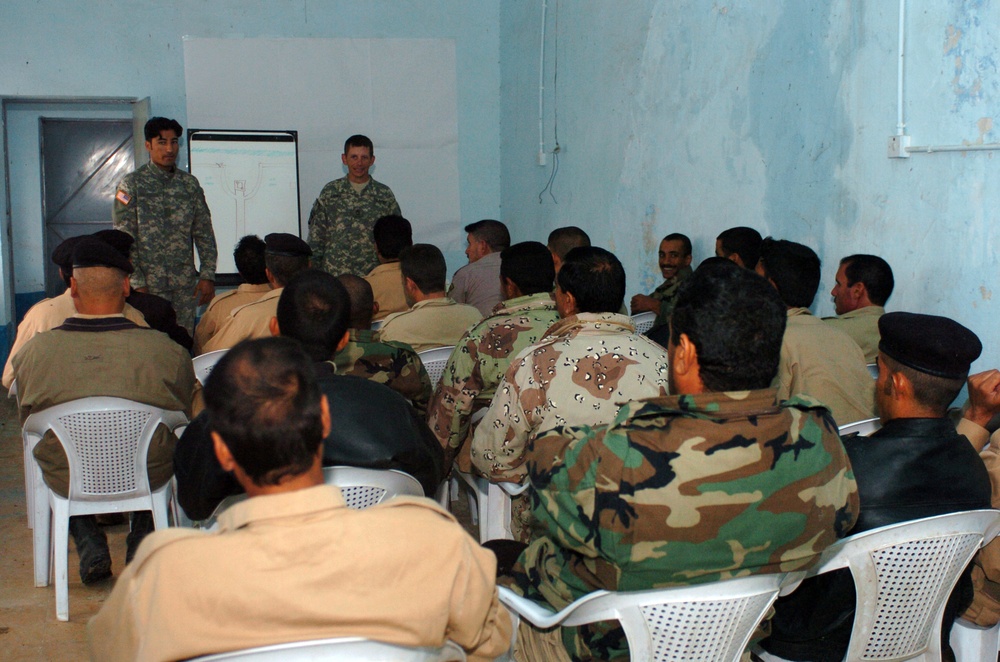
This advisory team, the Thundercats, conduct most of their training at an academy near Rabiyah. The academy is located in a border fort along the 72 kilometers of border currently guarded by 3rd Squadron, 4th U.S. Cavalry from Schofield Barracks, Hawaii.
The academy was developed and funded by the BTT with recommendations from the 1st Battalion, Iraqi Border Police, according to Tomlin.
He said the purpose of this training is to increase the proficiency of the Iraqi battalion's junior leaders by developing their mission-essential tasks and their leadership skills.
The goal is to develop a security plan that the 1st Battalion, IBP will be able to execute without assistance, he added.
Team members agreed that while training with the IBP, they had to "practice patience."
Sergeant First Class Michael Eames, maneuvers advisor, stated that the language barrier and long hours cause frustration, but it is rewarding to witness the professional growth of the Iraqis.
Unlike in the U.S. military, in which noncommissioned officers are taught to be leaders, mentors and perform their duties in the absence of orders, Iraqi enlisted soldiers were taught to only act on orders and were not encouraged to take initiative. Developing a strong NCO corps was a priority for the team, Tomlin said.
For them, leadership is learned by observation.
"They pick up on a lot of non-verbal [cues] such as leading by example," Eames said.
But leadership is only one of many courses taught at the academy.
Class content was developed from weaknesses identified by both the BTT and 1st Battalion, IBP. These classes included NCO leadership fundamentals, weapons and vehicle maintenance, driver training and other necessary skills.
During communications training, IBP used their own equipment and practiced using call signs.
Some of the other classes covered were basic supply and accountability, border fort defense, detainee operations, and first aid.
Eames said it was interesting to work in an environment with such a diverse mix of Kurdish, Sunni, and Shia, because they all brought different aspects to the classroom and a range of experience to practical exercises.
The course is scheduled to last 20 days and the academy's first graduation occurred in late October.
For the first cycle, all of the primary instructors were Thundercats and assistant instructors were from Troop A, 3-4 Cavalry Regiment.
However, 1st Battalion, IBP leaders understand the BTT is a transition team. Just like any school in the military, the graduates of this class will pass on the torch of knowledge to others in the IBP. The next class will be taught by a few graduates from the first cycle and by members of the Thundercats.
For the following class, all of the primary instructors will be graduates from the 1st Battalion, IBP. The BTT members will only monitor the training.
The academy reflects President Bush's and the Pentagon's vision of the military's long-term role in Iraq, where U.S. BTTs act as advisors for local forces that will be doing the actual fighting.
Military Transition Teams here started on an ad-hoc basis. In 2004, 1st Cavalry Division commander, then Maj. Gen. Peter W. Chiarelli, created 70 small teams who "lived, ate and trained with the Iraqi Army."
Later that year, Maj. Gen. John Batiste, commander of the 1st Infantry Division, took the same approach in the Sunni Triangle north of Baghdad. The program was eventually expanded to include the entire country, as well as police and border patrol units. Now, there are thousands of MiTTs, BTTs and Police Transition Teams training, organizing and accompanying Iraqi units into action against insurgents and terrorists.
The work of the advisory teams is gaining more support by leaders in Iraq as they re-evaluate tactics and procedures used on the borders and consider the rising number of U.S. casualties. The success of the transition teams will be crucial to securing the country and bringing stability to the people of Iraq.
| Date Taken: |
10.26.2006 |
| Date Posted: |
11.13.2006 14:09 |
| Story ID: |
8253 |
| Location: |
RABIYA, IQ |
| Web Views: |
186 |
| Downloads: |
86 |
PUBLIC DOMAIN

This work, Border Transition Teams not new concept to U.S. military, by Samantha Treadway, identified by DVIDS, must comply with the restrictions shown on https://www.dvidshub.net/about/copyright.

 Subscribe





