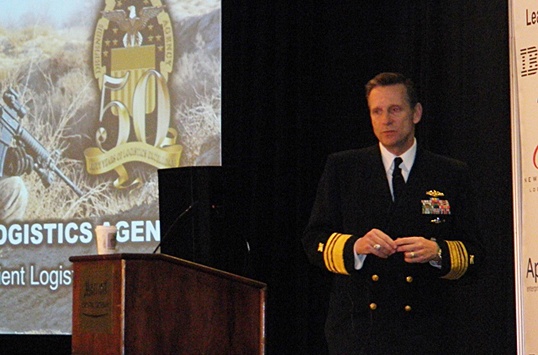
FORT BELVOIR, Va. - Effectiveness and efficiency have played an important role in the Defense Logistics Agency’s success and will be significant in the agency’s future support to the military services, DLA Director Navy Vice Adm. Mark Harnitchek said during a keynote address at the 2011 Defense Logistics Conference Nov. 30 in Arlington, Va.
“At DLA, day in and day out, we’re all about meeting the warfighter’s requirements. That’s the effective part. But, we’re also very mindful of how much that effectiveness costs, so if we can do it at a lesser cost, that’s exactly what we’re going to do,” Harnitchek told the audience of more than 400 military and industry logisticians.
As budget pressure increases in coming years, the agency will have to adjust, providing more efficient support while holding effectiveness constant, he said.
In fiscal 2011, DLA completed implementation of the 113 actions mandated by the 2005 Base Realignment and Closure legislation, which expanded the agency’s mission and support to the military services, he said.
“As a result of BRAC, DLA took custody of most of the inventory at service industrial sites; we got the people who manage that inventory and the folks who do the warehouse function,” Harnitchek said. “The notion was to get a single owner of the inventory and distribution function and then optimize it across the whole enterprise.”
The agency also assumed responsibility for service-managed depot-level reparables, which are parts that can be repaired or reused through their usable life, like transmissions and vehicle engines. The focus of this BRAC action was to leverage the agency’s collective buying power for reparables, saving the military services money and time on service and delivery, Harnitchek said.
“As with any BRAC, as you’re transferring either activities or functions, there are some growing pains, but we’re working through those and we’re looking forward to doing great things in the future in support of services,” he said.
The agency also continues to successfully support the force drawdown in Iraq and sustainment efforts in Afghanistan, Harnitchek said.
“The big thing for DLA in Iraq was making sure that when we were closing all the forward operating bases, that from a distribution and disposal perspective we left them as pristine as they were when we took them,” Harnitchek said. “If you’ve ever been to Iraq you know that with all the [supplies and equipment] there, that was a gargantuan undertaking. We processed 300 million pounds of scrap, returned about $100 million worth of items back to the services, and either reutilized, sold, donated or demilitarized and disposed of $27 billion worth of stuff.”
In Afghanistan, fuel and subsistence are DLA’s big commodity items, presenting unique logistics challenges for the agency, Harnitchek said. The agency uses the Northern Distribution Network, a system of rail and truck routes running through various countries in Europe and Central Asia, to transport fuel and subsistence support by ground to forces in Afghanistan.
“Afghanistan is probably one of the toughest places to get large volumes of stuff into,” he said.
“From a DLA perspective, our two big commodities—in fact, mostly everything that goes into Afghanistan—travels in a commercial network, and we rely exclusively on private industry to deliver our supply chains—food and fuel—to the customer, so we really have to watch those supply chains,” Harnitchek said.
Prior to assuming responsibility as director of DLA, Harnitchek served as deputy commander of U.S. Transportation Command, where the majority of his day was devoted to U.S. Central Command support, he said.
“After a couple days at DLA, my sense is it will be largely the same thing,” he said.
Speaking candidly about impending decreases in the nation’s defense budget, Harnitchek reiterated a challenge issued to industry partners by former DLA Director retired Vice Adm. Alan Thompson to reduce their prices and help DLA and the services reach their cost-saving goals.
“I know that’s hard, but that’s the challenge,” Harnitchek said. “The expectation is that [the items DLA purchases] from you will cost less and break less often. And if you’re in the repair business, [you should] think about having a repair turnaround time that’s one month long versus six months long, because the investment that DLA has to make for services that cover a six-month repair are a whole lot more than for a one-month repair.”
In fiscal 2011, DLA experienced a record-high $46 billion in sales, but the agency and its stakeholders in industry have to consider what will happen if that number is significantly less in coming years and be prepared to make adjustments in the way they do business, Harnitchek said.
“The agency is looking at ways to implement a more effective and efficient global storage and distribution network, and I think there’s a lot of money to be made there in terms of what we buy, where we store it and how we resupply it,” Harnitchek said. “Working with TRANSCOM, I think we’re on the leading edge of doing some great things there.”
The agency also continues to enhance information technology capabilities to improve supply planning and forecasting and procurement execution, Harnitchek said.
“When DLA initially implemented its enterprise resource planning solutions, one of the promises of ERP was to boost our success rate in forecasting. Also, something we didn’t do initially was the procurement piece [of ERP]. That is now well underway, and once both the procurement and the inventory management pieces are complete, we’ll be able to use the same systems and have visibility of what we’re doing across the enterprise. We’ll be able to do the 2005 post-BRAC inventory optimization,” Harnitchek said.
Moving into 2012 and beyond, the agency will continue to provide effective, efficient support to the military services and combatant commands, also lending aid to “pop-up contingencies” like those in Haiti, Libya and Japan as it did in 2011, he said.
“When I was coming up, DLA wasn’t operating in a true combat support role,” Harnitchek said. “They were largely about managing inventory and running disposal, which they still do. But since 9/11, they are forward almost like a functional combatant command, doing stuff in a no-kidding combat support role, operating all over the world.
“As a 35-year customer of DLA, I can tell you, DLA is a much different outfit today,” Harnitchek said.
| Date Taken: |
11.30.2011 |
| Date Posted: |
12.07.2011 11:28 |
| Story ID: |
81010 |
| Location: |
FORT BELVOIR, VIRGINIA, US |
| Web Views: |
49 |
| Downloads: |
0 |
PUBLIC DOMAIN

This work, Director outlines 2011 accomplishments, challenges to future support, by Monique Randolph, identified by DVIDS, must comply with the restrictions shown on https://www.dvidshub.net/about/copyright.

 Subscribe





