Spc. Lee Elder
133rd Mobile Public Affairs Detachment
BALAD, Iraq (March 29, 2006) - Work is progressing on three water treatment plant construction projects in Diyala Province under the watchful eye of Army Reserve Soldiers.
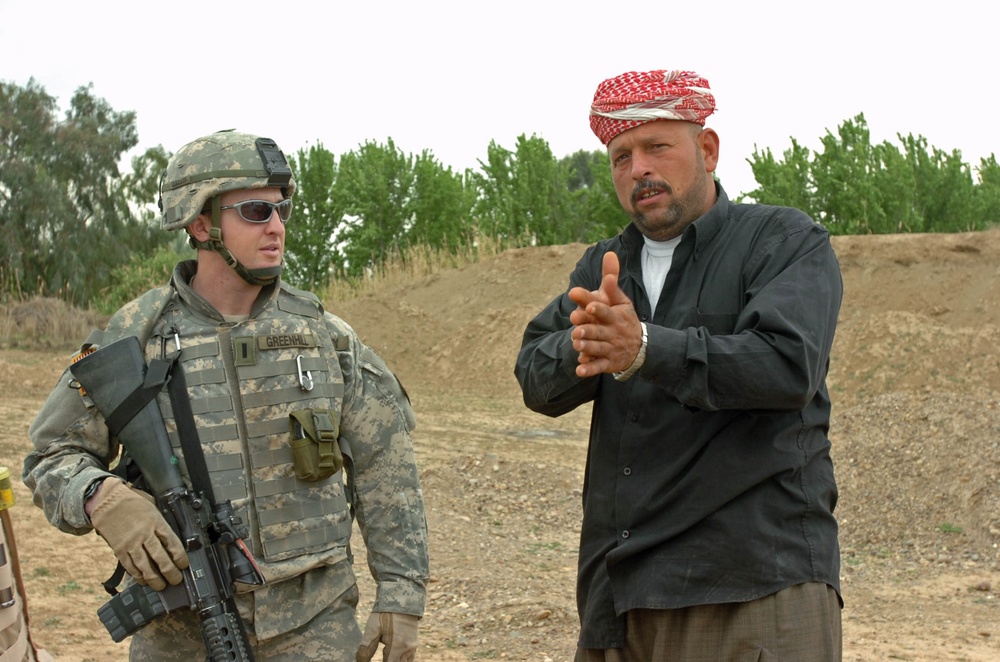
Members of Company C, 445th Civil Affairs Battalion, surveyed three construction sites recently. They checked on the progress of the construction and worked to pay vendors tasked with building the facilities.
The progress comes none too soon for many of the residents of this northern Iraqi province. Some have never had drinking water available to their homes said Spc. Vilhelm Heerup, a civil affairs specialist with Company C.
"Under Saddam, they had a few large-scale water treatment plants and several smaller ones that were usually privately built and operated," Heerup said. "They were funded by residents in the rich communities."
While some Iraqis used nearby rivers or canals, others relied on old wells and even captured rain water.
Heerup said the quality of drinking water was "pretty bad" when his unit arrived nine months ago. This leaves many Iraqis susceptible to water-borne diseases.
"For the most part, they pumped the water or used buckets to carry the water straight from the Tigris River or the irrigation canals they use on the farms," Heerup said. "It's the same water they use for bathing, for washing dishes and clothes for drinking and cooking."
That is beginning to change. As the security situation in Balad stabilizes, the water treatment plant projects are starting to come on line. Making sure they are completed and fully operational is one of the unit's big priorities.
"Since we got here, we've been able to repair the broken ones and been able to build many new ones," Heerup said. "Slowly, we are getting clean water to all the people."
It's a welcome development for Balad residents. They are anxiously awaiting the projects" completion said one local official.
"The people are very thankful for this water plant," said Maytham Abass, one of the operators of the Al Hussein Water Plant in Balad. "They have never had clean drinking water.
"Now, they have a source of clean drinking water."
The plants pump water from rivers or canals. After it is purified, it is pumped out to homes and other buildings.
While the plant in Balad is up and running, the plant in the nearby village of Mizzeara is still under construction. When completed, it will serve about 10,000 households.
"The U.S. helps the people a lot," said the project's chief engineer, Salim Khalaf Dawood. "The people want this plant to be finished.
"They all want clean drinking water."
Coalition forces pay for construction costs and use local Iraqi engineers and construction workers. They are paid in increments as their work is completed. Normally, payments are paid as the projects reach the 25-, 50- and 100-percent mark.
The efforts to build or repair water treatment plants go hand in hand with ongoing projects to provide basic infrastructure to the people of Iraq. Many of them still lack power, roads and nearby schools.
usar

 Subscribe






