
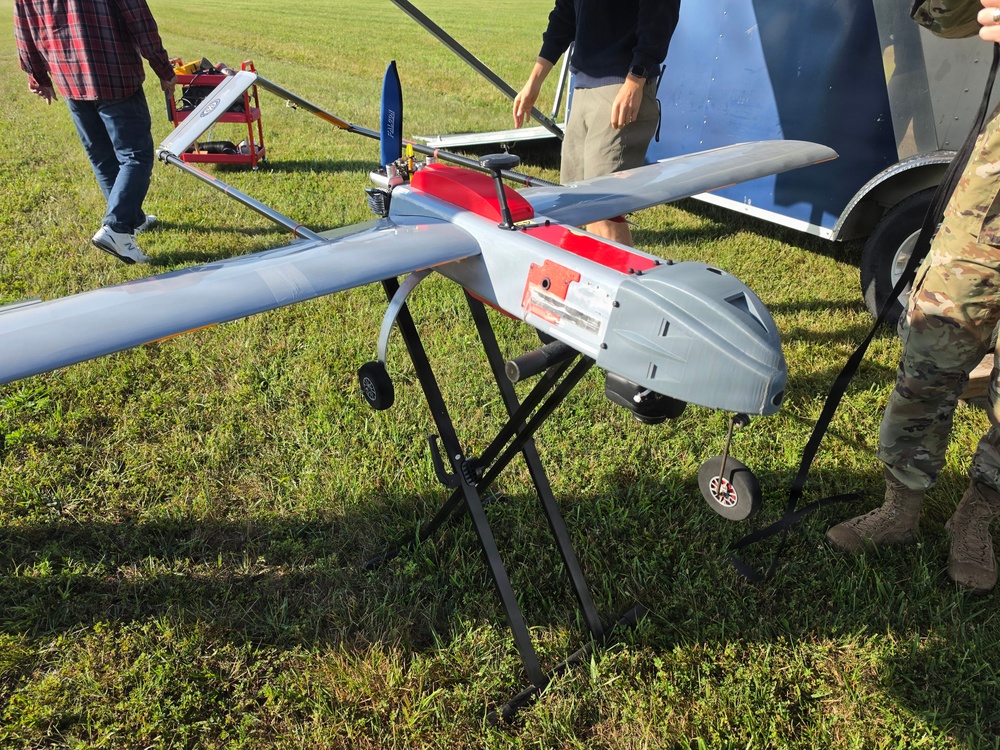
Photo By Katheryn Jennings | AFIT researchers are exploring how small unmanned aircraft systems could help Airmen...... read more read more
 Subscribe
The Air Force Institute of Technology is confronting a high-stakes reality: Airmen Engineers operate in harm’s way working to recover damaged airfields. They confront this task often without a clear picture of the hazards present, creating higher operational risks and slowing the Air Force's ability to regenerate combat power.The Air ForceCivil Engineer community has spent more than a decade building toward a solution, and AFIT researchers are now working to close the gaps that remain with rigorous academic and technical research.
Unexploded ordnance, possible chemical or biological contamination, cratered pavement and debris are all hazards that Airmen Engineers must be prepared for while recovering airfields after an attack. For that reason, AFIT researchers are looking beyond traditional post-attack assessment methods to speed up recovery and safeguard Airmen.
Small unmanned aircraft systems may be part of the answer AFIT is working toward. A team of Civil Engineer graduate students, backed by faculty in developmental and digital systems engineering, is building on more than a decade of Civil Engineer investment in sUAS-based airfield reconnaissance. This cohort has added rigorous graduate-level research and, notably, a fixed-wing component alongside multirotor systems.
“This effort supports the Air Force’s need to rapidly open, operate, and recover airbases in contested environments,” said Capt. Ross C. Jurek, a Graduate Engineering Management student at AFIT leading much of the research. sUAS, he said, can help Airmen quickly map unfamiliar locations, assess runways and routes, identify hazards, and build situational awareness before committing personnel and equipment. This is a direct enhancement of the Integrated Base Response and Recovery and Rapid Airfield Damage Repair capabilities that underpin the Air Force’s approach to post-attack recovery.
Today, situational awareness of airfield hazards is largely generated from eyes-on assessment and communicated over the radio. An Airman on the ground describes what they see, and command and control pieces together a complete picture from a string of verbal reports. It works but can oftentimes be slow or incomplete.
“The biggest impact is safer Airmen and faster, higher-quality information,”Jurek said. “A picture really is worth a thousand words.”
AFIT’s research splits the challenge into two distinct yet complementary pieces. A multirotor aircraft, which is the focus of Jurek’s graduate research, can launch from almost anywhere, hover, change angle, and pick its way through the confined, unpredictable routes that Damage Assessment and Response Teams would otherwise have to physically enter first.
A fixed-wing aircraft, the subject of a parallel developmental engineering project Jurek is running with Capts. Peter Stobinski, Nicholas Rife, and Spencer Peters, trades that maneuverability for endurance and reach, sweeping runways, taxiways, and parking aprons for craters, spalls, and debris across much larger operating areas.
Each capability works in concert with one another to provide the Airmen with relevant hazard information at the speed and level of detail required. Together, they could serve as a layered reconnaissance capability with one platform providing broad-area coverage while the other performs detailed inspection in confined or hazardous areas, ultimately enhancing leadership’s decision space.
“The goal is to put the sensor into the uncertain environment first and get the best possible information to the decision-maker as quickly as possible,” Jurek said.
“Efforts such as this enable Agile Combat Employment by accounting for and exploring solutions to an inevitable circumstance in a combat environment,” said Capt. Nicholas Rife, a Systems Engineering student on the fixed-wing team. The project, he said, is meant “to leverage technical solutions that can be both effective and expedient while putting greater distance between the Civil Engineer Airman and the threat at hand.”
Jurek’s thesis, advised by Lt. Col. Daniel Weeks, is built to test that premise rather than assume it. It measures sUAS-supporter reconnaissance against conventional DART routes on three criteria—speed, accuracy, and safety—and evaluates the whole process, not just the aircraft: mission planning, flight execution, camera coverage, imagery collection, and the time it takes an analyst to turn footage into a usable hazard picture. If an aerial first-look cannot get accurate information to Civil Engineer leaders faster than the current DART methods, the case for fielding it falls apart.
AFIT treats the drone as one piece of a larger system rather than a standalone asset. The coursework and thesis process pushes students to trace an operational problem from concept, through requirements, into design and testing, and on toward fielding, accounting for the sensor, communications link, software, training pipeline, approvals, and the operator alongside the aircraft itself.
“Speed, precision, and usability are key to this effort,” Rife said. “By approaching this effort from a digital-engineering perspective, we can systematically root out technological anomalies to develop a reliable and usable system that can deploy at the speed of relevance.”
The ongoing research is helping AFIT build both operational experience and technical understanding as the Air Force continues evaluating how sUAS may support future operations. The objective behind the effort remains clear: give commanders a decisive information advantage over a damaged airfield, reduce the time it takes to get combat aircraft back in the air, and help Airmen Engineers restore combat capability more safely and effectively in contested environments. In short, the goal is to outpace the threat.
| Date Taken: | 09.17.2026 |
| Date Posted: | 09.17.2026 09:49 |
| Story ID: | 574968 |
| Location: | US |
| Web Views: | 28 |
| Downloads: | 0 |

This work, Eyes on the Airfield: AFIT sUAS Research Aims to Accelerate Combat Recovery, by Katheryn Jennings, identified by DVIDS, must comply with the restrictions shown on https://www.dvidshub.net/about/copyright.


No keywords found.




