
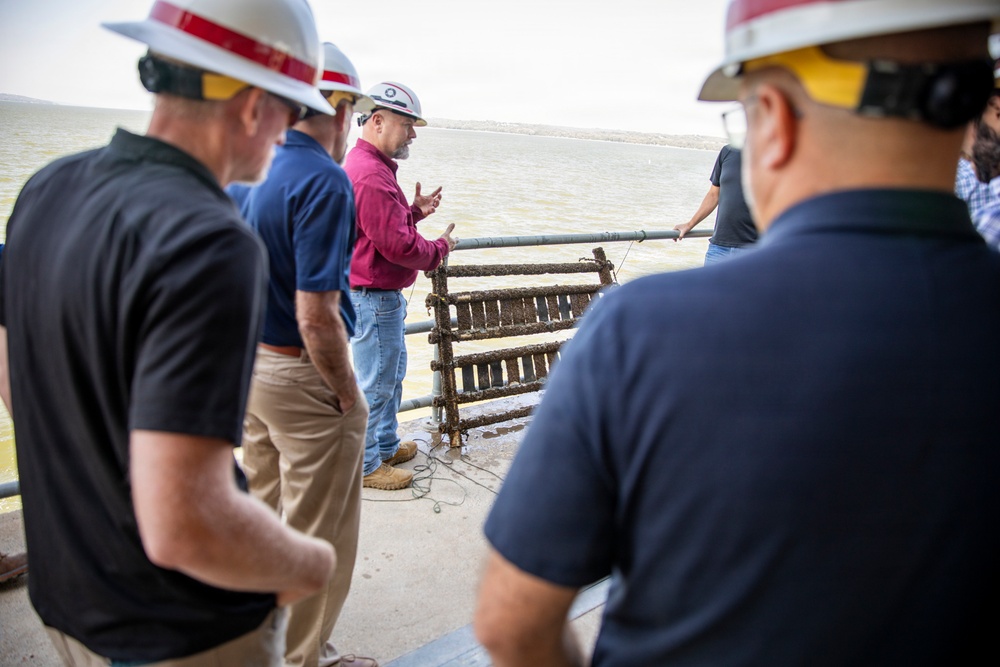
Photo By Lisa Crawford | Eric Johnson, Gavins Point Dam assistant power plant superintendent and maintenance...... read more read more
A dozen U.S. Army Corps of Engineers, Walla Walla District operations managers traveled to the corner of Nebraska and South Dakota to visit the Gavins Point Dam, Aug. 25-26, 2026, to collaborate and network with counterparts from the Omaha District as part of their quarterly operations management meeting.
The two districts compared different strategies for managing a variety of operational, maintenance and personnel tasks, including an in-depth discussion on the challenges of and methods used to combat against invasive zebra mussels.
Paul Ocker, chief, Walla Walla District Operations Division, said the training was an opportunity to get all the project managers together, learn new things, explore best practices and ultimately have the ability to phone a friend if you need one.
“I’ve worked for five federal agencies and with the Corps, someone always has an answer,” Ocker said. “In operations we do something every second of every day for the American public. Being able to call a friend when you need one is invaluable.”
The meeting kicked off with introductions by each attendee and summaries of the projects they manage, including the Omaha District’s six Missouri River mainstem dam projects, and Walla Walla District’s five lock and dam sites located on the Snake and Columbia rivers and four other projects.
Each participant shared what they enjoyed most about their favorite project with many emphasizing the people and teams they work with, and the variety of missions.
“What the Corps does is so diverse,” said Jamie Howard, operations project manager for the Lower Granite Dam, Walla Walla District. “We have so many missions that intertwine and overlap.”
Howard said she found Gavins Point to be a beautiful dam operated by great people, and she enjoyed seeing both similarities and differences.
“It’s been nice to see another part of the same division,” she said. “The programs are the same, but the processes are different. I’ve taken a lot of pictures and notes, and I’m taking it all back to share with my newer leadership team.”
Chad Rhynard, Walla Walla District’s chief of technical support, agreed visiting Gavins Point was time well spent. Rhynard speaks with his Omaha District counterpart, Ken Stratton, regularly, but said it was nice to overcome some of the difficulties created by the geographical divide of the division to now contextualize everything Stratton has mentioned before.
“This helped us break down some of those barriers,” Rhynard said. “It was nice to come together in a place where we could collaborate in person, to see the zebra mussels and learn firsthand while getting to know people that are in our business who have similar challenges and can share best practices.”
Some of those best practices included how the Omaha District has been battling zebra mussels infestations since they first appeared at Gavins Point in late 2015. The invasive species continues to present a significant maintenance challenge for dams and other industries along the Missouri River.
Eric Johnson, Gavins Point Dam maintenance and operations manager and assistant powerplant superintendent, described the invasive species as one of the powerhouse’s biggest challenges.
“Zebra mussels are the toughest thing right now,” Johnson said. “It’s the biggest problem we have here at the powerhouse and has been for over a decade.”
The scale of the buildup became especially apparent during recent work on intake gates, where Gavins Point Project crews removed more than 75,000 pounds of zebra mussels from three intake gates Aug. 3-5. While a clean gate weighs approximately 88,000 pounds, three gates recently cleaned by crews averaged about 113,000 pounds each.
Johnson emphasized that the impacts extend beyond Gavins Point Dam. Zebra mussels are established in reservoirs and waterways throughout the region, affecting systems used for cooling, water treatment and other critical water infrastructure.
Ocker said it’s likely only a matter of time before their district will need to combat against this invasive species, which is why he suggested his team make the trek to the Omaha District to see firsthand the methods being used to keep the powerhouse and dam from being inundated by these unwanted organisms.
During a tour, the Walla Walla District crew was able to view the zebra mussels up close, and see the infrastructure in place at Gavins Point to fight against them, including an ultraviolet light system and a molluscicide drip system. While research continues to find better ways to eradicate the mollusks and keep them from building up on the intake gates, the current methods have helped with internal powerhouse systems, by limiting the numbers that attach, grow, and stay within the raw water system’s pipes and coolers.
Gavins Point managers also shared how maintenance and prevention against zebra mussels comes with increased operating costs and require a significant amount of time and labor. Preventing the spread remains an important part of the response, as zebra mussels can be transported between reservoirs on boats and recreational equipment.
Johnson suggests education can be key to slowing the spread, and encourages boaters to thoroughly clean their boats, live wells and equipment and follow aquatic invasive species prevention guidelines before entering another body of water.
“This is step one in our planning process, coming here and listening to you guys,” Ocker said to the Omaha District during the operations meeting. “We’re here to start thinking about it. And if everyone on our team takes away one thing from this, it was worth it.”
Walla Walla District plans to reciprocate the meeting in the future, inviting the Omaha District operations team to the Pacific Northwest to view their locks and dams, and collaborate further.
(Delanie Stafford contributed to this article)
| Date Taken: | 09.09.2026 |
| Date Posted: | 09.14.2026 15:16 |
| Story ID: | 574641 |
| Location: | YANKTON, SOUTH DAKOTA, US |
| Web Views: | 20 |
| Downloads: | 0 |

This work, Walla Walla District visits Gavins Point for operations collaboration, zebra mussel education, by Lisa Crawford, identified by DVIDS, must comply with the restrictions shown on https://www.dvidshub.net/about/copyright.


No keywords found.





