
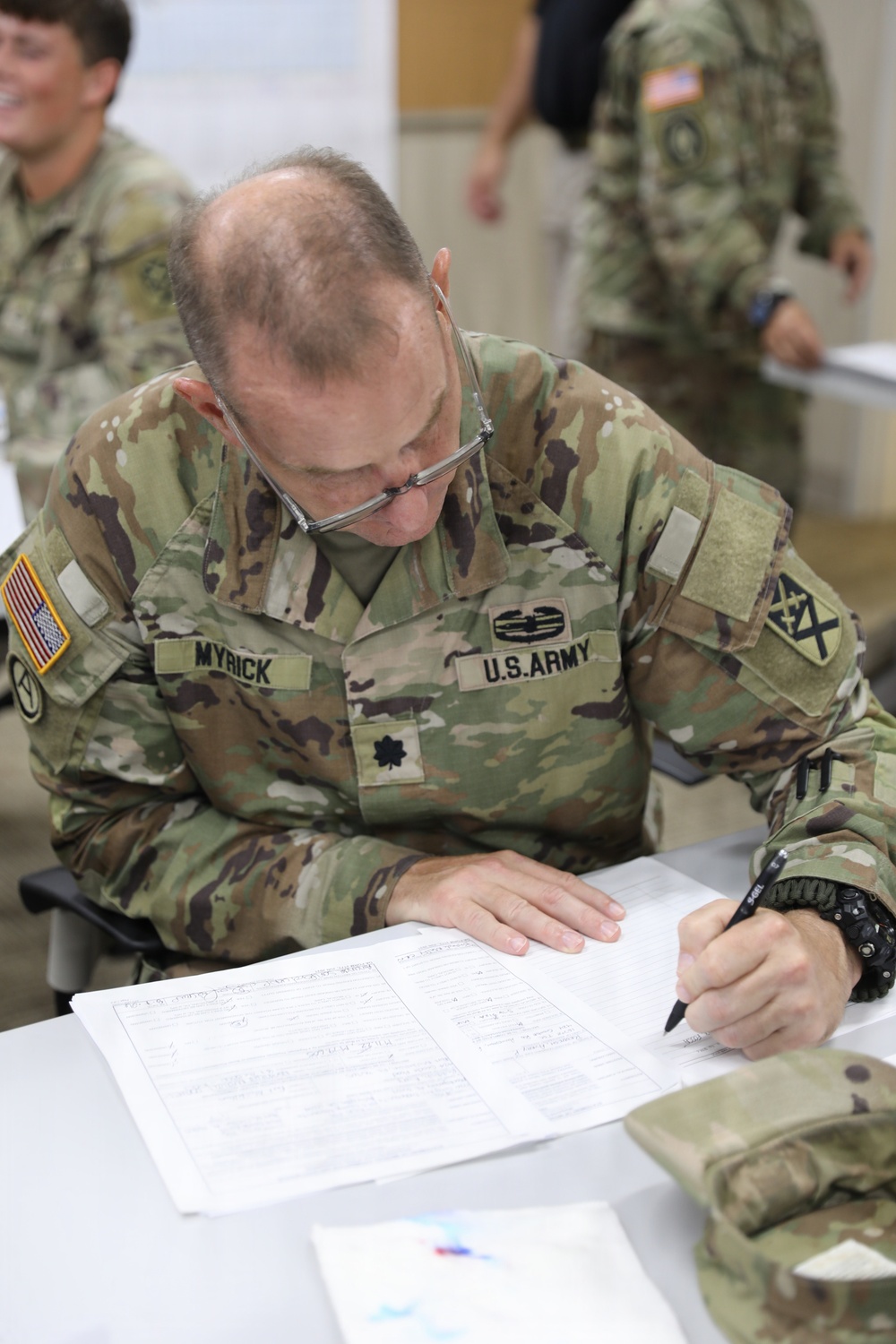
Photo By Sgt. 1st Class Katherine Dowd | Lt. Col. Gregory Myrick, surgeon, 167th Theater Sustainment Command, works to develop...... read more read more
FORT MCCLELLAN, Ala. — Soldiers of the 167th Theater Sustainment Command participated in a Wide Area Search (PER-213) course Aug 6-8. This course is a Department of Homeland Security (DHS) / Federal Emergency Management Agency (FEMA) grant funded course provided by Texas A&M Engineering Extension Service (TEEX). Soldiers gained skills designed to help military and civilian responders organize search operations and manage information during large-scale disasters.
While the course is titled Wide Area Search, the training extends beyond physically searching for victims. The heart of the instruction lies in guiding participants to quickly manage and sort through large amounts of information while effectively coordinating resources. The goal is to turn raw data into actionable decisions during a complex disaster.
Glenn Palmer, TEEX adjunct faculty, said the course is designed as a management and planning class for personnel who could be involved in responding to a large-scale disaster. “We teach all agencies—military, police, fire, sheriffs, emergency operations, physicians, nurses, anybody that could be involved,” Palmer said. “Even city managers and city planners.”
The Alabama Army National Guard often works alongside federal, state, and local agencies during domestic emergency response missions. Familiarity with FEMA planning methods, terminology, and resource coordination helps Soldiers work effectively with their counterparts during these missions. A common understanding of processes among responding organizations improves communication and reduces duplication of effort. Clarity helps ensure the right resources are coordinated and employed where they are needed most.
“Whatever the disaster is, there’s a chance of an unknown number of victims and the likelihood that local resources are overwhelmed,” said Joe Palfini, an adjunct instructor for the course. “You’ll know that you need to have a variety of different types of resources to accomplish the search mission.”
Providing this course to a variety of agencies is beneficial because it allows for an established standard for all resource teams, regardless of affiliation. Set standards lead to clear communication.
“What we teach in this class gets everybody on the same page as far as language, process, procedure, the way we mark things – such as building markings when you search a building,” said Palmer.
Spc. Logan Whitehead, an intelligence analyst with the 167th TSC, said the emphasis on standardization was particularly useful. “Standardized symbology makes sure that everybody’s always on the same page. You can bring organizations from anywhere into one space and they can communicate effectively. It allows the mission to move faster, even with groups of responders from anywhere in the country.”
That process was reinforced through practical training. After working through management and planning scenarios, the Soldiers transitioned to field operations, putting their plans and strategies into practice. Palmer said the progression was intentional. “We start with management, move to boots on ground, then wrap up with large-scale disaster planning so they can see how it all comes together.”
Covering all aspects of how to plan, manage and conduct search operations also allows for the participants to be able to train others in an emergency situation.
“The biggest thing I got through this FEMA course was learning how to quickly pass information to other people who may not be experienced in the process,” said Whitehead. “That would allow teams to be trained up in a short amount of time so we could all operate together.”
The result is not simply a group of Soldiers trained to search an area, but Soldiers better prepared to help organize the information, people and resources required to respond when a disaster exceeds the capacity of local responders.
| Date Taken: | 08.09.2026 |
| Date Posted: | 09.12.2026 12:26 |
| Story ID: | 574524 |
| Location: | ANNISTON, ALABAMA, US |
| Web Views: | 13 |
| Downloads: | 0 |

This work, Alabama Army National Guard Soldiers Enhance Readiness with FEMA Training, by SFC Katherine Dowd, identified by DVIDS, must comply with the restrictions shown on https://www.dvidshub.net/about/copyright.


No keywords found.





