
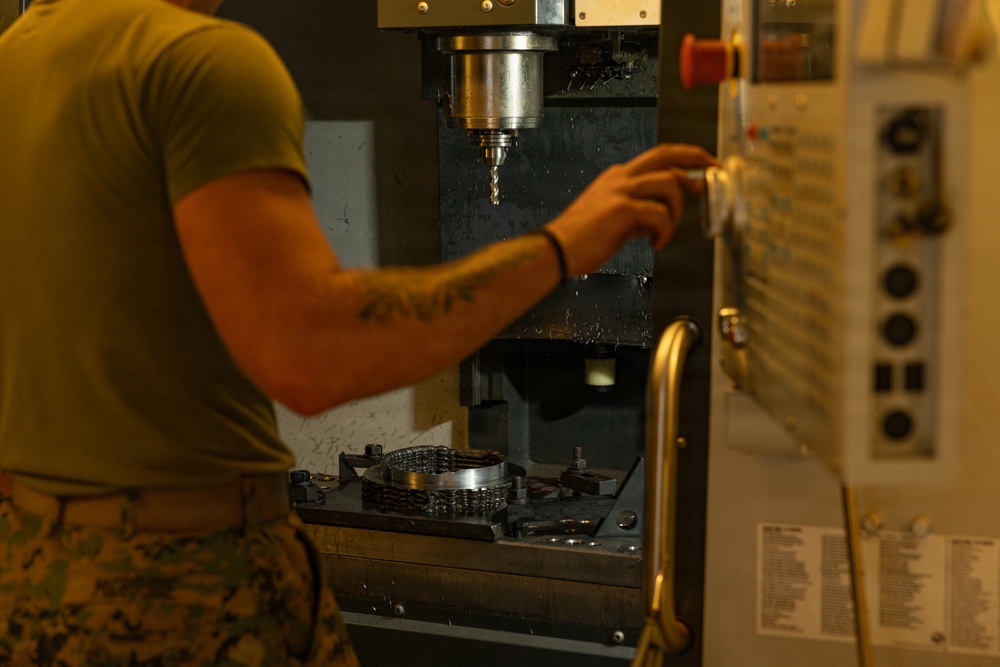
Photo By Sgt. Desiree Ruiz | A U.S. Marine with 1st Maintenance Battalion, 1st Combat Readiness Regiment, 1st...... read more read more
 Subscribe
CAMP PENDLETON, Calif. -- The speed of modern warfare leaves no room for lag between technological innovation and tactical execution. Demonstrating this concept, Marines and Sailors with 1st Maintenance Battalion, 1st Combat Readiness Regiment, 1st Marine Logistics Group, conducted Exercise PHOENIX FEX 2-26 from Aug. 17 -26, 2026 on Marine Corps Base Camp Pendleton, California.
By integrating advanced manufacturing and forward-thinking logistics into a rigorous field environment, the battalion operationalized a blueprint for sustaining combat-credible forces against modern pacing threats.
“The ability to organically manufacture new warfighting capabilities in an expeditionary environment is not a future concept; it is our reality, and we are executing it now,” said U.S. Marine Corps Lt. Col. Zachary Pagan, commanding officer of 1st Maintenance Battalion. “We approached this exercise as a full mission rehearsal against a peer adversary. We approached it as if it were our last opportunity to prepare for conflict, because it very well may be.”
The battalion designed a training environment that compelled Marines to operate under persistent adversary intelligence, surveillance, and reconnaissance; degraded communications; and simulated chemical, biological, radiological, and nuclear conditions.
Marines and Sailors quickly adapted and learned to conceal and mask operations for survivability. The unit sustained a strict combat mindset through live-fire ranges, Tactical Combat Casualty Care, and advanced field craft to reinforce that every logistician must remain a warfighter first.
A critical component of the exercise was demonstrating how the Marine Corps can rapidly integrate commercial-off-the-shelf technology to solve tactical problems. Working alongside industry partners like Phillips Federal who provided the advanced hardware, Marines provided the tactical labor to fabricate, produce, and employ small unmanned aerial systems, counter-UAS interceptor drones, and electric dirt bikes for low-signature mobility.
Operating from subterranean facilities, Marines managed self-contained, deployable 3D print farms capable of generating 10 drones per day, while concurrently launching interceptor drones to thwart simulated adversary attacks. These print farms were exercised on 24-hour operations to measure production limitations, demonstrating a potential output of over 1,400 drones a month.
The employment of emerging technology extended to the integration of Artificial Intelligence into supply chain management. By pairing a custom-built proprietary AI platform designed by TAGUP, the battalion’s Reparable Issue Point utilized enterprise data to predict optimal maintenance strategies for secondary reparables. Supply Marines queried embedded Large Language Models to navigate the defense industrial base and source critical repair parts in real time.
Beyond experimentation, the battalion remained focused on its core mission of sustaining the I Marine Expeditionary Force. The battalion generated and deployed over nine Maintenance Support Teams to MEF and TECOM units across Camp Pendleton. In total, 84 maintenance technicians performed more than 4,500 labor hours, repairing over 25 critical equipment items. Prepositioned repair part blocks were delivered via Landing Craft, Air Cushion amphibious connectors to facilitate forward intermediate level equipment repairs in multiple training areas. The flexible and responsive logistics architecture the battalion developed enabled same day repairs and provided supported commands with immediate gains in materiel readiness.
The Marines also spearheaded the repair of Amphibious Combat Vehicle components, by rebuilding unserviceable brake calipers and wheel end assemblies, they returned parts to a like-new condition, generating cost savings of over $20,000 per unit. Over the course of 12 training days, the Marines produced enough brake calipers to restore 60 ACVs to fully operational status. Furthermore, fabrication Marines utilized the newly fielded Advanced Integrated Mobile Machine Shop to machine high-grade tool steel into ACV tool kits that are currently unavailable in the supply system.
Looking toward the requirements of distributed maritime operations, the exercise simulated the need to task-organize multifunctional maintenance capabilities across a contested island chain. Exercise injections drove staff planning and the deployment of an Intermediate Maintenance Company to a secondary location.
Senior leaders were forced to execute maintenance control procedures across unfamiliar weapon system platforms. This dynamic environment provided unique cross-training opportunities, ensuring Marines are prepared for the uncertainty of future equipment platforms and operating environments.
“Our responsibility as leaders is to cultivate realistic training environments that accelerate our Marines’ decision-making and solidify their trust in their equipment and each other,” said 1st. Sgt. Julian Billmair, the acting 1st Maintenance Battalion Sergeant Major. “Adversity builds character and strengthens resiliency. These Marines and Sailors have proven themselves to be ready to support the demands of I MEF with innovation and resolve.”
The establishment of multiple combat service support areas and lines of communication across land and sea enabled the battalion to effectively employ its capacity across the rear, main, and forward areas of the battlespace. Every tactical movement and hybrid capability developed were meticulously captured in embarkation systems, preparing the unit for rapid, no-notice future deployments.
Ultimately, 1st Maintenance Battalion is committed to elevating the readiness of the entire Marine Corps by proving what is possible at the tactical edge today as stated by Pagan, who motivated his unit at the kickoff of the exercise.
“Innovate, dig in, build grit and resiliency, and move the needle on readiness,” he exclaimed.
-30-
| Date Taken: | 08.28.2026 |
| Date Posted: | 09.10.2026 14:41 |
| Story ID: | 574326 |
| Location: | MARINE CORPS BASE CAMP PENDLETON, CALIFORNIA, US |
| Web Views: | 32 |
| Downloads: | 0 |

This work, Sustaining Readiness in The Field: Marines with 1st Maintenance Battalion execute FEX, must comply with the restrictions shown on https://www.dvidshub.net/about/copyright.


No keywords found.




