
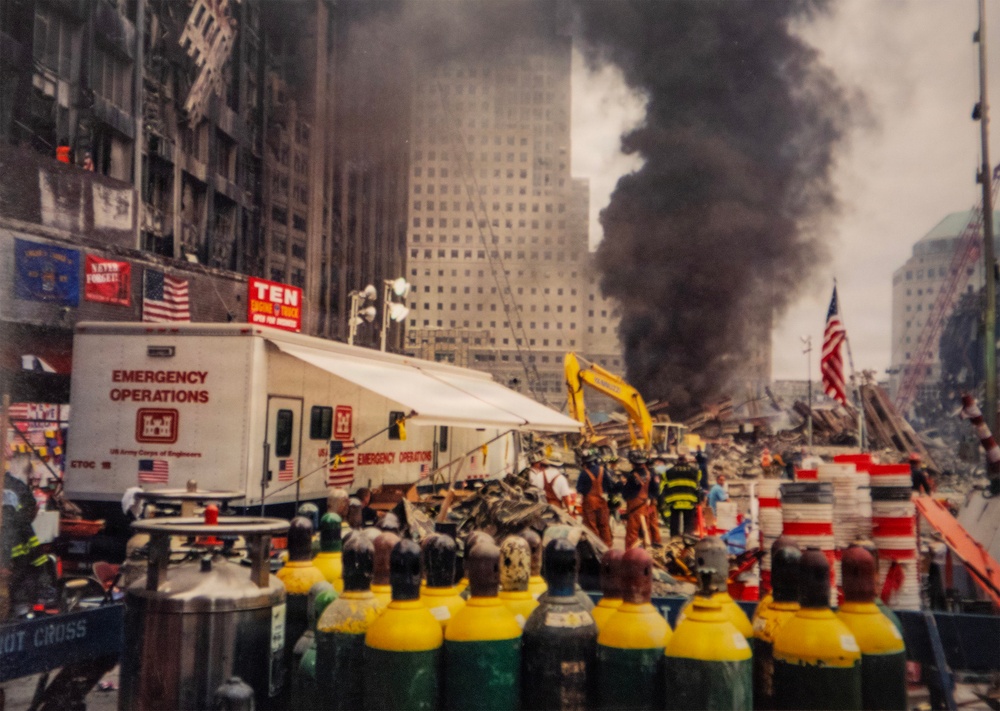
Courtesy Photo | A U.S. Army Corps of Engineers emergency operations trailer is seen near the site of...... read more read more
OMAHA, Neb. – Twenty-five years ago today, seven U.S. Army Corps of Engineers, Omaha District employees found themselves in a dusty, somber New York City, viewing the aftermath of the terrorist attacks of Sept. 11, 2001.
The following accounts are from Richard Rappe and Sue Blair who both deployed to Ground Zero shortly after the attacks to support search and recovery efforts. These firsthand experiences were recorded in December 2001 and are highlighted again today as part of a short series in recognition of the 25th anniversary of the September 11th attacks. The attacks claimed 2,977 victims and required one of the largest disaster response efforts in U.S. history.
Their original accounts describe the devastation at Ground Zero and the role USACE had in supporting the New York City Fire Department, the Federal Emergency Management Agency and other agencies involved in the search and recovery effort.
Today, both Rappe and Blair are retired from the Omaha District. Their memories, however, provide a lasting perspective on an extraordinary time in our nation’s history.
Richard Rappe: Pride in the mission
Rappe worked from one of four emergency USACE Deployable Tactical Operations System, or DTOS, command posts positioned around the perimeter of Ground Zero. The modified semi-trailers served as command post for fire chiefs managing search, rescue and debris-removal operations.
Working 12-hour shifts, seven days a week, Rappe and his fellow USACE employees provided the logistical and administrative support needed to keep operations moving. Their duties included maintaining communications equipment, keeping operations logs, cataloging findings from the debris piles, preparing reports and coordinating with agencies working at the site.
But no description of the work could adequately capture what it was like to stand at Ground Zero.
“Television was not able to adequately convey the immensity of the destruction, nor the effect it imparted on the workers,” Rappe wrote in his original account. “It’s magnitude could only be realized by walking around the perimeter and seeing the destruction.”
He remembered the experience as one that affected every sense.
“From the time you arrived at Ground Zero until the time you left, you saw the destruction, you smelled the smoke and ash, and you heard the sounds of heavy equipment and trucks removing the debris.”
The assignment was physically and emotionally exhausting, but Rappe came away with an even greater appreciation for the firefighters and search-and-rescue personnel working in the rubble.
He was particularly struck by the firefighters from a station that had suffered heavy casualties in the South Tower.
“They were all extremely tired, and yet dedicated professionals,” Rappe recalled. “It was a pleasure working with such great people, and I am still amazed they were able to keep their spirits up with the type of work they were doing.”
Looking back through the lens of 25 years, Rappe’s words also underscore USACE’s responsibility to respond when the nation needs its expertise.
“We, the U.S. Army Corps of Engineers, should be proud that we are entrusted with a disaster relief mission, and the tremendous responsibility that comes with that mission,” he wrote.
For Rappe, the Omaha District’s contribution was ultimately about service.
“The Omaha District, as part of the Northwestern Division’s Logistics Planning and Recovery Team, provided a valuable service to the firefighters, the people of New York and the nation.”
Sue Blair: Memories that remain
Retired Omaha District employee Sue Blair spent 15 days at the World Trade Center disaster site, working the overnight shift from 7 p.m. to 7 a.m. from Sept. 17 through Oct. 3.
Blair worked primarily at the West Command Post, supporting the New York Fire Department, FEMA and the DTOS.
Like Rappe, her work focused on administrative duties and identifying the location of items recovered from the debris.
Yet it was the people and the small moments that stayed with her.
Blair remembered a conversation with a fire division chief who told her he had 1,500 firefighters under his command. He had lost 51 of them in the disaster.
She remembered a firefighter who refused to leave the site after completing a 24-hour shift because he believed rescuers were close to finding his brother, who was missing.
And she remembered another firefighter who entered the USACE DTOS trailer ostensibly to make a telephone call. Instead, he sat down and talked with the people inside.
Blair believed he simply needed a brief escape from the relentless noise of Ground Zero.
“With all the generators running, the dump trucks and semi-trucks coming in and out of the site constantly, it was very noisy,” she recalled.
Then there were the reminders of the destruction that appeared in unexpected places.
One night, Blair noticed what appeared to be a small square of concrete dust near the trailer. She eventually realized it was part of a pedestrian walk signal.
“I took a picture of that ‘walk sign’ because it made me realize how finely that the concrete was pulverized,” she wrote. “We couldn’t read the street signs because everything was plastered with that concrete dust.”
Another memory involved the enormous responsibility placed on everyone working at the site.
One night, a representative from the New York City mayor’s office came to her trailer and asked for help after the FBI believed it had located a “black box” and wanted to use a crane in the search.
He told her: “We don’t want any cranes to move without the Corps’ permission because if they breach that foundation, we could lose all of lower Manhattan.”
“When you’re standing on a New York street in lower Manhattan in the middle of the night with the World Trade Center ruins on your right and the Hudson River two blocks away, and you hear a statement like that, you remember it.”
For Blair, some of the most powerful memories were moments of quiet respect.
She witnessed firefighters and police officers stand at attention as the remains of a fellow responder were transported from the site.
“As the ambulance passed, the men standing in line saluted their ‘brother’ and then returned to work,” she recalled. “I witnessed this procedure several times.”
She also remembered the New Yorkers who lined the streets each day to show their appreciation for those working at Ground Zero.
“People were always there when we went to work, and again when we returned to the hotel,” Blair wrote. “They were there, rain or shine, holding up their ‘Thank you’ signs and cheering for every car.”
For Blair, the experience was deeply personal, even if her role was only one small part of the response.
“I am proud to have been able to help out at Ground Zero - even in such a small way,” she wrote 25 years ago.
Twenty-five years later
At the time their accounts were published, Rappe and Blair were Omaha District employees describing an assignment that was still fresh in their minds.
Twenty-five years later, Rappe said his perspective on the experience has not changed. What remains most vivid is the gravity and immensity of the destruction.
“It’s impossible to comprehend the expanse of the destruction at the World Trade Center plaza and surrounding blocks,” he said.
But amid that destruction, he remembers something else just as clearly: people from different organizations working together toward the same goal.
“I remember most vividly how everyone at Ground Zero was working together for the one purpose of finding anyone alive as soon as possible,” Rappe said.
When he left New York in 2001, he said he felt grateful that he had been able to provide a valuable service, supporting two fire chiefs each day through operations reports, categorizing findings from the debris piles and general logistical support.
A quarter-century later, he considers the assignment the most important accomplishment of his military and civil service careers.
“Every organization and individual worked extremely hard together to try and save lives and preserve the remains of the fallen,” Rappe said. “I’m proudest of how all seven of Omaha District’s responders worked our hardest 12 hours a day, every day we were there, to support the fire chiefs in their mission.”
| Date Taken: | 09.09.2026 |
| Date Posted: | 09.10.2026 11:54 |
| Story ID: | 574285 |
| Location: | US |
| Web Views: | 11 |
| Downloads: | 0 |

This work, Looking Back at Ground Zero, Part 3: Personal accounts of Omaha District employees who joined disaster response following the 9/11 attacks, by Delanie Stafford, identified by DVIDS, must comply with the restrictions shown on https://www.dvidshub.net/about/copyright.


No keywords found.





