LANDSTUHL, Germany – Capt. David Winter and Staff Sgt. Andrew Robles, both assigned to Landstuhl Regional Medical Center, earned first place and top overall score during Europe’s Best Medic Competition Aug. 28-30 at Breitenwald Range, Rhine Ordnance Barracks and Ramstein Air Base, Germany.
Winter serves as executive officer at Dental Clinic Rheinland-Pfalz, while Robles is an operating room specialist at LRMC.
Capt. Joshua Siemiaczko, Headquarters Company commander at LRMC, and officer in charge of the competition, said the event was designed to evaluate battlefield decision-making, medical expertise and Soldier skills under high-stress conditions.
“This is a division-level competition, and we have teams from LRMC, Medical Department Activity Bavaria, the 2nd Cavalry Regiment, and the Polish Army’s 1st Field Hospital,” Siemiaczko said. “This competition is a great way to get a top-down look at the training we are putting into some of our best Soldiers to prepare them for modern warfare.”
Siemiaczko said the competition planners incorporated lessons observed from current conflicts, including the war in Ukraine and ongoing operations within the U.S. Central Command area of responsibility.
During the award ceremony Aug 31, Command Sgt. Maj. Kalani Kalili, command sergeant major of Medical Readiness Command, Europe, praised the Soldiers who competed in the demanding competition.
“They sustain the fighting force by saving lives, maintaining readiness, and providing critical medical support wherever the Army goes,” said Kalili. “They are the ones who provide comfort, care and compassion to the wounded, ill and injured.”
The competition, also included a team from the Polish Army’s 1st Field Hospital, highlighting the importance of allied medical interoperability in future operations.
Competing alongside the U.S. Soldiers gave the Polish and American teams an opportunity to exchange techniques, built trust, and strengthen the relationships necessary to provide care in multinational environments.
“We're putting them through the wringer in these lanes,” Siemiaczko said. “We aren’t just testing their physical grit and their mental ability to think critically through complex scenarios from polytrauma and disease to non-battle injuries and everything in between."
He said the competition was designed to challenge clinicians outside the controlled environment of a hospital and force them to perform while fatigued, under pressure and operating in austere conditions.
“It is one thing to provide world-class, lifesaving care in the sterile, well-lit trauma bays of a state-of-the-art facility,” Siemiaczko said. “It is another challenge entirely to drag a simulated casualty through the mud while your lungs burn and your gear weighs you down,”
He said the event demonstrated that medical professionals accustomed to working in hospitals must also be prepared to deliver effective care in tactical environments.
Winter said the competition tested both individual competition and teamwork.
“The lanes really show you what you’re made of,” Winter said. “It’s one thing to treat a simulated injury in a classroom, but it's a completely different situation when you have to think critically under extreme physical stress.”
He said each lane presented competitors with new challenges.
“Every lane throws something unexpected at you, from disease to polytrauma, and you quickly realize how much you have to rely on your team to get through it,” Winter said.
Robles echoed the sentiment, emphasizing that no individual medic can manage the chaos of high-intensity field care alone.
“He’s spot on," Robles said. “When the pressure spikes and multiple casualties start rolling in at once, individual skill will only take you so far and if you aren’t moving as a single, coordinated unit with total trust in the person next to you, the mission falls apart.”
The event pushed competitors through a series of medical, tactical and Soldier tasks designed to test endurance, judgement and technical proficiency.
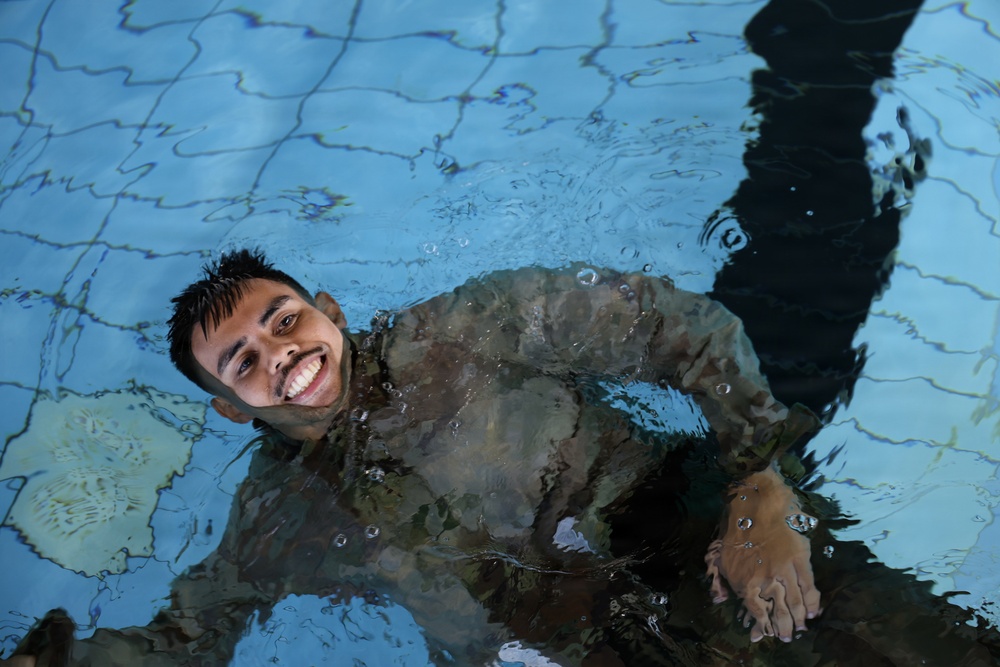
Events included combat water survival, a physical fitness assessment, an extended foot march, weapons qualification and stress shoots with the M4A1 carbine, tactical combat casualty care, prolonged casualty care, rough terrain rescue, a written examination, detainee operations and land navigation.
Winter said the experience left competitors better prepared for future missions.
“They pushed us to our absolute limits, but we’re coming out of this sharper, faster, and more confident in our capabilities,” he said
Team Delta, representing the 2nd Cavalry Regiment was named the U.S. Army Europe and Africa winner. The team consisted of 1st Lt. Aden Rothmeyer and Spc. William Shapley.
Both teams will advance to represent Medical Readiness Command, Europe, at the U.S. Army Command Sgt. Maj. Jack L. Clark Jr. Best Medic Competition scheduled for February 2027.
“This win was great to represent LRMC and our medical readiness and physicality,” Winter said. “We look forward to representing LRMC and MRC-Europe at the Army-wide competition.”
| Date Taken: |
08.30.2026 |
| Date Posted: |
09.10.2026 04:32 |
| Story ID: |
574247 |
| Location: |
RAMSTEIN-MIESENBACH, RHEINLAND-PFALZ, DE |
| Web Views: |
65 |
| Downloads: |
0 |
PUBLIC DOMAIN

This work, Landstuhl Soldiers Win Europe Best Medic Competition, by Bernhard Lashleyleidner, identified by DVIDS, must comply with the restrictions shown on https://www.dvidshub.net/about/copyright.