
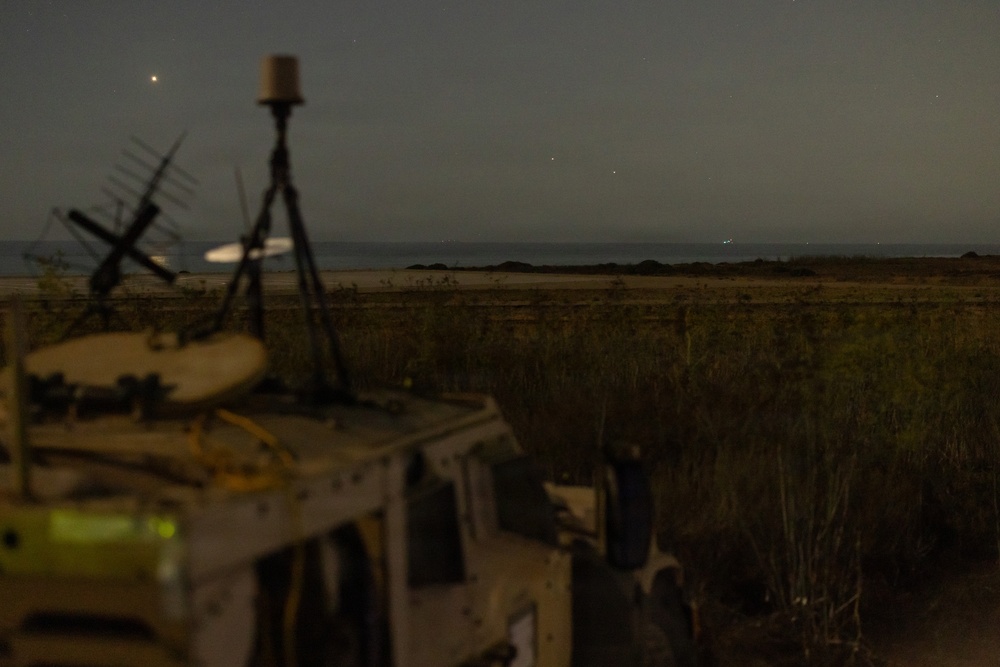
Photo By Sgt. Martha Linares | U.S. Marines assigned to 13th Marine Expeditionary Unit, detect and track simulated...... read more read more
 Subscribe
CAMP PENDLETON, Calif. - At one coastal outpost, Marines scan the horizon using radar systems and small unmanned aircraft to track adversarial activity. Miles away at a second location, a forward command element directs tactical operations on the ground while an adjacent fueling site rapidly rearms and refuels aircraft to keep them airborne in support of operations.
Executing a single expeditionary advanced base requires significant planning and coordination but operating two distinct EABs simultaneously represents an advanced capability that showcases the planning capacity, command flexibility, and distributed lethality of the 13th Marine Expeditionary Unit.
By establishing a forward sensing site alongside a separate forward command and control element with an adjacent forward arming and refueling point (FARP), the MEU exercised its ability to disperse combat power, decentralize decision-making, and sustain operations without losing the ability to communicate with the operations center located miles away aboard naval ships.
“Connecting the land and sea is where the Marine Corps makes our money,” said 1st Lt. Joseph Nameth, a platoon commander assigned to Battalion Landing Team 2/4, 13th MEU.
The first location, a sensing expeditionary advanced base (SEAB), brings together coastal surveillance radars, electronic sensors, and Marines ashore to extend maritime domain awareness, complementing the radars and sensors already at work aboard naval ships off the coast.
When SEAB systems identify surface vessels in nearby sea lanes, small unmanned aircraft system (sUAS) operators launch their platforms to visually identify and track the contacts. Sensor data and imagery are transmitted in real time across the blue-green command network to decision-makers.
“We pull those grids, capture the imagery, and send that critical data directly back to the MEU commander,” said Sgt. Javier Guzman Granados, an sUAS operator assigned to Battalion Landing Team 2/4, 13th MEU.
Speed and precision are vital. Because maritime traffic moves constantly, tracks can spoil quickly. Rapidly passing verified sensor data ensures commanders maintain an accurate common operational picture across the force.
Meanwhile, at the second expeditionary advanced base, the MEU established a forward command and control node co-located with a FARP. The forward command element acts as an extended command and control center, linking the EABs, afloat operations center, and aircraft flying overhead.
Adjacent to the command post, aviation Marines maintain a continuous fueling and ordnance line to maximize aircraft on-station time.
“Forward arming and refueling points minimize the time aircraft spend out of the fight and maximize their time in the air,” said Sgt. Cody Quittner, a bulk fuel specialist assigned to Marine Medium Tiltrotor Squadron (VMM) 364 (Reinforced), 13th MEU. “Instead of flying all the way back to the ship or a main base for fuel and ordnance, aircraft come directly to us, rearm, refuel, and immediately return to supporting the infantrymen on the forward line.”
Operating dual expeditionary advanced bases simultaneously divides logistics, transportation, and security assets across separate geographic locations, requiring precise planning and execution across the Marine Air-Ground Task Force.
“One of the major takeaways from this training evolution is the sheer number of moving parts required to establish a site and deliver that capability,” Quittner said.
The simultaneous execution of a sensing node and FARP reinforces the 13th MEU’s ability to project power and maintain high-tempo operations across multiple distributed sites. Dispersing capabilities across coastal terrain creates a combined-arms dilemma for adversaries while providing combatant commanders with flexible, sea-based options.
“Flexibility is the biggest advantage to what we provide,” Nameth said.
By mastering the complexity of simultaneous EAB operations, the 13th MEU continues to hone its edge as the nation’s premier crisis-response force, capable of sensing threats, directing the fight, and sustaining combat power from the sea.
| Date Taken: | 09.05.2026 |
| Date Posted: | 09.06.2026 02:09 |
| Story ID: | 573956 |
| Location: | MARINE CORPS BASE CAMP PENDLETON, CALIFORNIA, US |
| Web Views: | 16 |
| Downloads: | 1 |

This work, 13th MEU Demonstrates Simultaneous EAB Capability During Training Underway, by Sgt Martha Linares, identified by DVIDS, must comply with the restrictions shown on https://www.dvidshub.net/about/copyright.


No keywords found.




