
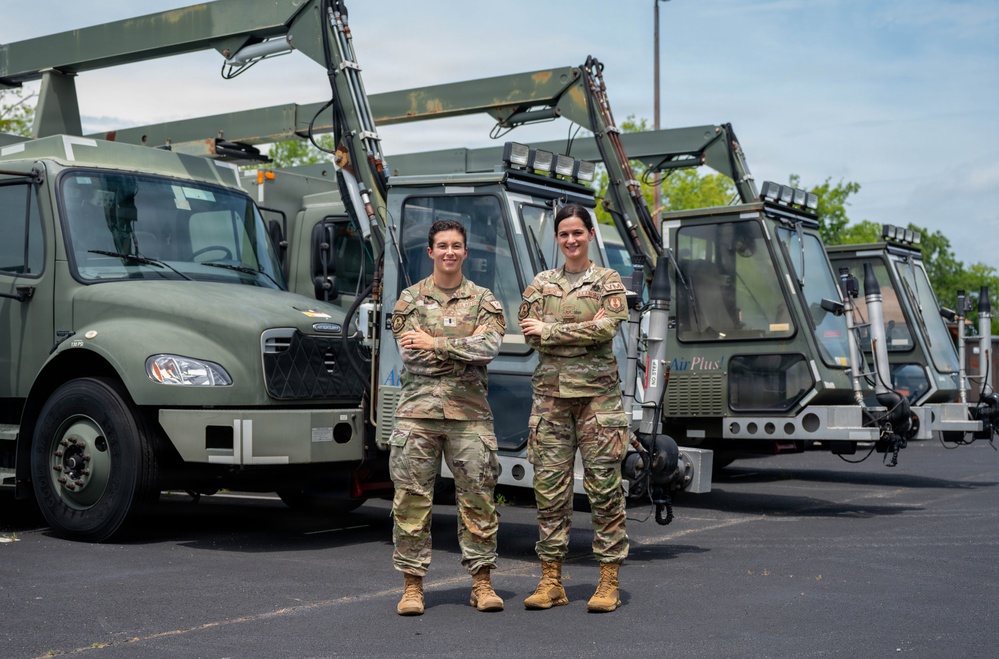
Photo By Airman 1st Class Chloe Goodman | From the left, U.S. Air Force 1st Lt. Peyton Yake, 441st Vehicle Support Chain...... read more read more
 Subscribe
JOINT BASE LANGLEY-EUSTIS, Va. -- Air Force combat power is projected not only through aircraft, but through the ground mobility required to move personnel, equipment and capabilities where they are needed. That mobility is supported across the Department of the Air Force by the 441st Vehicle Support Chain Operations Squadron, headquartered at Joint Base Langley-Eustis. Through centralized fleet management, vehicle requirements are balanced across installations and major commands to ensure ground transportation capabilities remain available for daily operations, contingency response and global force projection. An inventory of approximately 85,000 vehicles valued at $13.5 billion is managed by the squadron’s approximately 80 personnel. Although vehicles are not physically maintained by the unit, their authorizations, funding, policy, distribution and lifecycle management are overseen at the Air Force level. “We are responsible for the centralized management of every vehicle within the Department of the Air Force fleet, including the associated funding, policy, authorizations, and the contingency logistics support that goes with it,” said U.S. Air Force 1st Lt. Peyton Yake, 441st VSCOS, operations flight commander. From passenger vehicles used for installation operations to specialized platforms required for defense, logistics and contingency missions, vehicle requirements are assessed against operational priorities throughout the Air Force. At JBLE, the squadron’s mission is directly connected to the installation’s role as a joint power projection platform. Airmen, Soldiers, equipment and capabilities are prepared and positioned from the installation to support missions worldwide, making reliable ground mobility an essential component of readiness and force generation. Across the force, the lifecycle of each Air Force vehicle is monitored by the 441st VSCOS, from initial authorization and distribution through reassignment and retirement. Fleet data is used to identify requirements, evaluate available capacity and determine where resources can best support operational demands. “We have all the data to every single vehicle in the Air Force,” said Yake. “With that data, we have to be able to make the best decision for not only the Air Force, but also the warfighter.” Those decisions require coordination among installations, Headquarters Air Force, major commands and functional area managers. Fleet requirements and vehicle authorizations are evaluated to ensure limited resources are positioned where they can best sustain mission requirements. “Each installation and Major Command have unique mission sets,” said Yake. “We must balance competing priorities to ensure one mission isn’t prioritized at the detriment of another.” That coordination becomes particularly important during contingency operations, when vehicle requirements can shift rapidly and capabilities may need to be sourced from across the force. During contingency operations, available vehicle capacity is assessed across installations to determine where required capabilities can be sourced without unnecessarily degrading readiness elsewhere. “We are constantly analyzing vehicle data from bases all over the world to determine which bases can support,” said Staff Sgt. Elizabeth Girondo, 441st VSCOS, Contingency Management action officer. “My team and I manage the intake of critical sourcing requests, validate those operational requirements and rapidly coordinate the deployment of those specific capabilities to the theater.” Through that process, individual vehicle requirements are viewed as part of the Air Force’s broader logistics network. Resources can be redistributed based on operational demand while readiness requirements are balanced across major commands and installations. From JBLE, the 441st VSCOS provides an Air Force-wide view of ground mobility, allowing vehicle resources to be aligned with operational priorities. Fleet data is translated into sourcing, authorization and distribution decisions that support installation operations, power projection and contingency response. As forces are generated and deployed from installations such as JBLE, centralized fleet management helps ensure the vehicles needed to move people, equipment and capabilities are available when required. By connecting vehicle resources to operational requirements across the force, the 441st VSCOS helps sustain the ground mobility required to generate readiness and project combat power worldwide.
| Date Taken: | 09.03.2026 |
| Date Posted: | 09.03.2026 15:48 |
| Story ID: | 573936 |
| Location: | US |
| Web Views: | 27 |
| Downloads: | 0 |

This work, 441st VSCOS drives ground mobility across Air Force, by A1C Chloe Goodman, identified by DVIDS, must comply with the restrictions shown on https://www.dvidshub.net/about/copyright.


No keywords found.




