
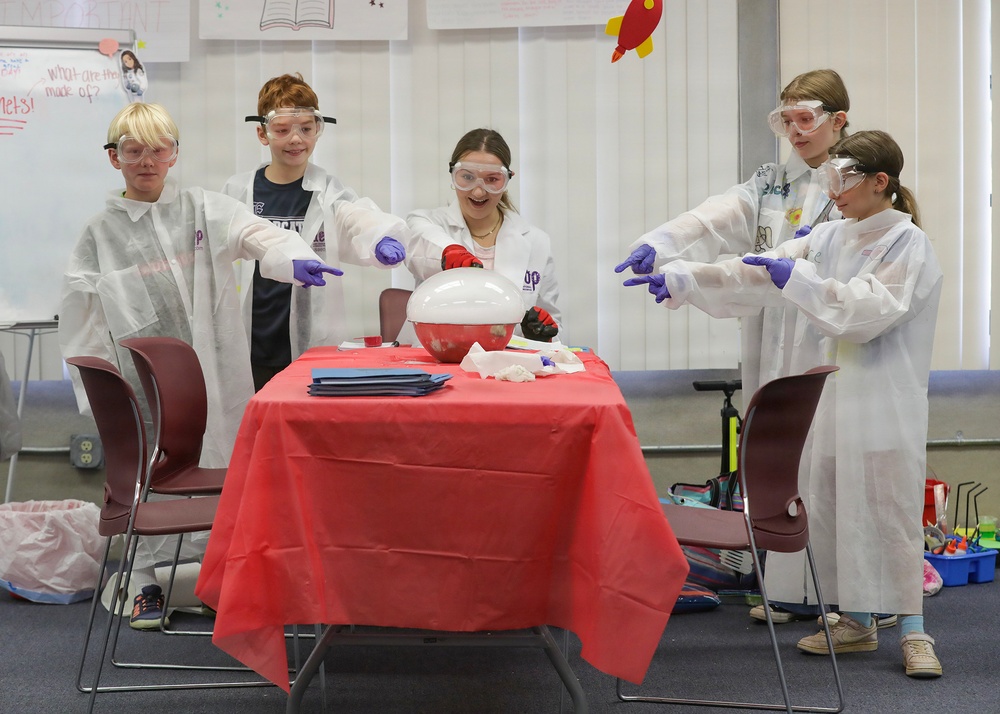
Photo By Stephen Williams | Students in Planetary GEMS investigated geology, oceanography, and meteorology. These...... read more read more
The U.S. Army Aeromedical Research Laboratory successfully concluded its 16th annual Gains in the Education of Mathematics and Science program in mid-July 2026, marking another milestone in its mission to inspire local youth toward careers in science and technology. The program, which included four, week-long intensive sessions, brought together hundreds of students, professional educators and near-peer mentors onto the USAARL campus.
"GEMS’s hands-on approach hooks students into the world of STEM outside of what they experience in school and sparks their natural curiosity," said Alane Williams, the USAARL STEM education administrator who coordinates the program. "Our guest speakers from Fort Rucker and surrounding communities introduce students to a multitude of STEM careers they may have not considered."
The 2026 GEMS curriculum consisted of four unique, age-appropriate modules designed to foster critical thinking and practical skills. For fourth and fifth graders, Planetary GEMS offered a hands-on investigation into geology, oceanography, and meteorology. Sixth and seventh graders explored the anatomy, function, and development of the central nervous system and brain in Neuroscience GEMS. In Biochemistry GEMS, eighth and ninth graders explored chemical processes and reactions in living organisms alongside practical chemistry and biology experiments. Finally, Agriscience GEMS engaged 10th and 11th graders in applying science to agriculture while building an understanding of human relations, communication and agricultural economics.
The educational impact of these modules was felt deeply by the participating students. Haley Hudson, an eighth-grade student at Coppinville Junior High School in Enterprise, Ala., shared how the program helped clarify complex scientific concepts. "I've learned a lot of new stuff that I didn’t learn about at my school," Hudson said. "This is definitely going to help with next year."
Alexander Vasquez, an 11th-grade student at Dothan High School in Dothan, Ala., emphasized the accessible and engaging nature of the program. "It's a really fun experience for people who don't have the chance to do a bunch of science," Vasquez said. He continued that some students thought they did not “want to do the science, but in the end, they found themselves enjoying the experiments without even realizing it."
The GEMS program utilizes high school seniors and college students as near-peer mentors to guide participants through laboratory experiments. This unique dynamic creates a comfortable, supportive environment that eases classroom anxiety and helps mentors build vital professional skills. While the mentors are teaching students, they are also learning about themselves.
Sabihabanu Bhonhariya, who soon begins her freshman year at the University of Alabama at Birmingham (UAB) in Birmingham, Ala., completed her second year teaching with GEMS. Bhonhariya explained that the program helped her overcome personal hurdles.
"GEMS has given me the opportunity to build my confidence," Bhonhariya said. "When I first joined GEMS, I struggled with giving presentations and speaking confidently in front of others. Over time, GEMS helped me develop those skills by providing regular opportunities to present and practice in front of different groups of students each week."
Ethan Ingram, an incoming freshman at Johns Hopkins University in Baltimore, Md. completed his second year of teaching after completing all eight GEMS modules as a student. Ingram noted GEMS taught him how to work with diverse teams.
"At GEMS, I’ve learned so much about how to build strong bonds and work together with people from a wide range of backgrounds," Ingram said. "I believe this skill will be a necessity throughout my future education and even more valuable in the workplace."
Samuel Keller, a 12th grader at Enterprise High School in Enterprise, Ala. completed his first year as a mentor after having completed three modules as a GEMS student. Keller expressed the same ideas as his fellow mentors, highlighting the leadership and collaborative skills gained during the summer.
Professional educators are also critical to the success of GEMS, providing oversight into structured lessons that build students' knowledge.
Dr. Shavonne Burrows, a sixth-grade mathematics teacher at Brookwood Elementary School in Enterprise, Ala., completed her fifth year with GEMS. Burrows described GEMS as one of the most rewarding professional experiences of her career, explaining that she leaves the program each year with new instructional strategies, stronger connections with fellow educators and fresh ideas to implement in her classroom.
"One of the biggest takeaways from GEMS that can be applied in the classroom is providing students with authentic, hands-on inquiry-based learning experiences that encourage critical thinking, collaboration and problem-solving," Burrows said. "Rather than simply teaching content, GEMS emphasizes engaging students in meaningful investigations where they ask questions, test ideas, analyze data and communicate their findings."
Tawana Tucker, an educator at Coppinville Junior High School who is moving to a computer science position for the 2026-27 school year, completed her second year with the GEMS program. Tucker looks forward to integrating her GEMS experiences into her new role.
"The focus on careers and professional employment options will be useful to me as I work with students," Tucker said. She also praised the GEMS leadership team, noting that they "work tirelessly to design and revise curriculum procedures and obtain materials and supplies to make the lab experiments for students come alive."
The long-term impact of GEMS was highlighted by guest speaker Julie Strickland, a Doctor of Optometry graduate from the UAB School of Optometry who was born and raised in Enterprise, Ala., and graduated from Enterprise High School in 2018. Strickland completed one GEMS module as an elementary student in 2011 and went on to serve as a mentor for six summers, guiding students through modules like Forensics, Neuroscience, Simple Machines and Biochemistry.
"GEMS helped me develop skills that have benefited me throughout school and continue to shape me today," Strickland said, noting that she carried perseverance, communication, leadership and teamwork into her education and upcoming career. Her interest in vision science was sparked directly while mentoring the Neuroscience module, where she connected with vision scientists and researchers at USAARL. After earning an Associate of Science from Enterprise State Community College in Enterprise, Ala. and a Bachelor of Science in Chemistry from UAB, she completed her optometry degree. Returning to GEMS as a speaker was a meaningful full-circle moment for her.
"To come back now and share my own journey with students and mentors is incredibly meaningful," Strickland said. "I hope my story encourages someone the way those speakers encouraged me."
After 16 years of hosting this revered STEM program, USAARL GEMS has surpassed a lot of milestones. Since the program's inception in 2011 through this year, a total of 2,262 unique students participated in GEMS, completing a cumulative 4,847 modules. Over half of all GEMS participants returned to complete more than one module.
During 2026 GEMS, 402 students participated in the program, with 158 students being first-time attendees. Forty-two students received the Brilliant Cullinan Award for completing four GEMS modules. Seven students earned the Octahedron Award for completing all eight modules: Simple Machines, Planetary, Forensics, Neuroscience, Robotics, Biochemistry, Medical, and Agriscience.
Over the program’s history, 384 students earned the Brilliant Cullinan Award. Since the introduction of the Octahedron Award, only 20 students have successfully completed all eight modules.
The GEMS program would not be possible without its instructional staff. The historical instruction team includes 205 participants, consisting of 170 near-peer mentors, 24 teachers, and 11 observing teachers. Almost half of the near-peer mentors and teachers participated more than once.
This year included 26 near-peer mentors, four lead teachers, and two observing teachers. The four lead teachers supervised a combined 18 modules over their time with GEMS, while the 14 returning mentors supported a combined 46 modules over their years of service to GEMS.
Showing the program's desired progression, 12 near-peer mentors were previously GEMS students who had completed a combined 68 modules. Six former students stepped into their first mentoring roles this year.
Planning for the 2027 GEMS program begins shortly after completion of this year’s program. Applications for teachers and near-peer mentors should open late this year. Student applications should open in the early part of 2027. The modules for 2027 will be: Simple Machines GEMS for fourth and fifth graders; Forensics GEMS for sixth and seventh graders; Robotics GEMS for eighth and ninth graders; then 10th and 11th graders will participate in Medical GEMS. Updates will be posted to USAARL’s website (https://usaarl.health.mil/index.cfm/stem/gems) as soon as 2027 program information becomes available.
| Date Taken: | 09.02.2026 |
| Date Posted: | 09.02.2026 11:44 |
| Story ID: | 573768 |
| Location: | FORT RUCKER, ALABAMA, US |
| Web Views: | 32 |
| Downloads: | 0 |

This work, USAARL Continues Setting Milestones with the GEMS Program, Shaping the Next Generation of STEM Leaders, by Laren Vance Fleming, identified by DVIDS, must comply with the restrictions shown on https://www.dvidshub.net/about/copyright.


No keywords found.





