
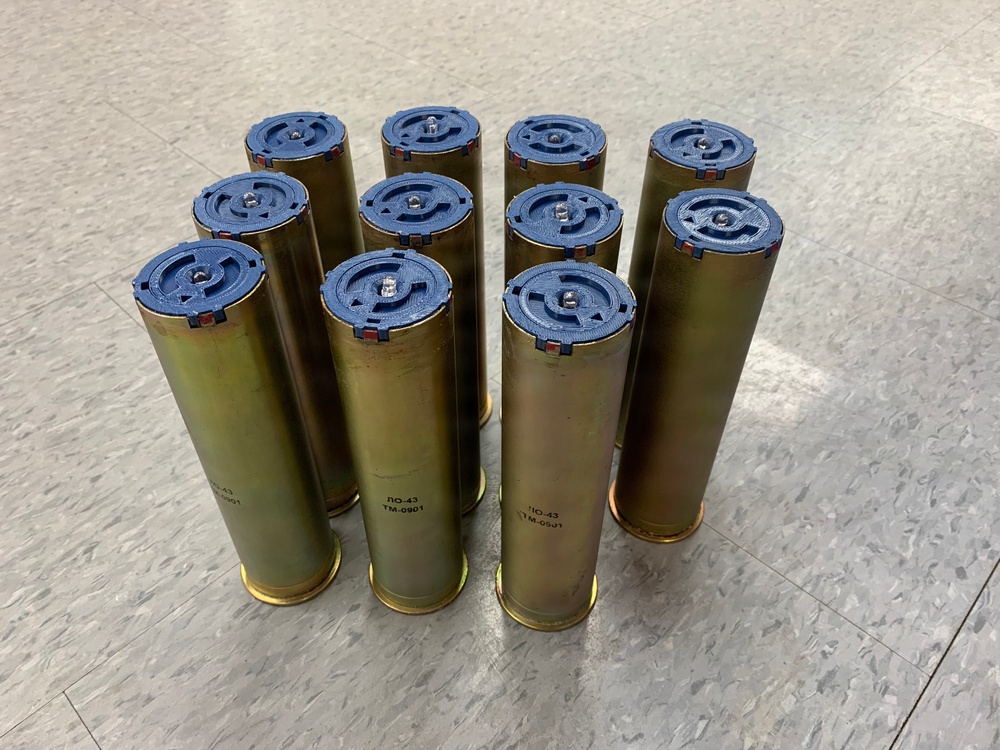
Courtesy Photo | Flare magazine test units developed by the 53rd Test Support Squadron sit at Tyndall...... read more read more
TYNDALL AIR FORCE BASE, Fla. — The aircraft? Skyward. The test? Underway. Personnel, equipment and range time? Already committed.
The countermeasure system, though? Unresponsive.
For test teams, that’s the wrong time to discover a problem.
Engineers from the 53rd Test Support Squadron at Tyndall Air Force Base, Florida, recently developed a flare magazine test unit to help Tyndall’s 82nd Aerial Targets Squadron identify those problems before QF-16 Full-Scale Aerial Targets ever leave the ground.
“These units provide the opportunity to fully ground test the remote operational control of countermeasures during our pre-flight checks,” said 1st Lt. Maxine Bresnaider, 53rd Test Support Squadron lead engineer of special devices.
During the check, personnel send demand signals from the control room to the QF-16. Test units loaded into the aerial target then indicate whether the command successfully traveled through the system and produced the expected response.
In effect, the device lets test personnel ask the aircraft a simple question before flight: “Did you get the message?” Testing that communication on the ground can identify false signals, failures or other problems.
“Doing so ensures that we don’t waste countermeasures or mistakenly expend them during flight, giving us and the 82nd ATRS the opportunity to fix the problem,” Bresnaider said.
For developmental and operational test events, finding those problems early can have effects well beyond saving a flare.
QF-16s provide full-scale aerial targets for weapons evaluations and tactics development. When an aircraft or one of its systems doesn’t perform as expected, evaluators risk losing not only a sortie, but the time, range availability and other test resources that have already been committed to producing usable data.
Identifying a malfunction during preflight allows the team to correct it while the aircraft is still on the ground.
“This ensures that evaluations and tactics, techniques and procedures development for the weapons systems and pilots execute properly and are not wasted time, effort and money for all organizations involved,” Bresnaider said.
Building the tester, however, required engineers to work within a space that already existed.
Instead of redesigning the aircraft around the test equipment, the equipment had to fit where the real countermeasure would.
The units were designed to fit within the QF-16’s existing flare canisters, requiring engineers to match their physical dimensions and electrical connections.
“These were important factors to get right as these testers are what would provide us warning that we need to troubleshoot prior to using genuine flare assets that would malfunction and not go off,” Bresnaider said. Function, cost and ease of fabrication drove much of the design.
The result gives test personnel a reusable means of checking the system without relying on an actual pyrotechnic countermeasure to determine whether the aircraft will respond correctly.
“These units reduce risk by ensuring proper operations of the countermeasure systems while on the ground, thereby lowering the probability of in-flight hang fires or misfires,” Bresnaider said.
For a device built to ensure the correct deployment of a 4,000-degree ball of light and fire, success is decidedly uneventful.
A signal leaves the control room. The aircraft receives it. The tester responds.
And the real flare stays exactly where it belongs.
| Date Taken: | 08.28.2026 |
| Date Posted: | 08.28.2026 14:36 |
| Story ID: | 573477 |
| Location: | TYNDALL AIR FORCE BASE, FLORIDA, US |
| Web Views: | 13 |
| Downloads: | 0 |

This work, 53rd TSS develops flare magazine test unit for QF-16 aerial targets, by SSgt Christian Conrad, identified by DVIDS, must comply with the restrictions shown on https://www.dvidshub.net/about/copyright.

No keywords found.





