
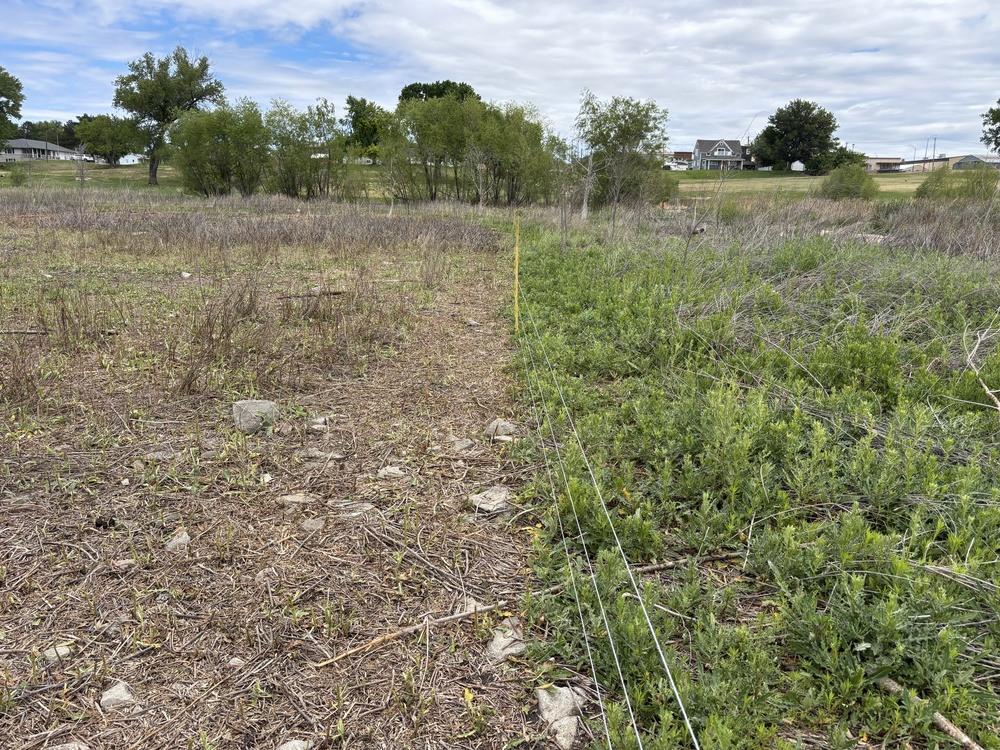
Photo By Lawrence Brooks | A photo comparison of the targeted area below Alma, Nebraska. The left side of the...... read more read more
 Subscribe
For the hundreds of thousands of annual visitors that set foot on the nearly 31,000 acres of the Harlan County Lake Project during summer recreation and hunting seasons, the sight, smells and unexpected presence of hundreds of sheep and goats could be quite perplexing.
Although agricultural leases are the norm for USACE, the spectacle of it all begs the question: Why are sheep and goats out there grazing instead of the cattle that are emblematic to American agriculture, and what are they used for?
Noah Erichsen, natural resources specialist for the Harlan County Project Office, has answers. “The [animals] are part of the Harlan County Goat and Sheep Grazing Partnership. This is currently a pilot program, but it has so far been a great success,” he said.
Erichsen’s concept was sparked by a USACE-funded continuing education course in the summer of 2025, building on earlier discussions within the Harlan County Project Office. After the district and Harlan County Lake leadership bought in, Erichsen turned the concept into reality leveraging both his new training and an established local partnership to drive the project forward.
“One of our agriculture lessees, Lance Stone, said he previously had interest [since he] owns sheep and goats,” he said. “I drew up the memorandum of understanding and the maps [last] winter. We got the final agreement signed in April [2026].”
Given the positive results Erichsen mentioned and the continued presence of the wooly four-legged labor force, the program is more than mere novelty because it seeks to be a long-term, environmentally friendly solution that confronts one of USACE’s most unrelenting challenges: land management.
“We have been able to reliably control noxious weeds, most notably Canada thistle,” he said.
Disaster accelerated existing invaders
According to the U.S. Forest Service policy, invasive plant species or noxious weeds are considered nuisances because they’re not only harmful to agrarian economics, but they’re also harmful to human health and the environment.
However, to experienced outdoorsmen and nature specialists like Erichsen, who spends countless hours surveying USACE land, they are nothing new.
“Canada thistle came from Europe in the 17th century, and it spread across the U.S. as settlers moved west. Musk thistle arrived in the 19th century most likely as a contaminant in imported seed,” he said.
In addition to those, Harlan County Lake has other problematic species such as Phragmites — a thick grass species that grows to around 15 feet in height; the Eastern Red Cedar Tree, an invasive tree that crowds out native grasslands and the Eastern Cottonwood Tree — although native, they grow extremely fast and outcompete more manageable and environmentally friendly plant species native to the region.
Erichsen stated that while some of the issues the plants cause overlap, each plant presents its own unique challenge to land and aquatic ecosystems.
“Canada thistle crowds out crops and desirable forage. Musk thistle can make an area almost unusable, while phragmites block shoreline access for swimming, fishing, boating and hunting. They also damage fish spawning grounds and waterfowl habitat,” he said. “Eastern red cedars can overtake grasslands and riparian areas by reducing the open spaces many wildlife species require.”
Land and vegetation management is a routine part of operations at USACE lake projects — especially when the problem plant species remain under control.
But when devastating floods struck the heartland in 2019, lake projects across the affected region faced a new problem in their aftermath: an exponential increase and expansion of problematic plants or noxious weed species.
“When all the native grass was underwater and killed, the thistle was able to take over the bare ground, growing when the water receded,” Erichsen said. “The flood also was able to transport seeds to areas that previously had no thistle.”
A cost-effective, efficient path forward
Traditionally, controlling the expanding nuisance plant populations requires a familiar arsenal of tools: All-terrain vehicles with custom spray rigs, modified drones, helicopters or small aircraft. The costs for these products, machines and services ballooned in 2025 — costing the Harlan County Lake Agricultural Leasing Program approximately $26,330 on chemicals and spraying for Canada thistle, musk thistle, and phragmites.
But Erichsen and the Harlan County Project Office have taken an unconventional approach, using some of the earth’s living and breathing garbage disposals, who happen to have four stomachs and considerable appetites.
“We currently have 500 sheep and 50 goats working across targeted areas of the lake project,” he said.
The process is relatively simple and substantially cheaper. Once Erichsen identifies areas to eradicate or control nuisance vegetation, a perimeter is mowed for Stone to place his electric fence. After installing and energizing the barrier, Stone brings in the grazers and lets them do what they do best — devour everything in sight.
The partnership’s first trial run came in early May 2026; Canadian thistle was identified directly adjacent to Cedar Point Beach. Here, around 90 sheep would target one of our nations and the lake projects’ most devastating weed: Canada thistle. After the sheep were finished at Cedar Point, Canada thistle was identified on approximately 30 acres of lakebed below Alma, Nebraska. This area served as their second testing ground.
As time progressed, Erichsen and Stone increased the herd to 200, which eventually grew to about 400 animals.
“It took them about three weeks on 10 acres to completely clean off all the thistle,” Erichsen said. “As of August, the program has successfully controlled around 100 acres of undesirable and invasive vegetation.”
At the time of this article, Erichsen noted that the project office has spent only about $1,200 to treat 15 acres of Canada thistle, largely because livestock are doing most of the heavy lifting. By comparison, traditional chemical spraying for 100-acres of infestation would typically cost around $8,000 for labor and chemicals.
“This is way cheaper instead of spending thousands of dollars on chemicals and man-hours to spray either by hand, drone or plane,” he said.
Outside of the cost benefits, these animals offer other advantages. Both species possess digestive systems that decimate seeds they consume, destroying the plants’ ability to reproduce and they’re biologically wired to target woody vegetation and all types of broadleaf weeds.
Another advantage is the animal’s ability to climb or descend to places that are difficult for humans or machinery to reach in rocky, steep or densely vegetated areas around the lake project.
“The waste from the goats and sheep acts as a fertilizer for the area so the native ecosystem can come back with extra nutrients,” Erichsen said.
For Erichsen and his office, using this organic approach to land management represents an unconventional yet simple method to constrain the spread of harmful weeds.
It also presents an opportunity to gradually restore native plants to the surrounding 17,750 acres around Harlan County Lake’s footprint while reducing the use of chemicals that could potentially run off into the river system or cause collateral damage to wildlife and insect species that inhabit the area.
“This partnership allows the animals to do what they do naturally while helping us improve habitat quality and suppress invasive vegetation,” Erichsen said.
Because the mission of land management is never-ending, the work sheep and goats provide is always needed — which means there is no projected completion date for the pilot program.
Immediately after an area is grazed, sunflower and grain seeds are introduced to the soil.This strategic planting helps crowd out returning thistle while establishing a natural food source for local wildlife. As the animals move on, many of the high-visibility, high-traffic plots across the property will likely see their return in 2027 to keep the pressure on the persistent weed seed bank.
For now, however, the Harlan County Goat and Sheep Grazing Partnership remains a pilot program. But its early results have given Erichsen reason to believe the idea could become a long-term tool in USACE’s land-management toolbox.
“We’re always looking for practical and sustainable ways to manage our public lands,” he said. “We get to save money to work on other projects, and our local farmer gets to feed his animals.”
What began as an idea discussed after a professional development course has now become a strong, working partnership between the federal government and a local farmer — one where the USACE provides the land, Stone provides the hundreds of livestock for the labor.
“It’s a win for the land, a win for us and a win for the public,” Erichsen said.
| Date Taken: | 08.27.2026 |
| Date Posted: | 08.28.2026 10:53 |
| Story ID: | 573448 |
| Location: | ALMA, NEBRASKA, US |
| Web Views: | 16 |
| Downloads: | 0 |

This work, From herbicides to herbivores: Harlan County’s new plan to tackle pesky plants, by Lawrence Brooks, identified by DVIDS, must comply with the restrictions shown on https://www.dvidshub.net/about/copyright.


No keywords found.




