
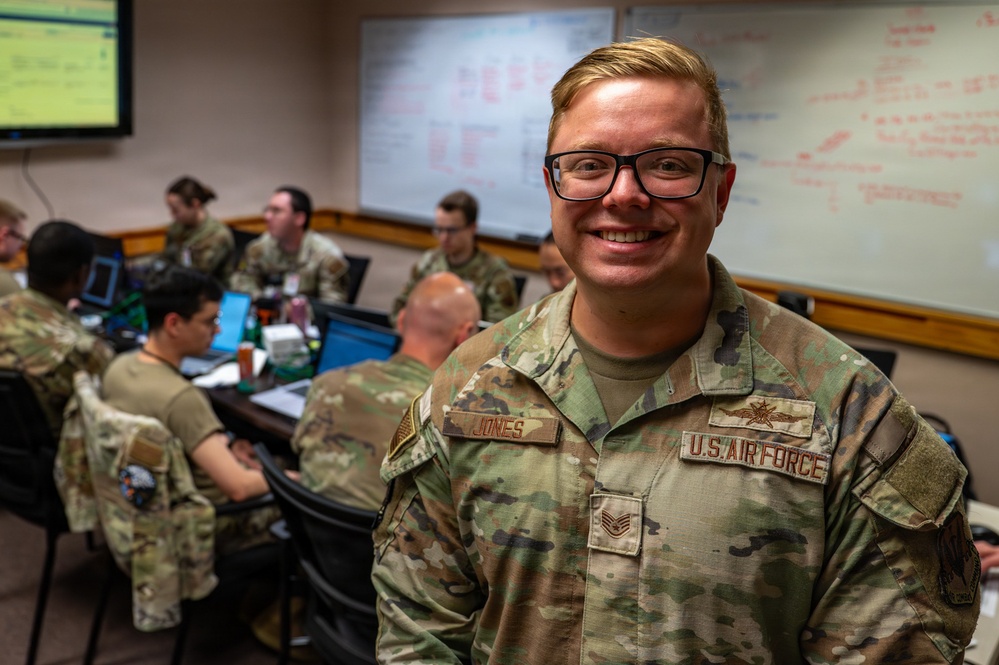
Photo By Senior Airman Andre Medina | U.S. Air Force Staff Sgt. Aleksey Jones, 837th Cyberspace Operations Squadron...... read more read more
 Subscribe
EIELSON AIR FORCE BASE, Alaska – RED FLAG-Alaska 26-3 will draw to a close on Friday, August 28, after two weeks of coordinated air combat training conducted within the Joint Pacific Alaska Range Complex, the Department of War’s largest overland airspace.
But not all battles take place in the air, on land–or even in the physical realm.
This year marks the second iteration in which cyberspace capabilities have been integrated into the RF-A exercise.
“I believe it is important to have cyber in these exercises to demonstrate the types of capabilities we are available to employ, to assist in a matter of layered effects,” said U.S. Air Force Chief Warrant Officer 2 Alexander Childs, 835th Cyberspace Operations Squadron chief operations advisor, and red team lead for RF-A 26-3. “Layered effects allowing a person or group of people to maneuver safely into contested areas is what we’re attempting to portray throughout the exercise.”
Layered effects, says Childs, are multiple types of capabilities that are being employed simultaneously to allow an action to happen. For example, in a Hollywood-esque action film, one might have an adversary controlling traffic lights while the other jams radio communications, which causes their opponent to be more confused and have to expend more effort and energy into attempting to correlate or communicate their movements to their partners.
Scenario development for the exercise began in January, during which cyber experts were tapped to weigh in.
“We created a scenario where we could have a realistic impact on the scenario that they were coming up with, and how we can play a role into that going forward,” said Chief Warrant Officer 2 Dennis Cracraft, 837th COS chief operations advisor, and blue team lead for RF-A 26-3.
In a traditional exercise, cyber teams do not integrate on such a tactical level. RF-A 26-3 is the first total force exercise these cyber protection teams have participated in, interacting with a wide range of careers and military branches to execute both kinetic and non-kinetic effects on the day’s mission objective. As the 353rd Combat Training Squadron further develops these unique opportunities for the Air Force’s cyber Airmen, they are opening a whole new pathway of what can be achieved for training across the board.
“The scenario [for RF-A 26-3] is that the red team has already compromised the network, and now the blue team has to go in there and solve the puzzle of what occurred,” Cracraft. “Then they have to develop action to kick them out of the network as soon as possible while also maintaining dominance. The way to do that is by teaching them certain hunt tactics, good practices on what they should do as operators, and what to look for.”
While defensive network operations are somewhat routine for cyber Airmen, the red team gets to have a bit more leeway with their work.
“For the offensive side, we are using a little more of the creativity that we don't typically get an opportunity to use,” said Childs. “With three of our four operators on the offensive side, they are traditionally defensive operators that have experience either doing red teaming or have experience doing threat emulation. We are utilizing that experience to build out what the threat looks like. That gives them a little bit of flex that way, a little bit of experience and more practice in developing those threats, so they can then document them and we can work to train our defensive cyber operators.”
At the end of the day, exercises are all about learning for everyone involved.
“It's been a unique experience,” said Childs. “With the inclusion of [cyber], we have been able to spark questions, ideas, theories and more questions amongst the flyers. So as they go through their non-kinetic effects planning processes, they reach out to us and say, ‘Hey, are you able to?’ That's what we want out of this. Additionally through that, if we're not able to in the real world, then we can go back and say, ‘Hey, these are effects that they want to generate. How do we get to that?’ Then that can spark more conversation internally.”
Homeland defense requires layered, integrated operations extending beyond U.S. borders–physically and through the web of networks spanning the globe. Exercises such as RF-A provide the training to sustain the capability and readiness required to support power projection and prepare for the full range of contingencies.
| Date Taken: | 08.27.2026 |
| Date Posted: | 08.27.2026 19:36 |
| Story ID: | 573415 |
| Location: | EIELSON AIR FORCE BASE, ALASKA, US |
| Web Views: | 36 |
| Downloads: | 0 |

This work, RED FLAG-Alaska 26-3: Battling in (cyber) space, by SSgt Kelsey Owen, identified by DVIDS, must comply with the restrictions shown on https://www.dvidshub.net/about/copyright.

No keywords found.




