
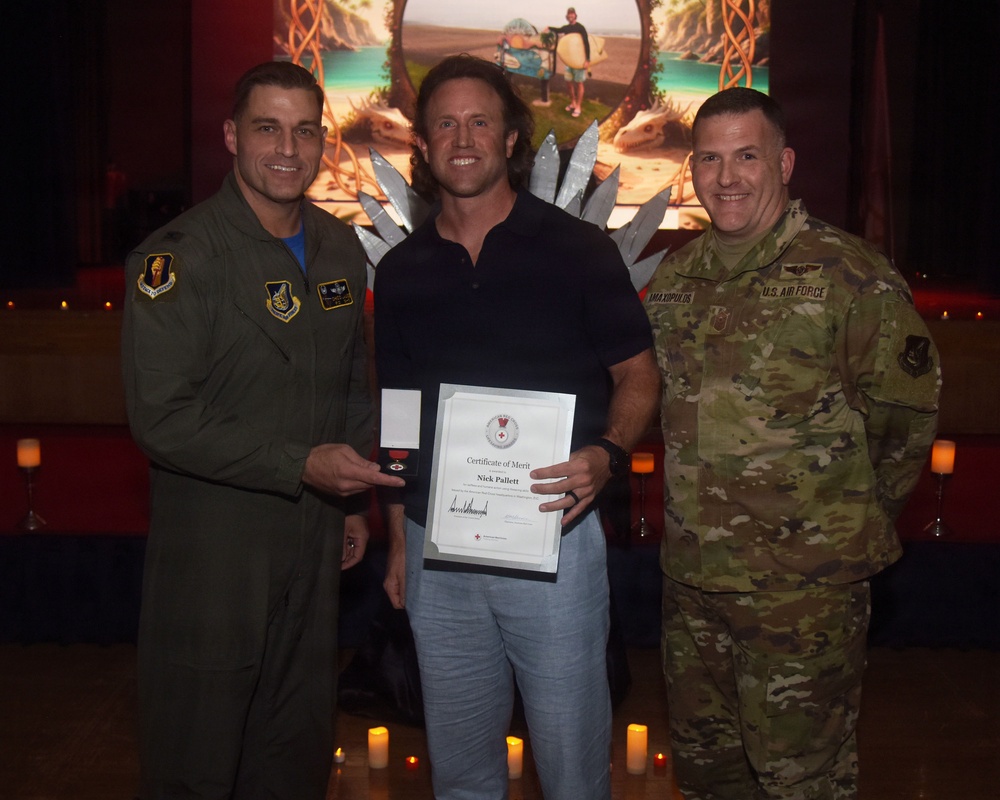
Courtesy Photo | Nick Pallet, center, receives the American Red Cross Lifesaving Award from U.S. Air...... read more read more
 Subscribe
MISAWA AIR BASE, Japan – White-capped Pacific Ocean waves crashed onto the shores of northern Japan. Wind roared over an empty stretch of beach as two surfers rode the waves just offshore with precision.
They effortlessly transitioned from belly to feet in a split second, finding their balance on a wavering surface and standing tall over the ocean with only a board between their feet and the icy water. Ocean spray pelted their wetsuits, faces and pruny fingers.
Water dripped from the tips of their short hair. Exhilaration tore whoops of joy from their throats.
The wave collapsed and dragged the surfers back inland. After a high-five and another cheer, they paddled back out to repeat it all over again. The frigid ocean embraced their burning muscles.
“We’d been out there for one hour already,” said Nick Pallett, American Red Cross Lifesaving Award recipient and spouse of a member assigned to the 35th Fighter Wing. “We both surf a lot so we were just having a good time. But bad things can happen at any moment.”
Nick had taken lifesaving courses through the American Red Cross, a decision that proved critical when a routine day in the water turned into an emergency with no one else around to help.
Nick watched from a little further out as his friend, Craig Hale, prepared for a wave, straddling his own surfboard in the rolling currents. Salty air chapped his lips. He swiped water from his scruffy beard.
Craig approached the wave. At the crucial moment between balance and failure, the ocean consumed the front of his board.
The board shot out from under Craig, tossing him into the churning surf. Emerging from the torrent, he clutched his board, struggling for air.
“I remember calling out to him and only getting a shake of the head back,” Nick said. “When I asked again, he didn’t respond.”
Nick’s stomach dropped as he paddled up to Craig.
Nick helped his friend get back on the board, tugging limbs out of the water one at a time. Craig groaned in pain as his right leg came up with blood mixing in the water. A three inch gash spurted blood onto the surfboard.
“It was gross,” Nick recalled. “The surfboard shot out of the water and somehow the fin on it sliced his leg through his wetsuit. I knew I had to get him out of the water. I was worried about infection.”
Nick pushed his friend to the shore, jumping off his own when the swell carried him into the shallows. He fought through the surging tide towards the safety of the beach, kicking water in every direction.
“I told him to keep his wetsuit on and tied a surf leash just below the knee to act as a tourniquet,” Pallett said. “The bleeding stopped but we were still soaking wet.”
He gritted his teeth tugging the improvised tourniquet as tight as he could and heaved Craig into his car, ignoring the sand and saltwater contaminating the interior.
Nick tried calling Craig’s wife at the 35th Medical Group, but got no answer. Then he called his own wife and told her everything.
“I could hear the concern in his voice,” said Dr. Alicia Pallett, 35th MDG chief of medical staff. “Given his estimated time of arrival, I dropped what I was doing and helped to coordinate receipt of the inbound patient at the medical group.”
They were fifteen minutes away from the base clinic.
His heart pumped with adrenaline, his leg bouncing at every stoplight and red sign as the seconds ticked by. Every minute felt too long.
“I kept checking on him,” Nick said. “He was already pale and pretty nauseous by that point. I wasn’t sure how much blood he had lost before the tourniquet, so I just kept talking to him, trying to keep him calm but conscious.”
He sped to the urgent care center. He pulled up to the curb and emergency medical services met him at the door.
Nick helped get his friend out of the car before medical personnel took him in a wheelchair.
He followed inside, his wetsuit barely dripping water by that point. Bright, sterile lights, white tile floors, short corridors and closed doors surrounded him. His bare, sandy feet were incongruous.
“I was honestly just so impressed at his ability to act swiftly and resolutely,” said Alicia. “It takes years of practice for some to be comfortable in an emergency like this.”
They took Craig into the trauma bay to suture his wound, and he was released after three hours.
“He would’ve done the same thing for me,” Nick said. “I just thought, ‘Thank goodness I’d went through that lifesaving training.’”
His record of lifesaving skills didn’t stop there.
A few months later, Nick responded to another emergency off base when a strong gust of wind knocked an older Japanese woman to the ground in a parking lot of a grocery store. Blood pooled around her head. He applied pressure with a padded crib mattress cover from his car and helped coordinate the emergency response through a translation app.
“While he has completed CPR and First Aid training through the American Red Cross, he has no formal medical training and was never a lifeguard,” said Alicia Pallett. “Recognition on a job well done is most definitely deserved.”
These rescues eventually led to Nick’s recognition at a wing awards ceremony. His wife led him to believe that she was getting an award, so he brought along his children.
Then the master of ceremonies called his name, and his wife urged him forward in the dark room. Pallett said he just shook his head at his wife, catching on to her white lie, but was still surprised.
“They called my name last,” Nick said. “I wasn’t expecting to go up there. Everyone else did their handshakes and salutes, and I went to stand beside the 35th Fighter Wing commander for this award.”
The American Red Cross Lifesaving Awards Program recognizes individuals trained in courses such as CPR, First Aid and AED who use those skills to respond during emergencies. For Nick, that was two emergencies he responded to with exceptional skill.
“He has received tons of thanks and congratulations from the community, and, of course, his family is beaming with pride,” Alicia said. “Our spouses deserve as much, if not more, recognition for the ways in which they contribute to our Misawa community. For Nick, he’s a lifesaver!”
Nick’s lesson was simple.
“I’m always going to maintain my lifesaving training, no matter what job I get in the future,” he said. “Training like that matters, especially when there’s no one else around to help.”
| Date Taken: | 08.27.2026 |
| Date Posted: | 08.27.2026 18:57 |
| Story ID: | 573413 |
| Location: | MISAWA AIR BASE, AOMORI, JP |
| Web Views: | 19 |
| Downloads: | 0 |

This work, From surfer to savior: Training makes the difference, by A1C Hannah Bench, identified by DVIDS, must comply with the restrictions shown on https://www.dvidshub.net/about/copyright.


No keywords found.




