
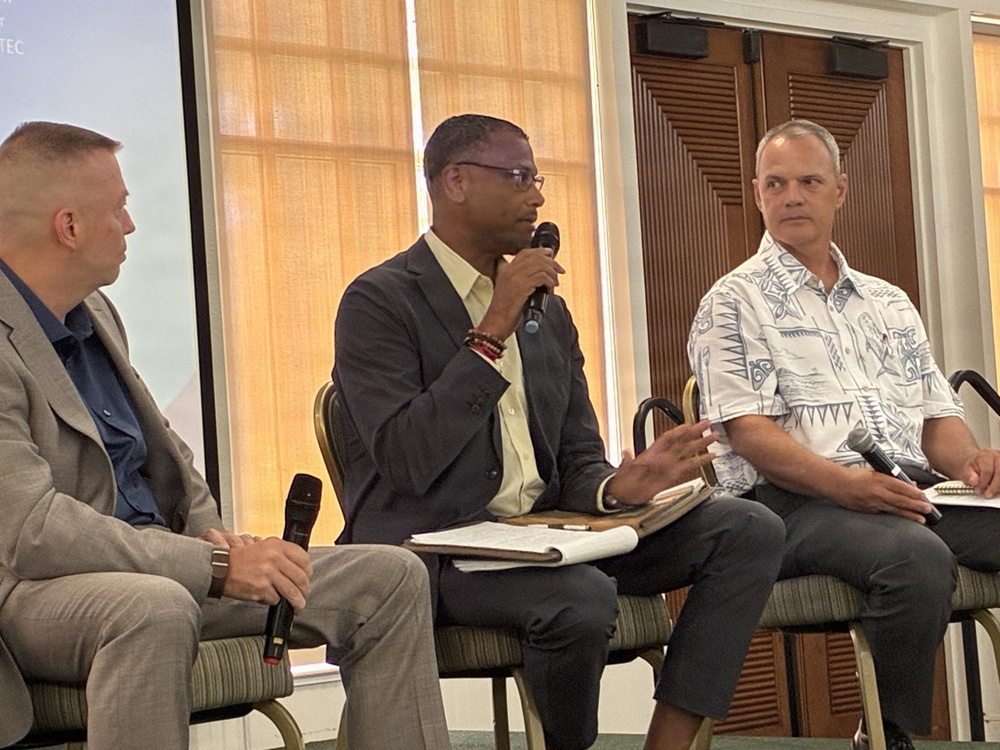
Photo By Eleanor Prohaska | From left, Robert Sholtis, chief information officer and deputy G-6, U.S. Marine Corps...... read more read more
 Subscribe
JOINT BASE PEARL HARBOR-HICKAM, Hawaii — The Armed Forces Communications and Electronics Association (AFCEA) Hawaii hosted a Tech Talk event at Joint Base Pearl Harbor-Hickam, Aug. 4, 2026, focused on the theme, "Mission-Ready AI." Department of War leaders, commercial technology partners, and industry experts convened to address the urgent demand for artificial intelligence, data integration, and distributed training to project credible deterrence in the Pacific.
Marine Corps Col. Michael Hlad, commander of the Defense Information Systems Agency Pacific, opened the event by emphasizing the critical role of commercial partnerships in modern conflict. Noting that commanders can no longer physically step out of a tactical operations center to see the battle, he stressed that the network itself has become the primary warfighting platform. Drawing on a lesson from his grandfather, a World War World War II veteran who advised him to ensure his Marines were "never in a fair fight," Hlad issued a direct call to action to the industry partners in attendance.
"There is no question in my mind that we have the most well-led, best-equipped military in the world because we have the best industrial base in the world,” Hlad said. “You are critical to delivering our continued strategic advantage."
During the event’s Warfighter Panel discussion, Dr. Andre Stridiron, U.S. Pacific Command (US PACOM) J7 Pacific Multi-Domain Training and Experimentation Capability (PMTEC) program manager, articulated why PMTEC actively partners with industry to provide warfighters with AI and other technological advances at speed. He invited industry partners to the tactical edge to field-test prototypes alongside operators during US PACOM joint and coalition exercises.
According to Stridiron, pitching commercial solutions developed years prior is no longer viable in a theater where threats evolve daily. By shifting from static laboratory demonstrations to live, iterative training environments, PMTEC enables industry to adapt, refine, and prove capabilities in real time, ensuring the Joint Force is equipped with technologically-superior, battle-tested solutions when and where they are needed most. This rapid transition of technology directly supports the Department of War’s mission of projecting a credible, modern deterrent posture.
Working from this collaborative perspective with a focus on Joint Force integration, Stridiron outlined five transformational advances PMTEC has delivered since 2022. These include establishing combined joint all-domain operations as the baseline for all major training events and utilizing distributed live, virtual, and constructive (LVC) infrastructure to enable cost-efficient, high-fidelity participation across the massive Pacific area of responsibility.
PMTEC replicates adversarial capabilities—ranging from unmanned aerial systems and hypersonics to ballistic missiles—at a realistic scale and magnitude. This enhances realism for the training audience, pushing joint and coalition warfighters to adapt to complex, integrated scenarios across multiple domains.
“If you're familiar with the term F2T2EA—find, fix, track, target, engage, and assess—that's the kill chain,” said Stridiron. “During exercises, we are now able to execute the entire kill chain from the strategic-operational down to the tactical layer, up and down, left and right, which was never done before.” This end-to-end multi-domain kill chain capability serves as a powerful deterrent, demonstrating to potential adversaries that US PACOM can detect, track, and defeat threats in real time under any conditions.
Jeff Bloom, AFCEA Hawaii vice president of corporate affairs, noted that professional forums like AFCEA’s Tech Talks play a critical role in bypassing traditional bureaucratic bottlenecks.
"AFCEA is able to say, how do we put an environment together for everybody to come together and be able to talk," Bloom said. He explained that typical pre-contract barriers often stifle necessary communication and hinder direct feedback from warfighters.
Neal Faradineh, representing the corporate industry perspective, echoed the need for open dialogue, characterizing the relationship between industry, contractors, and the Department of War as "one team, one fight."
"There is a lot of urgency," Faradineh said. "But it's going to take unification or unity of effort from partners with government, military, and academia."
Achieving this level of rapid transition requires a shared cultural shift in how the military and commercial sectors manage operational risk while the National Capital Region works on policy, acquisitions, and bureaucratic processes. According to Mission Partner panel moderator Marine Corps Maj. Steven Norris, All-Domain Attritable Autonomous Systems, Marine Corps Forces Pacific, both industry and defense must be willing to collaborate together.
“Like Mr. Bob Sholtis [MARFORPAC chief information officer] said during the warfighter panel, ‘Fail forward, but go together,’" said Norris.
| Date Taken: | 08.25.2026 |
| Date Posted: | 08.26.2026 21:13 |
| Story ID: | 573222 |
| Location: | JOINT BASE PEARL HARBOR-HICKAM, HAWAII, US |
| Web Views: | 20 |
| Downloads: | 0 |

This work, AFCEA Event Highlights Mission-Ready AI and PMTEC’s Role in Pacific Warfighting Readiness, by Eleanor Prohaska, identified by DVIDS, must comply with the restrictions shown on https://www.dvidshub.net/about/copyright.


No keywords found.




