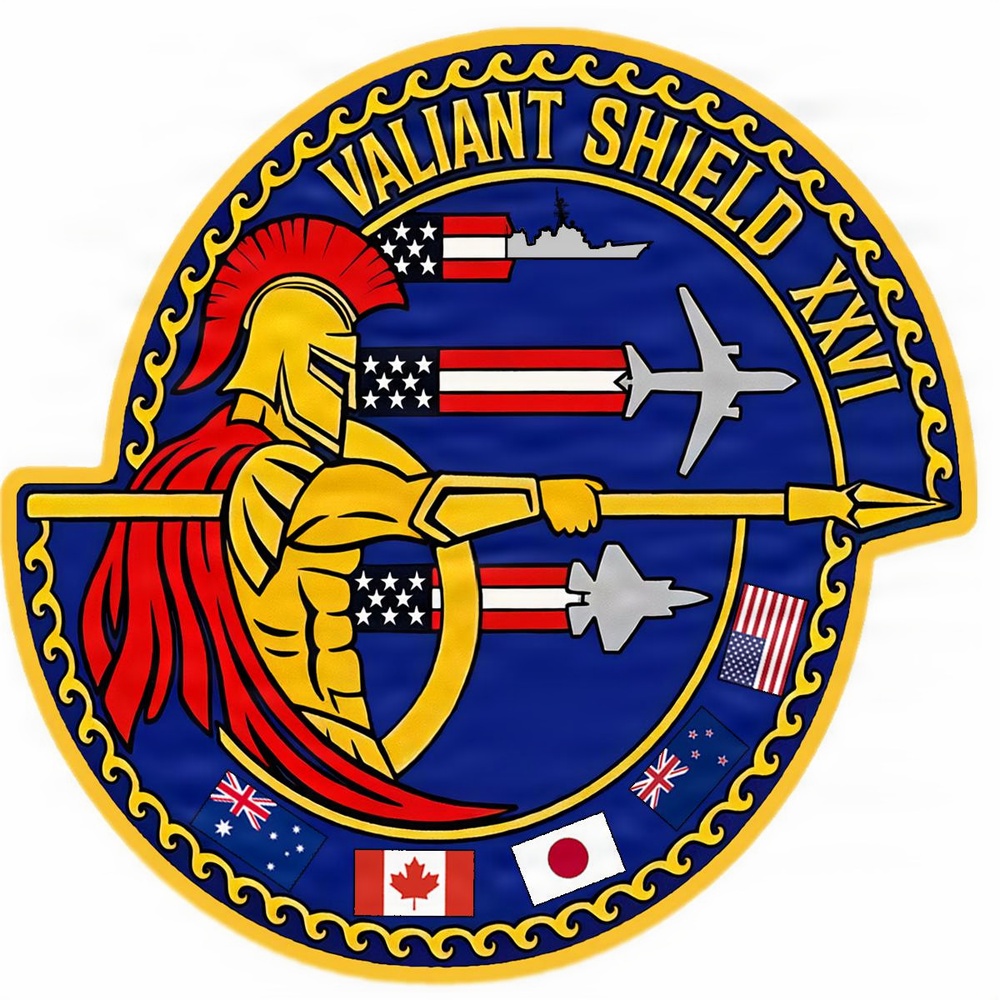
Photo By Senior Airman Austin Salazar | Exercises like VALIANT SHIELD allow Pacific Command Joint Forces the opportunity to integrate forces from all branches of service and with our allies to conduct precise, lethal, and overwhelming multi-axis, multi-domain effects that demonstrate the strength and versatility of the joint force and our commitment to a free and open Indo-Pacific. see less
| View Image Page
Valiant Shield 26 Breaks New Ground in Vast Synthetic Training Environment
ANDERSEN AIR FORCE BASE, Guam — U.S. joint and combined forces trained side by side in a vast live, virtual, and constructive training environment during Valiant Shield 2026, June 22 to July 1. Live pilots, high-fidelity virtual simulators, and constructive computer-generated forces operated together in realistic scenarios, across air, land, sea, space, and cyber domains linking key command and control and operational nodes across the Pacific and beyond.
"We are integrating from Guam to Japan to Hawaii,” said Dr. Mike Foust, U.S. Army Portfolio Acquisition Executive-FIRES exercise lead and Valiant Shield 26 technical director. “We are connecting geographically dispersed participants into a common synthetic environment, integrating training capabilities across the Pacific.”
This high-end integration, enabled by the U.S. Pacific Command J7 Pacific Multi-Domain Training and Experimentation Capability, in collaboration with service components, other Department of War organizations, and industry partners, created a unique collaborative environment of warfighters, scientists, Department of War civilians, contractors, and industry.
U.S. Air Force Maj. Norman “Fuse” Hitosis, 36th Wing Weapons Officer, was the lead for the Guam defense line of effort during Valiant Shield 26. He said the live, virtual, and constructive environment provided unparalleled training that overcame the “tyranny of distance” inherent in the US PACOM area of responsibility.
“Pacific Homeland Defense is the cornerstone for maintaining our ability to conduct operations in and around the theater,” said Hitosis. “Being out on the remote and forward edge, I simply don't have the robust range infrastructure I had back in [continental U.S.] ranges. However, what I do have here are PMTEC-funded virtual and constructive capabilities which serves to enhance joint training and rehearsals for the Joint Force in Guam.”
Valiant Shield 26 featured an integrated air and missile defense scenario, where, for the first time, joint training audiences coordinated 360-degree Guam defense operations integrating solutions from the U.S. Army, U.S. Air Force, U.S. Navy, U.S. Marine Corps, Missile Defense Agency, and industry partners. In collaboration with the Guam Defense System Joint Program Office, PMTEC leveraged synthetic environments to present realistic threats, such as ballistic and cruise missiles, as well as airborne intelligence, surveillance, and reconnaissance platforms, allowing participants to rehearse and refine tactics, techniques, and procedures in a cost-effective, adaptive setting.
“Having a robust virtual, and constructive environment gives us the flexibility to pivot exercise events and maintain the integrity of our desired learning objectives,” said Hitosis. “Our virtual & constructive environment is mature enough to refine advanced TTPs to conduct Integrated Air & Missile Defense of the Pacific Homeland.”
While the live, virtual, and constructive environment linked warfighters and command and control nodes thousands of miles apart, it also brought them together. U.S. Navy, U.S. Army, and U.S. Air Force personnel trained and briefed side by side in the Andersen Air Force Base Installation Control Center.
“You think about the defense of Guam, it's a joint fight,” said Foust. “How do I get aircraft on and off the runway, flying through ground-based air defense? How do we coordinate engagements and adjust attrition and maintenance while maintaining combat effectiveness? Now everyone is in the same room, working the problem together,” Foust said.
One of the central tools used to identify problems was Simplified, Planning, Execution, Analysis, and Reconstruction, known as SPEAR. SPEAR is a multi-domain distributed debrief and adjudication asset that ingests and visualizes high-fidelity data streams—including sensor tracks, command and control messages, effects chains, and mission outcomes.
"SPEAR provides a rapid debrief capability where we can look at who did what,” said Foust. “We can play back the entire two-hour mission in a 30-minute window, pausing it at discrete events we want to look at—versus waiting three, four hours to pull all this data together.”
U.S. Navy Chief Warrant Officer 2 Michael DeTrolio, systems test officer onboard USS Kidd (DDG 100), and upper tier coordinator for Valiant Shield 26, said using SPEAR allowed operators to pinpoint what they were thinking when they made specific decisions.
“It was a really good way of figuring out something that went wrong, drilling down, and developing a plan to make sure it doesn't happen again," said DeTrolio. The joint debriefs and day-to-day collaboration renewed his appreciation for joint training opportunities.
“We have assumptions of how each other operate,” said DeTrolio. “But we found during this that a lot of those are not correct. Once we started digging into what each branch could do and what they were capable of, we were actually able to do a lot more."
Having industry representatives in the Installation Control Center was also a new and beneficial experience.
“I've never been asked for my opinion on this many things by this many people,” said DeTrolio. “You would give [industry representatives] something you liked or didn't like or would like to see, and sometimes they could have it available the next day.”
The robust live, virtual, and constructive architecture, joint environment, and industry-forward capabilities supported several other firsts during Valiant Shield 26.
In a significant step for interoperability with the Japan Self Defense Forces, the F-35 effects-based simulator delivered through a combined effort between industry and the F-35 Joint Program Office, provided the first virtual training contribution originating from Japan into Valiant Shield 26.
Utilizing the U.S. Air Force’s Simulator Common Architecture Requirements and Standards, otherwise known as SCARS, pilots from the 35th Fighter Wing at Misawa Air Base operated high-fidelity simulated fifth-generation aircraft, enabling complex mission rehearsal without leaving the hangar.
The Collaborative Combat Aircraft Program Office contributed computer-generated, semi-autonomous "loyal wingmen" entities that extend the reach and lethality of crewed aircraft and replicate realistic crewed-uncrewed teaming. This enabled the first ever live and virtual collaborative combat aircraft live fly test and exercise integration.
The partnership demonstrated how distributed fifth-generation aircrew can train against pacing threats with maximum realism west of the International Date Line. By combining the virtual F-35 effects-based simulator with constructive collaborative combat aircraft, they executed contested, all-domain scenarios that are otherwise difficult to replicate through live training alone.
For the pilots at Misawa, the ability to plug into the Guam fight from Japan carried immediate operational value, according to U.S. Air Force Lt. Col. John "Butcher" Widmer, commander of the 13th Fighter Squadron.
“The fighter jets Misawa brings to the fight are part of the first line of defense against aggression toward the U.S. and partners in the region," Widmer said. He noted that networking simulators at Misawa also allows pilots to train with off-station units and controllers at Guam without the cost and disruption of temporary duty travel. "By being able to simulate with off-station units while at Misawa, we can get the training we need while eliminating those other burdens," said Widmer.
Widmer framed the Japan-to-Guam link as an important step forward. “We have been able to prove that we can provide combat power in close conjunction with our allies," he said. "Our Airmen stand ready to defend our allies in the region if called upon."
Another initiative was the use of Joint All Domain Artificial Intelligence. Rather than relying on extensive manual control of the simulated environment, which requires numerous personnel to operate, JAD-AI generates intelligent agents that autonomously control entities across an all-domain, large-scale live, virtual, and constructive simulation. Each agent draws on a library of tactical behaviors to express the most realistic activity possible, producing a far more complex adversarial and friendly force picture than traditional methods could achieve. Beyond generating the training environment itself, PMTEC also used the Valiant Shield LVC environment to support experimentation associated with future collaborative combat aircraft concepts, including crewed-uncrewed teaming.
While the F-35 pilots proved combat power could be projected across the theater from the air, another first-time experiment reached even higher—into space.
Valiant Shield 26 saw the first experimental integration of the Space Development Agency—demonstrating within the live, virtual, and constructive environment how the agency's tracking layer satellites could function as a sensor within the broader Guam Defense System architecture.
“Our tracking layer satellites are always on and detect the heat signatures of multiple threat types,” said Cmdr. David Yancey, military deputy at Space Development Agency-Pacific. “The key advantage is that they don't have to be tipped or cued by another system; they're always watching."
Yancey said the Valiant Shield experimentation ensures space-based sensing is woven into joint missile defense from the ground up — advancing the goal of advancing the Joint Force's goal of connecting distributed sensors and shooters across the Indo-Pacific.”
"The Guam Defense System Joint Program Office shares PMTEC's 'fail forward' mindset—encouraging us to participate as we're able so we can keep moving the effort forward,” said Yancey. “This is exactly the kind of constructive disruption SDA was built to deliver for the joint force.”
During the exercise, PMTEC also worked with industry partners to include cognitive load testing for pilots and battle captains, to inform future training needs and real-world considerations.
Valiant Shield 26 marked the culmination of PMTEC’s initial four-year campaign to link ranges, resources, and warfighters across the U.S. Pacific Command area of responsibility through a unified, distributed joint, live, virtual, and constructive training architecture.
“Valiant Shield 26 has demonstrated a new model for how the joint force prepares to fight and win in the Indo-Pacific,” said PMTEC Project Manager Dr. Andre Stridiron. “Representative systems, sensors and decision-makers rehearsed realistic defense scenarios together in a highly relevant operational environment.”
According to Stridiron, this synthetic architecture means that complex, realistic training is no longer restricted by geographic limitations, constrained airspace, or the massive costs of deploying physical assets. “Whether they [the warfighter] are a pilot coordinating with semi-autonomous wingmen, an air defender tracking simulated ballistic missiles, or a cyber operator defending critical networks, service members in the Pacific theater can rehearse high-end, all-domain operations from their home stations with the exact systems they would use in combat.”
Stridiron added that access to immersive, threat-representative scenarios like those provided during Valiant Shield 26, ensures that when warfighters face an adversary, they have already built the tactical muscle memory needed to operate confidently and decisively under stress.
Valiant Shield is a multinational, biennial field training exercise focused on integrating interoperability training in an all-domain environment. It emphasizes realistic training in detecting, tracking, and engaging threats across sea, air, land, space, and cyberspace domains to enhance overall combined and joint force readiness.

 Subscribe






