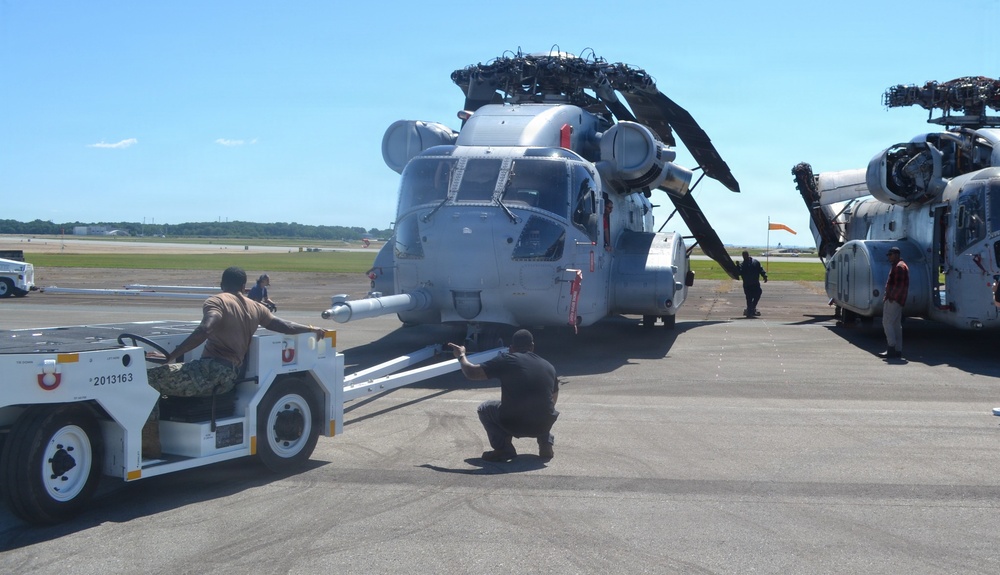
In preparation for the first deployment of the CH-53K King Stallion helicopter with a Marine Expeditionary Unit (MEU), a recent embarkation of four CH-53Ks, a MEU-sized detachment, successfully participated in a Type Commander’s Amphibious Training (TCAT) for the first time in June.
“The June TCAT was designed to enhance mobility, planning, and integration between the U.S. Marine Corps and the U.S. Navy,” said Col. Joshua Wort, Program Manager, H-53 Heavy Lift Helicopter Program Office (PMA-261). “It was also an opportunity to resolve some of the remaining shipboard integration issues identified during earlier sea trials.”
An important part of the TCAT was to increase squadron proficiency in towing, blade-folding, and aircraft strutting – optimizing the rapid movement and stowing of the aircraft on the flight deck and in the Landing Platform Dock (LPD) and Landing Helicopter Dock (LHD) amphibious assault ship hangars.
“Stowing the aircraft efficiently aboard an LPD or LHD is vital to ensuring space for required maintenance while clearing the flight deck for continued launch and recovery of aircraft,” said Wort.
Though the CH-53K King Stallion heavy lift helicopter is fully marinized for U.S. Marine Corps shipboard operations, parking requires assistance from an onboard tow tractor.
One shipboard integration issue identified by the Integrated Test Team (ITT) was the “fit” of the current Adjustable Length Towbar (ALBAR), which attaches the tow tractor to the aircraft’s nose. The ALBAR comes in standard lengths of 8-, 15- and 22 feet.
Less than three months before the training, the Naval Air Warfare Center Aircraft Division Lakehurst (NAWCAD LKE) Support Equipment Test and Evaluation (SE T&E) Branch began coordination with the NAWCAD LKE Air/Ship Integration Branch for a towing analysis, confirming the 22-foot ALBAR was too long.
“An ALBAR that is too long would put limitations on the flight deck space preventing the successful spotting of the CH-53K,” said a CH-53K Support Equipment Test Engineer for NAWCAD. “While an ALBAR that is too short could cause the tow tractor to impact the aircraft’s Aerial Refueling Probe during towing.”
Earlier in the year, the team modified two existing towbars as test assets, creating 18- and 20-foot towbars for further analysis using a Shipboard Tow Tractor fleet asset for validation.
“Working with the test squadron, our analysis determined the solution was to develop an ALBAR specifically for the CH-53K, allowing flight deck maneuverability without impacting the Aerial Refueling Probe,” said the team lead.
An additional ALBAR was converted prior to the TCAT and the NAWCAD Cargo and Special Operations Lab transported the two specialized ALBARs to the fleet.
“From program office testing to NAWCAD engineering design, test team analysis, and the Cargo Lab delivery, this joint effort exemplifies the total commitment and unified response we are able to provide to resolve the needs of the fleet,” said Wort.
| Date Taken: |
08.25.2026 |
| Date Posted: |
08.25.2026 09:19 |
| Story ID: |
573149 |
| Location: |
MARYLAND, US |
| Web Views: |
23 |
| Downloads: |
0 |
PUBLIC DOMAIN

This work, Not too big, not too small: joint effort creates “just right” CH-53K tow bar for fleet, by Megan Wasel, identified by DVIDS, must comply with the restrictions shown on https://www.dvidshub.net/about/copyright.