
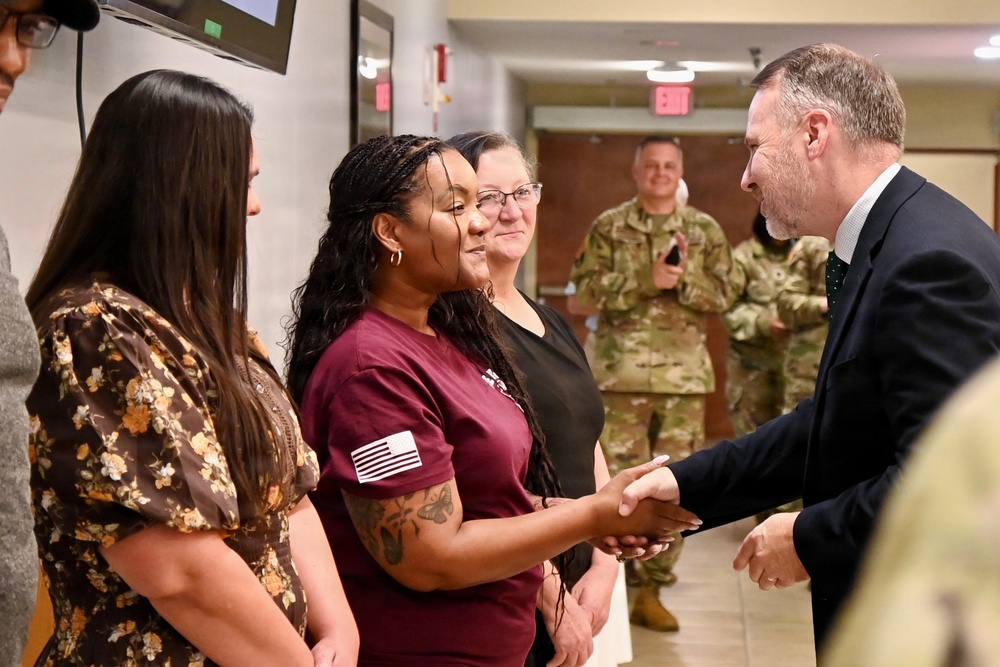
Photo By Jean Graves | Joseph “Chris” Rheney, chief of the Army Medical Department Civilian Corps and a...... read more read more
FORT POLK, La. — Joseph “Chris” Rheney, chief of the Army Medical Department Civilian Corps and a member of the Senior Executive Service, visited Bayne-Jones Army Community Hospital Aug. 21 to share his leadership philosophy and invest in the professional development of the hospital’s military and civilian workforce.
Col. Patrick W. Miller, BJACH commander, invited Rheney to Fort Polk as part of the hospital’s ongoing emphasis on leader development.
“To really grow as an organization, I think it’s important to hear from various vantage points,” Miller said. “The team hears from the command sergeant major and me regularly, and that’s very intentional.”
Rheney spent the day learning about BJACH and its mission through a command brief, hospital tour and discussions with leaders and employees before conducting an interactive leader professional development session focused on four themes: learning, leading, empowering and developing.
For Rheney, effective leadership begins with lessons he learned from leaders who invested in him.
“I had leaders early on that showed me what servant leadership looks like as far back as my ROTC experiences,” Rheney said. “Leaders invested in my development and took time to understand what my strengths and weaknesses were so that I could grow as a leader.”
Those experiences also showed him what leadership should — and should not — look like.
“I also had a good look at how great leadership and poor leadership can be modeled, so that I learned not only what to emulate, but also what to avoid,” he said.
Leading with TRUTH
Rheney has distilled those lessons into a leadership philosophy he calls TRUTH: Trust, Responsibility, Understanding, Tenacity and Happiness.
He said the philosophy is an outgrowth of his faith, which he described as the foundation of his life, but each element also carries a practical application for leaders.
Trust begins with considering who and what people trust and how leaders build trust within an organization. Responsibility, Rheney said, requires leaders to both accept responsibility for themselves and clearly give responsibility to others.
Understanding operates on two levels: leaders need to understand the people with whom they work, but they also need to clearly understand the problems they are trying to solve.
Tenacity becomes particularly important when leading change.
“Especially at the strategic level, change requires tenacity due to the changes in momentum and time horizons we often deal with,” Rheney said.
The final element, happiness, is less about simply enjoying a job than finding purpose in a vocation.
“Happiness is not a must for a job, but for a vocation, it is a must,” Rheney said. “To sustain long-term, effective leadership, you really have to love what you do and the people you serve.”
For Rheney, those principles ultimately manifest through everyday behavior.
“The small things matter in each and every moment — how we treat each other and how we prioritize our time and effort,” he said.
Same principles, different tools
Rheney brought that philosophy directly into his discussion with Team BJACH.
“The leadership principles are universal, the tools are different,” he said. “For us to be an effective team, we all need to lead by listening better, treating everyone the same and giving each other our very best.”
Throughout the LPD, Rheney used experiences from his military and civilian career to demonstrate those principles.
He recalled entering the military treatment facility environment as an Army officer after spending much of his early career in operational units. Faced with responsibilities in an unfamiliar environment, he relied heavily on experienced civilian professionals who understood the organization, its systems and its mission.
“Learn from your civilian staff; they have a lot to offer,” Rheney told the audience.
The lesson now informs the way he approaches leadership: expertise does not necessarily follow rank or position, and leaders need to listen to and learn from the people around them.
Developing people
Rheney also emphasized the responsibility leaders have to deliberately develop others — something rooted in his own experience with leaders who invested in him.
During the LPD, he challenged supervisors to understand employees’ professional goals, provide meaningful feedback, identify potential and create opportunities for people to broaden their experience.
He said employees also have a role in their own development by seeking opportunities, accepting challenging assignments and being willing to take calculated professional risks.
That emphasis on development is one reason Miller said having Rheney physically come to Fort Polk was important.
“Getting a well-respected Army Medicine senior leader to not only address the team, but to physically make the trip here and conduct an LPD in person speaks volumes,” Miller said. “It shows that BJACH and Fort Polk are vital to Army warfighter readiness and valued within Army Medicine.”
With civilians comprising approximately two-thirds of BJACH’s workforce, Miller said the opportunity was particularly relevant.
“I want to ensure every member on this team feels connected and appreciated,” Miller said. “Leader development applies to our entire team, including our civilian teammates.”
Leadership for the future
When asked which leadership competency will become increasingly important to the future military medicine workforce, Rheney’s answer was immediate.
“Emotional intelligence is No. 1,” he said.
Rheney described emotional intelligence as knowing one’s own strengths and weaknesses, being able to manage and improve weaknesses and understanding when and where individual strengths can be most effectively applied.
That self-awareness complements the outward-looking elements of his leadership philosophy: understanding others, building trust, listening and investing in people.
Rheney demonstrated another of those principles at the conclusion of the LPD when he recognized five BJACH civilian employees with AMEDD Civilian Corps Chief coins for their contributions to the organization and military medicine.
Miller encouraged Team BJACH to carry Rheney’s lessons beyond the session.
“Take it with you,” Miller said. “Put it in your pocket, pay it forward.”
For Rheney, effective leadership ultimately comes down to both what leaders do and the relationships they build while doing it.
“There is an art and science to leadership,” Rheney said. “The science is in developing and relentlessly following processes. The art is in fostering relationships. Both are essential to becoming an effective leader.”
| Date Taken: | 08.24.2026 |
| Date Posted: | 08.24.2026 15:30 |
| Story ID: | 573112 |
| Location: | FORT POLK, LOUISIANA, US |
| Web Views: | 53 |
| Downloads: | 0 |

This work, The art and science of leadership: AMEDD Civilian Corps chief shares lessons with Team BJACH, by Jean Graves, identified by DVIDS, must comply with the restrictions shown on https://www.dvidshub.net/about/copyright.


No keywords found.





