
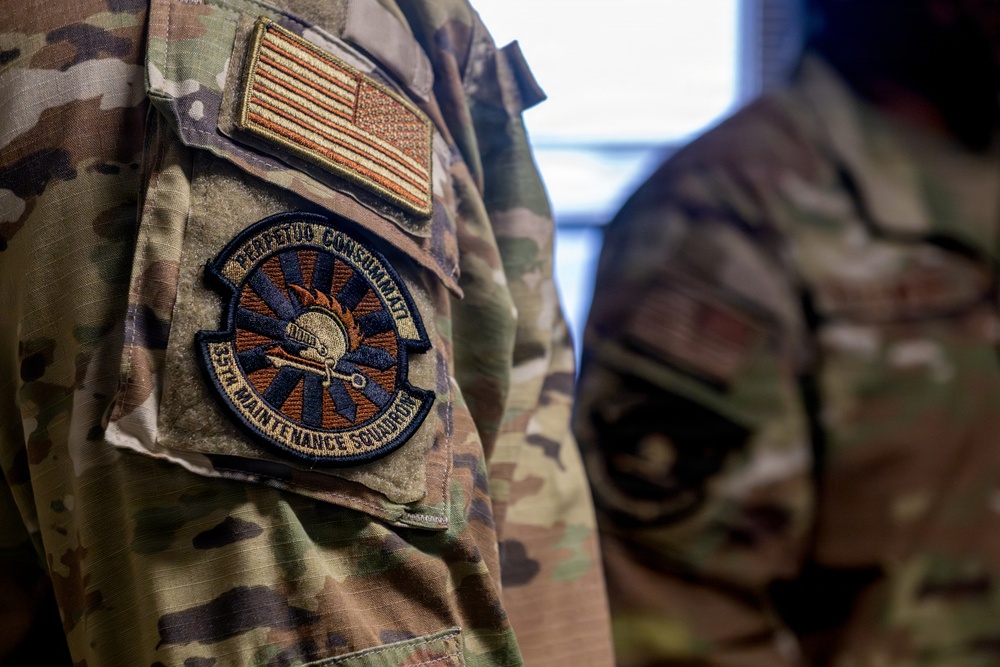
Photo By Airman 1st Class Hannah Bench | A U.S. Air Force 35th Maintenance Squadron (MXS) patch is displayed at Misawa Air...... read more read more
 Subscribe
MISAWA AIR BASE, Japan – Deployment life settled into a rhythm familiar to many maintainers: six-day workweeks, long hours on the flightline and just enough sleep to do it all again the next morning.
In early 2016, then-Senior Airman Jeffrey Thompson deployed as an F-15 Eagle crew chief to Al Dhafra Air Base, United Arab Emirates.
Among Airmen, Al Dhafra carried a reputation as one of the more comfortable deployment locations. The canvas tents had air conditioning. The gym was clean and well-equipped. Gravel paths connected rows of beige tents that stretched across the installation like a small neighborhood in the desert.
Inside the tents, wood floors were covered with worn rugs left behind by previous rotations. Bunk beds lined the walls beside military wall lockers stuffed with uniforms, boots and duffel bags. Each Airman carved out a small section of living space, separated only by curtains.
“You just go through the motions,” Thompson said. “If you've been deployed, you know what it's like.”
He spent his days launching and recovering aircraft beneath the desert sun. Even during the winter months, the heat lingered. Sunburns became part of the job, followed by long evenings in the gym before returning to tent city for a few hours of sleep.
Five months into the deployment, Thompson prepared for just another day of work when his phone dinged with a notification. He sat down on the bottom bunk of his bed, his fresh uniform whispering his movements.
A wall of text messages from his wife waited for him. By the time he finished reading, his eyes filled with tears. His marriage was over.
“When I got the page-and-a-half text message of her saying goodbye,” Thompson said, “I remember thinking, ‘What just happened?’”
The air conditioning still hummed overhead. Airmen continued moving through the tent outside his curtained room, getting dressed for another shift. Outside, buses arrived to carry maintainers to the flightline.
Thompson stared at his phone with his hands shaking and his eyes burning.
“You never expect something like that to happen,” he said. “It was painful. There was confusion. Anger.”
A few minutes later, he put on his uniform, grabbed his gear and boarded the bus. Tents passed by outside the window. The sun already torched the sky at 6 a.m.
He stepped into the maintenance break room just before roll call. Airmen filled the room, some preparing to shower after a night of work and others getting ready for another day on the flightline.
One of his closest friends during the deployment, Senior Airman Zack Goodwin, turned to greet him.
“I hadn't even said anything yet,” Thompson said. “He looked at me and knew something was wrong.”
Thompson’s eyes were still red. His gaze remained distant as he tried to process the message. Goodwin gently drew the information out of him as conversations continued around them about the previous shift.
His friend urged him to seek help and speak to the section chiefs, but Thompson hesitated.
“Maintainers often follow the ‘suck it up and figure it out’ mentality,” Thompson said. “The stigma that going to mental health would ruin your career still existed. Even I used to believe it.”
After sitting with the weight of the message, Thompson followed Goodwin’s advice and stepped into the section chief’s office. A simple question opened the floodgates.
How are you doing? he recalled being asked.
Thompson broke down in the office and his supervisors gave him a week off. He spent the time messaging friends and family and throwing himself into workouts at the gym. When he returned to the mission, he buried himself in long shifts on the flightline.
The routine helped, but it did not erase what had happened.
A few months after returning home, his divorce became final. Two weeks later, another phone call brought devastating news. A close friend died by suicide.
“The month I heard about the death was just as hard as the month I learned about my divorce,” Thompson said. “They were equally difficult, but by the time I heard about my friend choosing not to live anymore, I was numb.”
He immersed himself in work after arriving at his next base, where he said the demanding pace and close-knit maintenance team helped him regain a sense of purpose. Outside of work, he stayed in the gym, sought help through mental health resources and eventually met the woman who would later become his wife.
Looking back, Thompson said recovery did not happen all at once. It happened through small conversations, trusted friends and leaders who made him feel seen.
Years later, after arriving at Misawa Air Base, a basewide email from a chaplain caught his attention.
The message invited Airmen to an orientation for a new peer-support initiative called the HOPE Program.
Curious, Thompson walked into a conference room at the 35th Maintenance Squadron.
The orientation focused on spiritual fitness, instead of religion. Thompson felt glad that they talked about resilience, purpose and learning how to have difficult conversations with people who simply needed someone to listen.
As instructors posed questions to the class, Thompson answered from experience, sharing pieces of the journey that began years earlier in a canvas tent halfway around the world.
“I remember thinking, ‘This is cool,’” Thompson said. “He’s teaching me something, and I’m using it to help other people.”
What began as an afternoon of listening grew into regular training, weekly meetings and a volunteer community supporting Airmen before a crisis. Started within the 35th Maintenance Squadron, the program has expanded beyond maintenance, with Thompson hoping to expand it across the wing.
Today, Thompson serves as president of the HOPE Program at Misawa Air Base. Nearly a decade after learning what it meant to have someone ask if he was OK, he found himself on the other side of that conversation when an Airman walked into his office.
Heat and humidity hung low in the hangar, seeping into the offices. Portable air conditioners blasted relentlessly, their constant hum forcing conversations above the noise. The last few maintainers drifted out after day shift turnover, their voices fading into the parking lot as their workday ended.
Everybody headed home. One Airman hesitated.
She knocked softly on the office door before stepping into a room with four sergeants in the middle of turnover. All of them turned, and the Airman froze.
Her gaze shifted toward the person in the room she trusted most before quietly asking for some privacy, visibly embarrassed by the request.
Thompson immediately understood.
The two stepped into a nearby empty office, where Thompson spent nearly an hour listening as the Airman talked through everything she had been carrying.
“I kind of prefaced it with, ‘Don’t let me over-logic you,’” Thompson recalled with a laugh. “‘I'm not trying to solve all your problems. Talk to me. What’s going on?’”
For Staff Sgt. Marilhen Villanueva, 35th Maintenance Squadron F-16 Fighting Falcon crew chief, walking through Thompson’s office door took weeks of deliberation. Her husband was deployed, she was preparing for a move and she had filled her schedule with volunteer commitments to keep her mind off of things.
“You could see she was carrying the world on her shoulders,” Thompson said. “Like a lot of maintainers, she was trying to bury the emotion and just keep moving.”
Villanueva heard Thompson talk about the HOPE Program during roll calls and shift turnovers, reminding Airmen the program was available if they ever needed someone to talk to.
“He talks about the HOPE Program all the time,” Villanueva said. “He’s the most welcoming person in that office.”
For Thompson, the moment reminded him how much he’d developed.
Before, he was the Airman sitting in a small office, struggling to explain what he was going through to someone who simply stopped long enough to ask.
Now, he was the one listening.
“I want to do for other people what the HOPE program did for me,” Thompson said. “I want it to be a place people can go to learn or a place to go to help others.”
Thompson once sat inside a canvas tent at Al Dhafra Air Base, wondering how he would make it through the day. Now, when an Airman walks into his office carrying the weight of the world on their shoulders, he already knows where to begin.
He asks the same question that once changed everything for him.
“How are you doing?”
| Date Taken: | 08.20.2026 |
| Date Posted: | 08.21.2026 00:48 |
| Story ID: | 572884 |
| Location: | MISAWA AIR BASE, AOMORI, JP |
| Web Views: | 16 |
| Downloads: | 0 |

This work, HOPE starts here: Misawa Airmen strengthen resiliency, by A1C Hannah Bench, identified by DVIDS, must comply with the restrictions shown on https://www.dvidshub.net/about/copyright.


No keywords found.




