
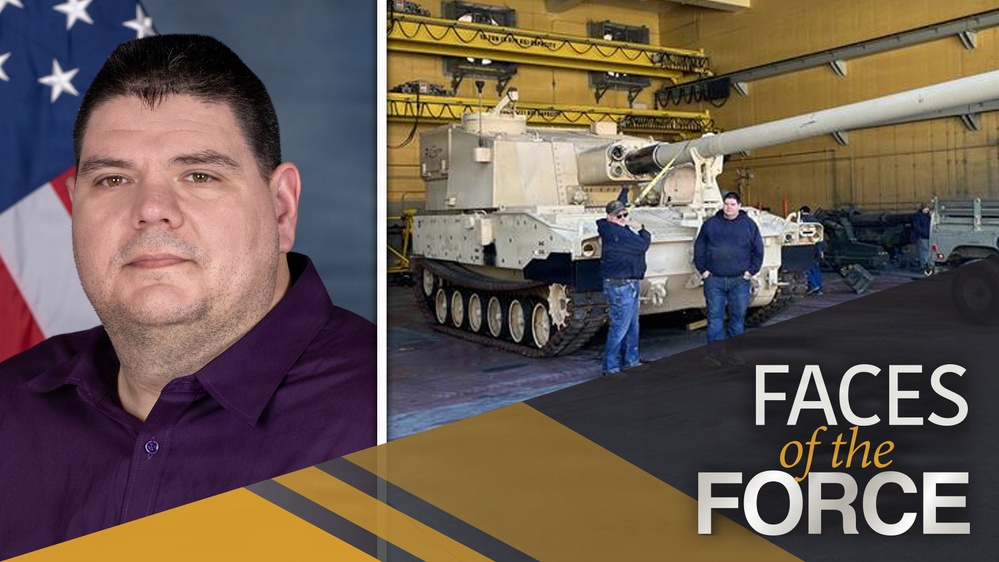
Photo By Cheryl Marino | FOTF Aaron Rider T2COM AFC read more read more
 Subscribe
COMMAND/ORGANIZATION: U.S. Army Transformation and Training Command and U.S. Army Combat Capabilities Development Command – Armaments Center, Explosive Ordnance Disposal, Demilitarization and Experimentation Directorate TITLE: Supervisory general engineer, acting competency manager YEARS OF SERVICE IN AAW: 21 DAWIA CERTIFICATIONS: Practitioner in engineering and technical management; Practitioner in test and evaluation EDUCATION: B.S. in mechanical engineering, Wilkes University AWARDS: Army Superior Unit Award (2024); Special Act or Service Award (2021-2024)
Aaron Rider traces the most important lesson of his engineering career to advice his father gave him years ago.
“He always said, ‘the main thing is, not to get excited,’ I think this is the best advice I ever got or could give to anyone,” Rider explained. “Basically, I see it as stop and think about what’s happening or happened, work out the details logically, figure out how to prevent it from happening again and move forward. No one wins when logic is thrown out the window and only emotions are utilized to make the decisions.”
Rider serves as the acting competency manager of the Armaments Experimentation and Evaluation Division, supporting the U.S. Army__ __Transformation and Training Command (T2COM) and U.S. Army Combat Capabilities Development Command (DEVCOM) – Armaments Center, in New Jersey, where he oversees two diverse branches including both engineering technicians and engineers. His key responsibilities are to ensure his team is properly trained, outfitted and experienced to perform the energetic activities the customer base relies on them to perform, and to do it as safely and efficiently as possible.
“We provide a very unique service to the Armaments Center as well as the PM [Project Manager] offices in that we are able to conduct experiments on anything from malfunctioning items in the Army’s vast array of ammunition and explosives to ballistically firing new production, large caliber projectiles to verify structural integrity throughout gun launch to completely experimental munitions and projectiles to aid development for in-house and industry engineering efforts,” Rider said.
Overall, his greatest satisfaction as an Army civilian comes from knowing that his team’s work has a direct and meaningful impact on the warfighter. Rider said he takes pride in contributing to capabilities that matter in real world operations where precision, reliability and timelines can make a difference. That sense of purpose, supporting those who serve, is what makes the work truly rewarding.
“The specialties that exist in my division include things like remote operations, where we can safely and efficiently tear down munitions to better understand a malfunction, fire in-house [Armaments Center] designed warheads into witness plates to evaluate explosively formed penetrators [EFPs] formation and performance, as well as energetic operators who test the structural integrity of new production projectiles for large caliber weapons to ensure our warfighters are getting only the best products from the Army’s production contractors, and literally everything in between,” he said.
Rider’s career with the Army began after graduating from college, and in the most unique and unexpected way. He had been working as a draftsman for a small company in Scranton, Pennsylvania when an old high school acquaintance called him “out of the blue,” asking if he wanted a job.
“I told him I had one, but he said ‘No, [to be clear] you get to be outside all day every day and play with guns, ammunition and explosives.’ What’s not to like right?” Rider joked. He sent him his resume, and a couple of weeks later received a phone call to come in for an interview.
“The gentleman I talked to said ‘don’t wear a suit’—I liked this already.” Rider said. During the interview, he toured the office, installation, test areas and facilities at the Armaments Center. When they stopped at the gunshed (large open-air facility for large caliber testing) Rider noticed two civilian engineers struggling to change a 155-mm gun tube.
“I asked the interviewer if I could go help them and he said ‘sure.’ When we finished changing the tube, I walked back to the interviewer and he said, ‘So, when do you want to start?’ Less than a month later I was a new civilian with the U.S. Army.”
Rider said he firmly believes that starting at the bottom of the organization as a newly hired engineer and working his way up the ranks to lead engineer, then branch chief and now competency manager, really gave him an appreciation for the work, the people and the customers the Army services as a whole, that he may not have had if he started somewhere else.
“The biggest goal I have right now is to make sure the folks that work for me have everything they need to safely and efficiently do their jobs,” he said. “And provide whatever support I can to ensure that happens.”
Rider attributes this perspective, and much of his success to having a good mentor, “even though he probably didn’t think he was a mentor at all,” he said. “My old boss, now retired and whose position I am currently filling, showed me a lot of different things throughout my career that definitely aided in my ability to do a good job. He always had advice and instruction but didn’t give orders and allowed me, and my counterpart [the munitions branch chief], to run our respective branches how we saw fit. That style of leadership really helped me develop my own style and I think allowed me to build some respect from my employees.”
The best advice Rider said he would pass along to junior acquisition personnel would be the advice his father gave to him, with a couple caveats.
“The main thing is not to get excited—but don’t get complacent. Work through whatever problems you run into logically, seek advice from as many knowledgeable people as you can and if you think you are the smartest person in the room … find a new room,” he said.
Outside of work, Rider is best known for being “the guy that will help”—with whatever is needed.
“My wife and I volunteer at the local fire company, and I recently took up making sourdough bread, cookies, bagels and, well, anything with sourdough,” Rider said. His wife, April, is allergic to an ingredient in store-bought bread, so he thought he would give sourdough a try to see if that could be tolerated. Both he and his wife were surprised, and relieved, when she had no issues. “No more swelling after she eats it and I like the taste,” he said. “So, win-win.”
| Date Taken: | 08.18.2026 |
| Date Posted: | 08.19.2026 16:28 |
| Story ID: | 572783 |
| Location: | US |
| Web Views: | 29 |
| Downloads: | 0 |

This work, Always Apply Logic – Aaron Rider, by Cheryl Marino, identified by DVIDS, must comply with the restrictions shown on https://www.dvidshub.net/about/copyright.


No keywords found.




