
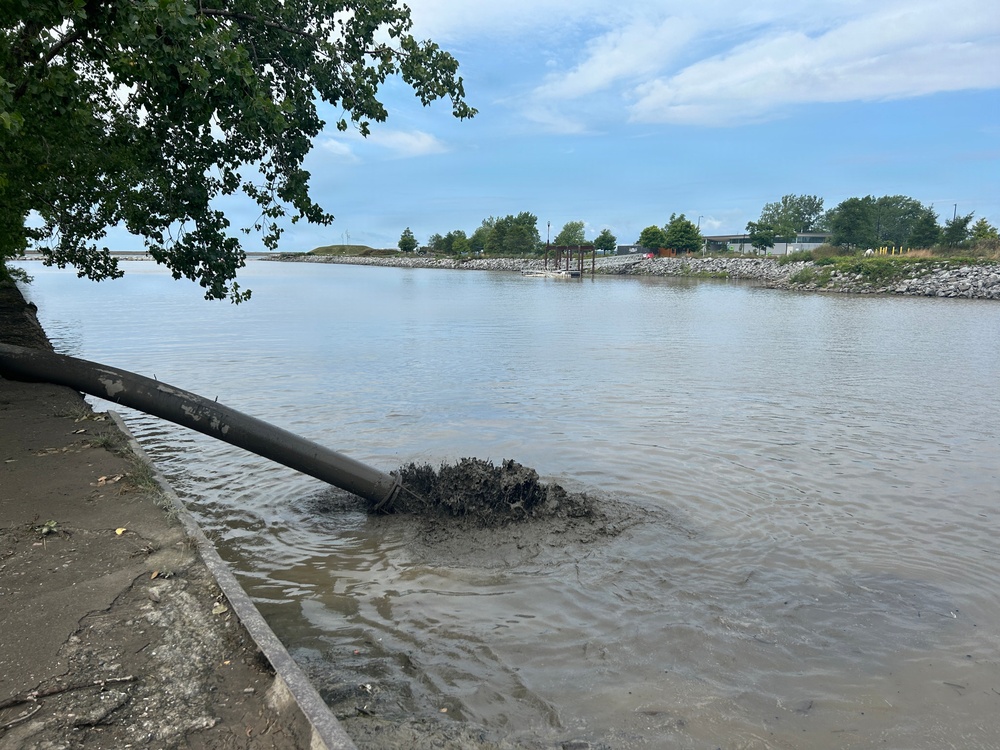
Photo By Kaylee Wendt | U.S. Army Corps of Engineers, Buffalo District placement of beneficially used dredged...... read more read more
BUFFALO, N.Y. — Beneath the surface of the Buffalo Harbor and River, sediment is constantly accumulating. Left unchecked, that material can reduce channel depths and create challenges for the vessels that depend on Buffalo Harbor and River to deliver commodities.
The U.S. Army Corps of Engineers, Buffalo District is addressing that challenge through a $2.3 million maintenance dredging project designed to keep Buffalo’s federal navigation channels open, safe and reliable.
Contractors for the Corps of Engineers are removing about 190,000 cubic yards of accumulated sediment from the Buffalo Harbor and River, maintaining the authorized depths needed for vessels to safely move through the waterways.
“What we’re doing here is we’re pulling sediment out of the federal navigation channel to allow for ship traffic to get through,” said Andrew Kist, Buffalo District Contracting Office Representative for the dredging project.
Approximately $1.1 million of the project funding is allocated for work in Buffalo Harbor, with approximately another $1.2 million supporting dredging in the Buffalo River.
During operations, which occur roughly every two years depending on funding availability, the Buffalo District’s contractor uses a 12-cubic-yard clamshell bucket to mechanically remove sediment from the channel. The material is loaded into dump scows for transport.
Depending on lake conditions and operations, crews can fill approximately eight to ten scows each day. Each individual scow holds about 1,900 cubic yards of sediment. That’s roughly the amount of two Olympic-size swimming pools!
Once filled, the scows transport the dredged material to a designated location where it is hydraulically pumped into a confined disposal facility. The process securely manages the material after it is removed from the navigation channel.
A portion of the dredged material, about 80,000 cubic yards, from this year’s dredging will be taken to Slip 3 at the Outer Harbor as part of what is referred to as a CAP 204 project. The CAP 204 project beneficially uses dredged material for ecosystem restoration. How does it work? The dredged material is first sampled and tested by the U.S. Environmental Protection Agency in addition to local and state environmental agencies. Once deemed suitable for reuse, the dredged material is pumped hydraulically into Slip 3 at the Outer Harbor. After multiple phases over the next 5 – 10 years, the depth of the water within Slip 3 will rise to levels needed for creation of a coastal wetland habitat.
While the large dredging equipment and the hydraulic pumping equipment may be visible to people using Buffalo’s waterways, the work is being conducted with minimal disruption to recreational navigation.
“There’s no major impact to boaters,” Kist said. “People are able to go in and out of the channel just fine. Kayakers that typically use the launch at Slip 3 will not be able to use the launch for about 2-3 weeks while work is being done. We hope to have the slip back open to kayakers before the end of August.”
Boaters traveling near active dredging operations should remain alert, maintain a safe distance from work vessels and equipment, and give contractors the space needed to safely complete the work.
The dredging operation is one part of the U.S. Army Corps of Engineers, Buffalo District’s broader responsibility for maintaining federal navigation infrastructure across the Great Lakes.
In Buffalo, that work may begin with removing sediment from the bottom of a channel, but its impact reaches beyond the dredge itself, helping maintain reliable access to the waterways that connect the city and region to the Great Lakes navigation system and restoring ecosystems that help keep the Great Lakes clean!
The Buffalo District delivers world class engineering solutions to the Great Lakes Region, the Army and the Nation to ensure national security, environmental sustainability, water resource management, and emergency assistance during peace and war. Learn more at[www.lrd.usace.army.mil/buffalo]().
| Date Taken: | 08.19.2026 |
| Date Posted: | 08.19.2026 14:36 |
| Story ID: | 572766 |
| Location: | BUFFALO, NEW YORK, US |
| Web Views: | 21 |
| Downloads: | 0 |

This work, Buffalo Dredging Keeps Commerce Moving and Builds Habitat, by Kaylee Wendt, identified by DVIDS, must comply with the restrictions shown on https://www.dvidshub.net/about/copyright.


No keywords found.





