
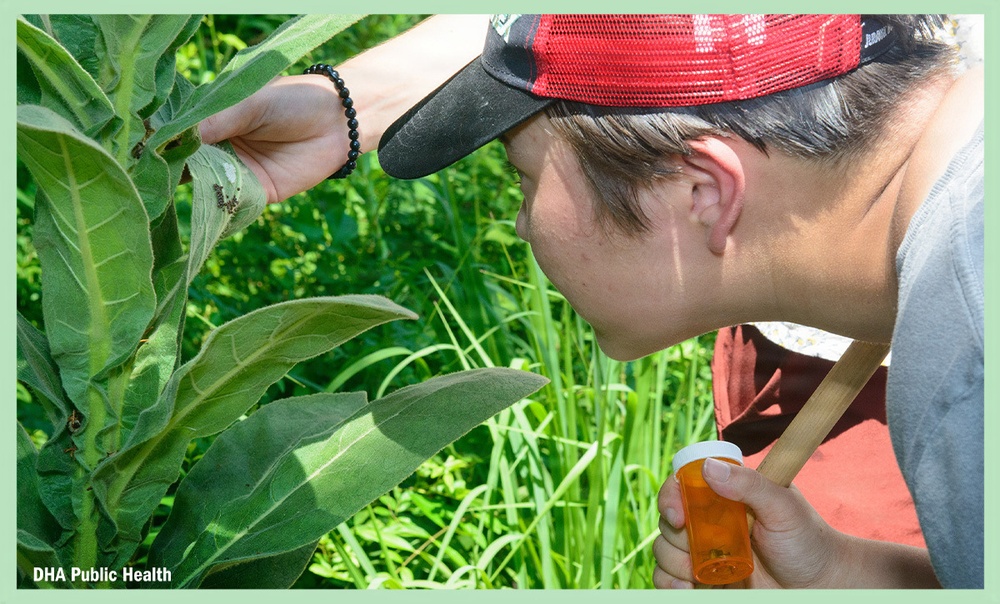
Courtesy Photo | Aila Kim, a student helper for Defense Health Agency-Public Health’s 2nd annual Bug...... read more read more
 Subscribe
If you visit Aberdeen Proving Ground, Maryland, you might find a unique father-daughter team studying insects. Army Col. Hee Kim, an entomologist and director of the Occupational Health Sciences Directorate for Defense Health Agency-Public Health at APG, and his 14-year-old daughter, Aila Kim, share a deep passion for bugs. This summer, Aila Kim, a rising high school sophomore, volunteered and was the only student helper for DHA-PH’s 2nd annual Bug Camp, held at APG, riding to work with her father each morning while her friends were still in bed.
"Mind you, she is out of school; it is her summer vacation," said Hee Kim. "She is riding with me to work and back. That alone is probably an eye-opening experience about getting exposed to a regular job and also having a sense of responsibility for other people for a week."
Their shared journey shows how military families can connect through science. Aila Kim did not always plan to study bugs. Her interest began after the family moved to Maryland, which is Hee Kim's ninth military duty station. The family's property has a trail in the backyard, where they go on walks and bug collection trips together.
"We've always been positive about teaching our kids about nature," said Hee Kim. He noted his wife, a children's book illustrator, draws and writes nature-themed books.
When their middle son shifted his focus to sports, he gave his insect collection to Aila Kim. Her interest grew after James Butler, an entomologist working at Fort George G. Meade and Hee Kim's former classmate, gifted her a Madagascar hissing cockroach. Today, Aila Kim keeps her own hissing cockroach colony right in her bedroom. Aila Kim's interest soon turned toward systematic science. She began reading her father's old college entomology textbooks and using his professional collection tools.
"I have access to my dad's old entomology things," she said. "So that got me into the more systematic side of it, of looking at what species they are and how to identify them."
This hands-on access helped her learn how to identify insects down to their genus and species. Today, father and daughter "talk shop" at home, using scientific family names like Tipulidae instead of common names like crane fly.
"It is a nice feeling to have your child find an interest on her own, other than video games and social media," said Hee Kim. "It is doubly joyful if our interests align, because we can talk about them."
At Bug Camp, Aila Kim put her scientific knowledge to work. As a student helper, she guided middle school campers through laboratory exercises, helped them focus microscopes, and taught them the delicate art of insect pinning. Her presence as a near-peer mentor helped campers who felt shy around the adult researchers.
"It was pretty cool," said Aila Kim. "I got to learn what working with other people as a leader in a camp, instead of being a participant, would be like."
During field collections, she used her own background knowledge to help campers solve problems.
"On the first day, we did insect collection, and I was able to help people identify what they were catching, and whether or not they wanted to keep it," said Aila Kim. "I helped people catch dragonflies, because my dad taught me that they mostly hunt in circles. If you can get in between their range — it is a lot easier to catch them than chasing after them."
Because of her experience with pinning bugs, she was able to assist other facilitators.
"I knew stuff," she said. "There was another adult helper who didn't know anything about bugs but was just doing it, so it was nice to know about bugs and be able to help."
For Aila Kim, the top reasons to be a peer mentor are clear.
"You get to help teach other kids about something they would probably enjoy too, and you can also listen to the presentations and learn as well," she noted.
The camp also gave Aila Kim a closer look at her father's scientific work. During a presentation on DNA extraction by DHA-PH entomologist and resident tick expert Robyn Nadolny, Aila watched the same polymerase chain reaction techniques that her father used for his doctoral research. Hee Kim was completing his doctoral degree when his daughter was a young child, making this her first real opportunity to see his work in action.
"I was really happy to see Aila go through that side of the tour and see that," said Hee Kim. "She can say, 'Okay, that's what dad did for his Ph.D.'"
He has been in the U.S. Army for more than two decades. Hee Kim noted while many military units conduct outreach, such as his former unit at Fort Stewart helping local Scouting America scouts earn their insect study merit badge, Bug Camp is his first experience with a centrally organized program.
"What Bug Camp provides that is unmatched is that from a public health perspective, the participants see their impact from start to finish," said Hee Kim. "They collect ticks, but they don't just put them in a bag and send them off to some la-la land. They know it goes through the step of DNA extraction, all the way to identification of a pathogen, and how that data is used to provide individual results for a patient — while also going into the bigger dataset for public health."
While Aila Kim plans to attend college, she does not plan to duplicate her father's career as a U.S. Army officer. Instead, she plans to focus on the systematic side of entomology.
"I'd rather do systematics, where I can identify bugs and do taxonomy, like managing museum collections," said Aila Kim.
For Hee Kim, his daughter's career choice is completely up to her. "The best thing a father can ask for is that she pursues her passion and has fun doing it," he said.
The Defense Health Agency is a Combat Support Agency, serving as a force multiplier for the joint services by optimizing lethality through warfighter medical readiness.
NOTE: The mention of any non-federal entity and/or its products is for informational purposes only, and is not to be construed or interpreted, in any manner, as federal endorsement of that non-federal entity or its products.
| Date Taken: | 08.17.2026 |
| Date Posted: | 08.17.2026 16:58 |
| Story ID: | 572535 |
| Location: | ABERDEEN PROVING GROUND, MARYLAND, US |
| Web Views: | 13 |
| Downloads: | 0 |

This work, Bonding over bugs: How a U.S. Army entomologist and his daughter share a passion for science, by Douglas Holl, identified by DVIDS, must comply with the restrictions shown on https://www.dvidshub.net/about/copyright.


No keywords found.




