
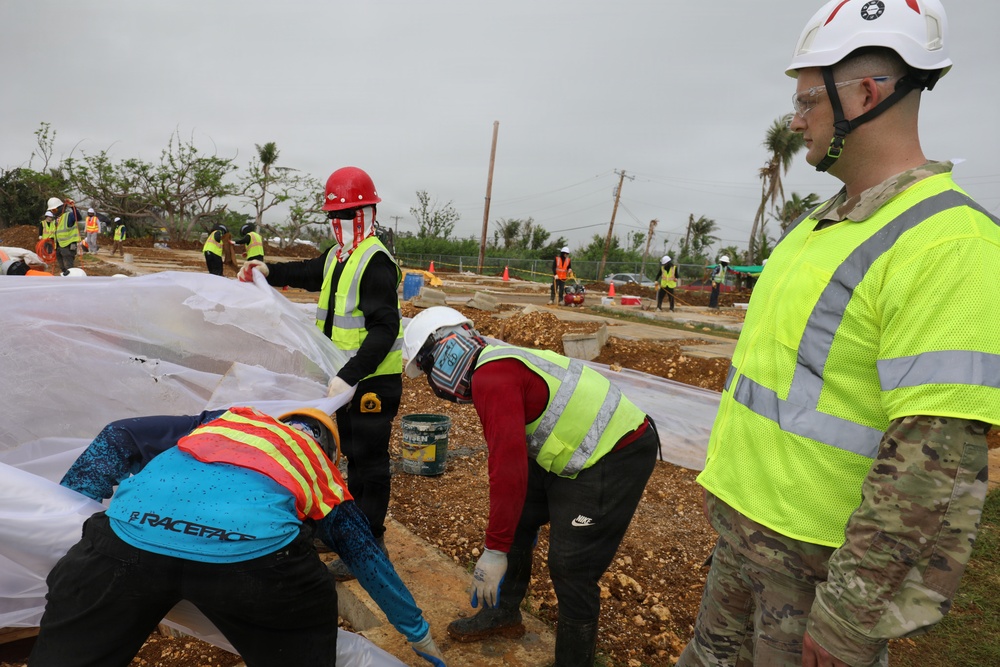
Photo By Monique Freemon | Maj. Matthew Kindig, contracting office, the U.S. Army Corps of Engineers – Rock...... read more read more
SAIPAN, Northern Mariana Islands—In April, one of the most powerful typhoons made landfall on the Commonwealth of the Northern Marianas Islands (CNMI)—Super Typhoon Sinlaku. With sustained winds at 170 mph, it was categorized as a “Super Typhoon” and a Category 5 storm.
The destruction Sinlaku caused on CNMI was no less than devasting. Across CNMI, there were reports of uprooted trees, overturned vehicles, toppled utility poles, loss of power, roofs ripped off homes, impassable roads, spoiled food due to loss of power, flooding and downed powerlines.
Then three months later, Super Typhoon Bavi hit. Though Bavi moved faster through the islands, it was stronger than Sinlaku. Winds were sustained at 185 mph. While Saipan and Tinian suffered damage, Rota—the southernmost island in CNMI—greatly suffered damage and lost power for almost two weeks.
Post-Sinlaku, the U.S. Army Corps of Engineers (USACE), The Federal Emergency Management Agency (FEMA), the American Red Cross, and other government and municipal agencies deployed to CNMI to assist in recovery efforts. Recovery was ongoing until Bavi halted operations, but USACE and their partners were able to respond quickly since they were already on the ground.
If you ask a USACE employee what an emergency mission is like, most will tell you that every mission is different. Each one is treated as a new experience with challenges and successes. From soldier to civilian, many have stated this was their first time deploying and shared their experience.
A Contracting Resource Before arriving to Saipan, Maj. Matthew Kindig never experienced a typhoon. That changed when Super Typhoon Bavi made landfall on CNMI. He was only a few days into his deployment for the Super Typhoon Sinlaku Recovery and experienced one of the most powerful storms of the year. And yet, Kindig cited it as one of his most memorable moments on his deployment.
“We had a safety plan that we developed and implemented; and then you just ride it out in the hotel,” he said, “It was interesting because you’re locked up in a hotel for a day and a half. And my hotel room didn't have a TV either. So, I was reading.”
However, rain was entering through his balcony door, which prompted him to lay down six towels to stop the rain from seeping into his room.
“That was the only hiccup I had, outside of that, it was fine; and eventually, we went to the lobby a little bit. I played some cards with people, but just sitting through a typhoon—being my first experience and not knowing what was going to happen.”
Apart from the heavy wind and rain, Kindig was calm about describing the experience. Additionally, Bavi did not cause much damage on Saipan and Tinian compared to Rota. Rota experienced severe damage that destroyed their power grid and left them without power for almost two weeks until the USACE Temp Power team began installing generators at critical facilities on the island.
A Memory of the Past While Kindig was not able to visit Rota, he did fly to Tinian when USACE leadership visited CNMI with the 249th Engineer Battalion to assess the damage post-Bavi.
“We did a tour of Tinian to see the power plant and see what issues they had to get back online and met with the 249th guys who are running power generation on Tinian,” he said.
According to the National Park Service, the two atomic bombs that dropped on Hiroshima and Nagasaki were prepped on Tinian in the early mornings of Aug. 6 and Aug. 9, 1945, respectively; with both missions being completed in Tinian.
“Additionally, we got to see a historical site where they had the docking bays for the atomic bombs during World War II. They left the island to go to Japan and drop the atomic bombs,” he said.
Mission Analysis Kindig served as the officer-in-charge of the operational contracting support integration cell for the Super Typhoon Sinlaku Recovery. Upon his return to USACE’s Rock Island District, he will continue serving as the contracting officer.
Over the years, he has had an expansive career in contracting domestically and overseas; and provides sound business advice to leadership and planning response teams.
“I don't execute (a) contract, but I also help inform them of updates and statuses on contracts or additional problems that we might face,” he said.
For instance, Kindig provided a mission analysis to address the logistical concerns on the conditions of Rota, one of the hardest hit areas after Super Typhoon Bavi.
“I think that helped paint a picture for everybody on what issues from, hotel rooms to power to how many vehicles they have, to just food and gasoline and all those types of problems that they might face,” he said.
This became a catalyst leading to Kindig becoming the executive officer (XO) of the Recovery Field Office (RFO). “So, I try to provide support where I can. Additionally, I was sort of roped into being the XO for the RFO, when Lt. Col. Singh was here. I was here to help coordinate things after Bavi. It was a lot of fun working with everybody,” he said.
He wore many hats from contracting officer to executive officer to executive officer at the Recovery Field Office.
A Slower Process Contracting is a career where one is always expanding their knowledge from engineering to entertainment to planes to ships. There is always something new in the contracting arena.
For Kindig, he noticed a few differences between contracting on the mainland and in emergency operations, “What surprised me most about this first employment was that we can't move as quickly as I thought we could.”
There is a specific hierarchy in the contracting approval process, with USACE being third behind FEMA and then CNMI. Without the country’s approval, coordination cannot fully begin, according to Kindig. For example, certain equipment, generators and roofing material needs to be shipped, which could take weeks. Hence, it comes down to resources and timing to acquire those resources.
“Then a lot of that is tied to cost-share and federal funding at the executive-level, which influences their decision making, and also FEMA's guidance as well,” he stated. “So, we're like third on the totem pole as the decision makers; being the action arm of the disaster response mission we don't get to move as quickly as I thought we could,” he said.
Why You are Here While recollecting on his deployment experience, Kindig stated there are two critical perspectives needed to thrive in emergency mission environment: be flexible and be ready to learn.
The purpose of an emergency mission is to assist in restoring a community that was devastated by a natural or manmade disaster. For Kindig, it was not about himself, it was about the people of CNMI; probably the most critical standpoint Kindig shared.
“Remember what you're here for. You're not here for yourself, you're here to help the people that's affected by the natural disaster,” he expressed. “Even though you might not have played a role like I did, I didn't directly interact very much with the people of CNMI, but remember that whatever you do does affect them and can either expedite or possibly delay support depending on how active you are within the mission side.”
One last thing… Kindig believes volunteering for a disaster mission is a great opportunity for USACE employees to participate in.
“You’ll gain a lot of experiences that you'll never forget, but also, you’ll meet a lot of wonderful people,” he said.
| Date Taken: | 08.17.2026 |
| Date Posted: | 08.25.2026 04:07 |
| Story ID: | 572522 |
| Location: | SAIPAN, MP |
| Web Views: | 11 |
| Downloads: | 0 |

This work, FIRST DEPLOYMENT STORIES: The Spirit of Remembering, by Monique Freemon, identified by DVIDS, must comply with the restrictions shown on https://www.dvidshub.net/about/copyright.

No keywords found.





