
Photo By Monique Freemon | When Super Typhoon Bavi made landfall on Rota, the southernmost island in the...... read more read more
SAIPAN, Northern Marianas Islands—In April, one of the most powerful typhoons made landfall on the Commonwealth of the Northern Marianas Islands (CNMI)—Super Typhoon Sinlaku. With sustained winds at 170 mph, it was categorized as a “Super Typhoon” anda Category 5 storm.
The destruction Sinlaku caused on CNMI was no less than devasting. Across CNMI, there were reports of uprooted trees, overturned vehicles, toppled utility poles, loss of power, roofs ripped off homes, impassable roads, spoiled food due to loss of power, flooding and downed powerlines.
Then three months later, Super Typhoon Bavi hit. Though Bavi moved faster through the islands, it was stronger than Sinlaku. Winds were sustained at 185 mph. While Saipan and Tinian suffered damage, Rota—the southernmost island in CNMI—greatly suffered damage and loss power for almost two weeks.
Post-Sinlaku, the U.S. Army Corps of Engineers (USACE), The Federal Emergency Management Agency (FEMA), the American Red Cross, and other government and municipal agencies deployed to CNMI to assist in recovery efforts. Recovery was ongoing until Bavi halted operations, but USACE and their partners were able to respond quickly since they were already on the ground.
If you ask a USACE employee what an emergency mission is like, most will tell you that every mission is different. Each one is treated as a new experience with challenges and successes. From soldier to civilian, many have stated this was their first time deploying and shared their experience.
The Spirit of the Corps Cpt. Alexander P. Webre, was supposed to be on vacation with a friend. But he got the call to be mission commander of the Grid Power team for the Super Typhoon Sinlaku Recovery mission and responded.
“I can hang out with my buddy anytime—having the opportunity to come out, it's life-changing. I really enjoyed it. I'm glad that I got to come out and do this,” Webre said.
Coming on, Webre did not know what to expect of the mission, but he found ways to learn and be a successful commander. Emergency missions have a quick turnover with most volunteers deploying for 30 to 60 days. Hence, there is little time to learn the job.
Prior to arriving on the island, Webre connected with the previous mission commander to get an idea of what his position entailed. Due to the speed of the mission, there was not much overlap. Overtime, Webre gained more knowledge and became a successful mission commander with the support of his team.
“I came in and I slowly figured it out. But it just took a little time to orient myself, but my team made that super easy. So, I appreciate them a lot,” he said.
Additionally, the welcoming atmosphere of the Recovery Field Office (RFO), Saipan and CNMI truly put him at ease to take the mission head on.
“Just the amount of how easy it was to come into this—not know anyone—and fitting in within like a week… you're ready to go, you're hanging out with people. It's a very well-connected community,” he said.
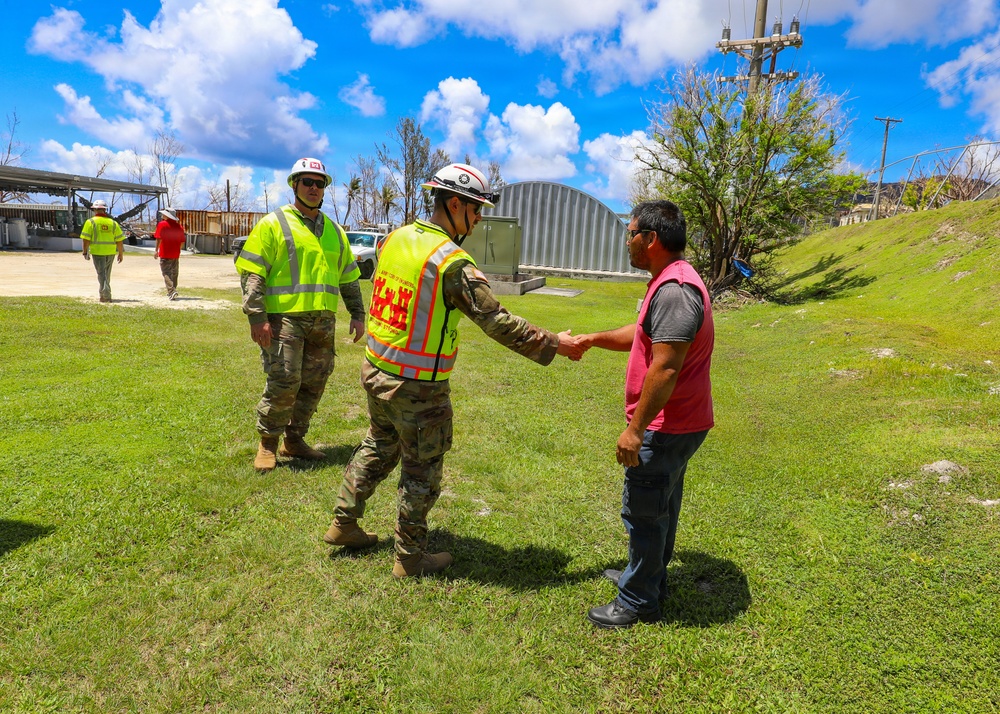
Grid Power in Rota Webre is originally from USACE’s Alaska district with almost a year under him. There he is an assistant project engineer for a runway extension project, which is not completed. Now, he is working on a pier repair project; but his priority is working on grid power for CNMI. One of the assessments the team conducted was the power plant on Rota, which Webre considers his most memorable experience.
After Super Typhoon Bavi, Rota’s—the southernmost island in CNMI—critical facilities such as the power plant and the health center were without power for almost two weeks. Hence, Webre along with the Grid Power Team and the 249th Engineer Battalion visited the island to assess the power plant and other facilities around the island. He never thought in his military career that he would be heading to a place such as Rota.
“To see the power plant and see the problems that they're having, see what they have to work with because they don't have a lot to work with on Rota, especially in the terms of power generation…,” Webre said.
Webre gained a deep admiration for the people of CNMI for their determined effort to clean-up their island.
“They're trying and the fact that they've gotten so far with what little they have is impressive. And just seeing that, really like, puts you in a good place, like you understand why you're here,” he said.
During emergency missions, USACE employees are working with people from various divisions, districts; contractors, federal and local agencies. Having a skillset in the realm of people and providing provide constructive criticism goes a long way in emergency missions.
“Having the people skills to tell someone, ‘Hey, you're not doing a very good job and to like, kind of steer them in the right direction,’” he said.
“Just do it” At USACE, the “Spirit of the Corps” represents many characteristics. For disaster response, it means restoring critical infrastructure to bring back some normalcy to the CNMI residents. It also means commitment to excellence. Webre could have been on vacation, having fun with his friends, but he chose something bigger than himself.
A true “Spirit of the Corps.”
Webre’s advice is simple, yet powerful for those who want to volunteer for an emergency mission, “Just do it [slightly laughing].” However, he highly recommended to look at the weather before packing to ensure you are at least prepared for the tropical climate because he definitely overpacked (his words, not the writer’s).
“It’s life-changing,” he said.
| Date Taken: | 08.17.2026 |
| Date Posted: | 08.25.2026 04:07 |
| Story ID: | 572520 |
| Location: | SAIPAN, MP |
| Web Views: | 12 |
| Downloads: | 0 |

This work, FIRST DEPLOYMENT STORIES: A True Spirit of the Corps, by Monique Freemon, identified by DVIDS, must comply with the restrictions shown on https://www.dvidshub.net/about/copyright.

No keywords found.





