IMCOM Executive Deputy to the Commanding General Robinson ends distinguished 39-year career serving Soldiers and their Families
Photo By Stephen Warns |
IMCOM Executive Deputy to the Commanding General Randy Robinson holds his hands close......read moreread more
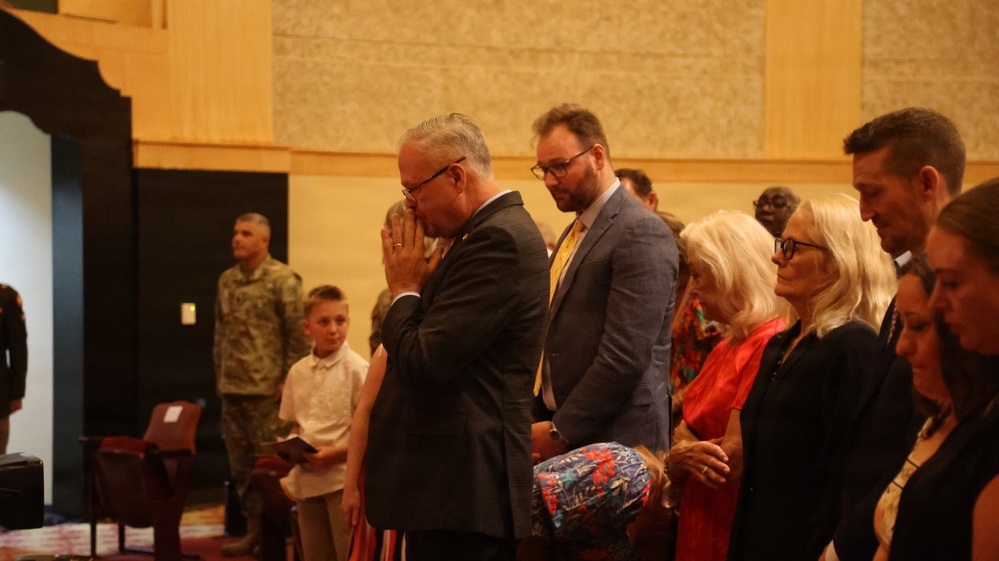
Photo By Stephen Warns | IMCOM Executive Deputy to the Commanding General Randy Robinson holds his hands close during his retirement ceremony Aug. 5 at the Fort Sam Houston Theater at Joint Base San Antonio-Fort Sam Houston. Robinson retired after a distinguished, 39-year career in the federal civil service. see less
| View Image Page
IMCOM Executive Deputy to the Commanding General Robinson ends distinguished 39-year career serving Soldiers and their Families
JOINT BASE SAN ANTONIO-FORT SAM HOUSTON, Texas – The beauty of Randy Robinson’s career as a civil servant, he said, was an answer to prayer.
“I said I would never work for the federal government because you didn’t make enough money,” said Robinson, who retired July 31 as the U.S. Army Installation Management Command Executive Deputy to the Commanding General, the command’s top civilian. “I had graduated college, and after college I was looking for a job. I had to pay the rent.”
Robinson said the turning point came in 1987 when he and his wife, Cecilia, prayed for direction. Both were recent college graduates and were working at a restaurant, where he washed dishes, and she bussed tables.
Divine intervention came from job offers in Northern Virginia — his at the Research Development and Engineering Center at Fort Belvoir as a GS-7/9/11 Program and Budget Analyst and hers in education.
Those humble beginning became the foundation of a distinguished, 39-year Army civilian career that saw 12 Army moves, overseas assignments, and some of the Army’s most consequential transitions in installation management.
IMCOM executes $13 billion annually and is responsible for maintaining the highest quality of life for Soldiers, Families, and civilians across 104 garrisons from Korea to Poland in support of Army readiness and deployability.
Not long after arriving at Fort Belvoir, Robinson accepted an opportunity to move to Saudi Arabia as an administrative officer, even though it meant taking a reduction in grade for broader experience.
“Prior to leaving for Saudi Arabia, when I was at Belvoir, I was speaking to headhunters about leaving the Army,” Robinson said. “It wasn’t satisfying to me, and it wasn’t scratching my itch. But going through Operation Desert Shield and Operation Desert Storm and seeing the dedication of the service members and their families who stayed, including my wife, who taught at the International School and was sought out by King Fahd to tutor his sister’s grandchildren in the Royal Compound, that’s when I said, ‘I’m going to dedicate my career to the Army and Department of War.’ ”
Robinson found the assignment that changed his career trajectory from resource management to installation management. As a young civilian, he was brought into Army Central Rear headquarters in Riyadh and eventually placed in charge of the emergency operations center overnight shift.
The experience taught him the importance of precision, trust, and calm under pressure, while also giving him a close view of the sacrifices made by Soldiers and Families during wartime.
Robinson’s career expanded through assignments at Fort Bragg, Fort Hood, Forces Command, the Installation Management Agency, the Office of the Assistant Secretary of the Army for Installations, Energy and Environment, and finally IMCOM headquarters. Along the way, he became one of the Army’s most experienced voices in installation management, helping to lead at the garrison, regional, headquarters, and Secretariat levels.
He also developed a reputation for seeing installations not as background infrastructure, but as operational enablers. When Robinson was the Deputy Garrison Commander at Fort Hood in the 1990s, he recalled, former III Armored Corps Commanding General Lt. Gen. Tom Schwartz impressed on him a philosophy that still resonates: “Mission first; people always.”
The philosophy stayed with him because it linked readiness to quality of life. Barracks, housing, childcare, public works, and family programs were not peripheral concerns. They were part of power projection.
Schwartz, who retired as a four-star general in 2002, put Robinson in charge of a re-engineering initiative that examined excess spending on the mission side.
“In one year, we harvested over $126 million from the mission side to quality-of-life initiatives and base operations,” Robinson said. “That was Gen. Schwartz’s philosophy.”
Robinson’s people-centric views were reinforced by mentors throughout his career. He spoke about leaders who shaped him, including retired Lt. Gen. Lawson Magruder, who once cautioned him against “falling on his sword” in a policy fight. Robinson said the lesson stayed with him because it taught him that leadership is not about one dramatic stand, but about staying in the fight long enough to make a lasting difference.
“Sometimes, leadership isn’t about winning one battle,” Robinson said. “It’s about remaining in the fight long enough to make a lasting difference.”
That perspective helped define Robinson’s approach in the Pentagon and at IMCOM headquarters, where he became known for collaboration, disciplined analysis and a relentless focus on outcomes.
“Mr. Robinson’s defining trait was his exceptional ability to get things done efficiently across the IMCOM enterprise,” said John Dumoulin, IMCOM Chief of Joint Basing, who has known Robinson since 2002 in the early days of the Installation Management Agency. “His powerful communication, cooperation, and collaboration reach with all echelons in the Department of War enabled IMCOM to achieve excellence.”
That ability to achieve excellence stems from a deep devotion to detail, said Frank Burns, who knew Robinson when he was the garrison commander at Fort Polk in 2009 and later served as Robinson’s executive officer.
“He stressed that every decision has consequences and has an effect on someone,” Burns said. “He truly cares about the workforce and how each person is developing and growing.”
IMCOM Commanding General Lt. Gen. James Smith echoed those sentiments during Robinson’s retirement ceremony Aug. 5 at the Fort Sam Houston Theater.
“His career has been nothing short of a masterclass in leadership, dedication, and unwavering commitment to our Soldiers and their families,” Smith said.
Smith said Robinson’s influence could be seen across the Army, from his early work in centralized installation management to his leadership and stewardship of major budgets, contracts, and quality-of-life programs. He credits Robinson with helping to establish systems and standards that continue to shape how IMCOM supports the Soldiers and their Families.
“Randy doggedly pursued the ground truth, and he demanded data, data, and more data,” Smith said. “He’s the one who created those installation housing scorecards that we use today.”
In retirement, Robinson said he looks forward to spending more time with family, traveling, working on his ranch and continuing mission and charitable work. But even as he closes this chapter, he said the values that guided his career remain the same: faith, service, and a desire to make a difference wherever he is called.
That includes IMCOM.
“Looking back, God has been faithful every step of the way,” Robinson said. “And I’m so proud of the people that make up this organization. They’re a part of the Army that are dedicated to the mission day in and day out, to improve the quality of life for service members and families.”
NEWS INFO
Date Taken:
08.16.2026
Date Posted:
08.16.2026 16:05
Story ID:
572506
Location:
FORT SAM HOUSTON, TEXAS, US
Web Views:
17
Downloads:
0
PUBLIC DOMAIN
This work, IMCOM Executive Deputy to the Commanding General Robinson ends distinguished 39-year career serving Soldiers and their Families, by Stephen Warns, identified by DVIDS, must comply with the restrictions shown on https://www.dvidshub.net/about/copyright.