
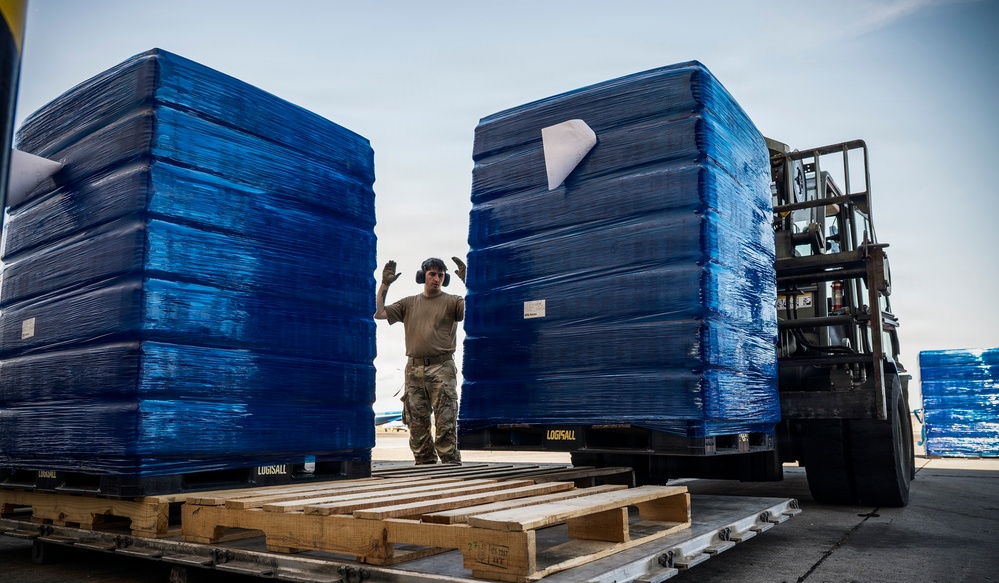
Photo By Yasuo Osakabe | U.S. Air Force Staff Sgt. Joshua Sanderson, 374th Logistics Readiness Squadron...... read more read more
 Subscribe
On Saturday morning, Aug. 8, members of the 374th Logistics Readiness Squadron received a short-notice tasking from U.S. Forces Japan.
The message directed Airmen to report to their designated work area and prepare for a humanitarian assistance and disaster relief mission supporting communities affected by the July 28 Kumamoto earthquake.
At the time, details were limited and the mission was still taking shape.
The Airmen knew their mission was to prepare humanitarian supplies for airlift, but much remained uncertain. They did not know how much cargo would arrive, how many personnel would be needed or how the shipment would ultimately move.
Still, they began preparing.
For the Air Transportation Function, operating with limited information was nothing new. The small team quickly assessed available manpower, coordinated with supporting organizations and determined what equipment would be required to prepare the cargo for airlift.
“When we have a task, especially a short-notice one, our office is designed to operate with augmentation and support from other units,” said U.S. Air Force Tech. Sgt. Joshua Moritz, 374th Logistics Readiness Squadron Air Transportation Function section chief.
When short-notice missions require capabilities beyond the ATF’s organic manpower and equipment, the team relies on coordination with the 730th Air Mobility Squadron and the 374th LRS Combat Mobility Flight to meet mission requirements.
“We provided the ATF a team of four personnel and a 10K Standard forklift,” said U.S. Air Force Staff Sgt. Joshua Sanderson, 374th LRS Contingency Support Team noncommissioned officer in charge. “We inspected all the pallets and nets we would be using to build and secure the cargo properly.”
That preparation became especially important as the mission required the ATF team to operate outside its routine operations.
“Normally, the customer brings the cargo to us,” Moritz said. “We conduct an in-check, inspect the cargo to ensure it’s ready for movement, and then coordinate with the AMS to begin the joint inspection process.”
This time, the team was responsible for building the cargo from the ground up.
“In this case, we built the cargo from scratch,” Moritz said.
Airmen staged empty 463L pallets and organized the work area before the water arrived. Once delivered, 374th LRS Ground Transportation personnel moved the water from the flatbed trailer as the team began building, securing and weighing each pallet.
Early in the process, the team identified a need for additional shoring to optimize the pallet configuration. The adjustment maximized available space while keeping each load within equipment weight limits.
“Having personnel from CMF with the know-how of building cargo allowed the ATF team to prepare the cargo faster and focus on the documentation side of the mission, such as load planning and manifesting the cargo,” Sanderson said. “With the use of our forklift and the forklift Ground Transportation lent us, we were able to build multiple pallets at once and break off into smaller teams to get the mission done.”
The additional support allowed the team to work on multiple pallets simultaneously and complete the palletization process in less than four hours.
“If it was just me and my team building those pallets, you would have seen three bodies out there,” Moritz said. “With the larger team, we can operate multiple forklifts, secure multiple pallets at a time and get them weighed quicker.”
The team prepared 20 pallets of bottled water weighing a combined 52,052 pounds (23,610 kilograms), containing approximately 33,000 bottles of drinking water.
The mission also took CMF beyond its routine role supporting 36th Airlift Squadron aircrew training, which includes packing cargo parachutes and building bundles for aerial delivery.
With the pallets prepared, the Air Transportation Function shifted its focus from cargo preparation to getting the shipment ready for airlift. The next challenge was determining how the water could be loaded onto the aircraft while maximizing available cargo capacity.
Instead of the U.S. Air Force C-130J Super Hercules the team routinely supports, the cargo would move aboard a U.S. Marine Corps KC-130J Super Hercules assigned to Marine Aerial Refueler Transport Squadron 152 (VMGR-152) at Marine Corps Air Station Iwakuni, Japan.
Because aircraft and service-specific procedures can vary, the Airmen worked directly with the Marine Corps aircrew to determine the aircraft’s actual cargo capacity and loading requirements.
“When they first landed, I sent my load planner out to meet with the crew,” Moritz said. “He showed them the cargo we had and asked what the aircraft could safely accept.”
That direct coordination allowed the Airmen to build the load plan around the aircraft’s actual capabilities rather than relying solely on standard estimates.
“We’re not relying on estimates or general aircraft limitations,” Moritz said. “We’re working with the aircraft’s actual weight and cargo limits, which allows us to build a more accurate load plan.”
The completed shipment was transported aboard the KC-130J from Yokota Air Base to a Japan Ground Self-Defense Force installation in Kumamoto. Following arrival, Japan’s Self-Defense Forces were responsible for distributing the water to affected residents through relief-supply management centers.
For the Airmen involved, the mission carried added significance because their efforts directly supported communities in the country where they live and serve.
“These missions are super important to us, especially with the humanitarian aspect,” Moritz said. “It hits a little bit harder because it’s Japan.”
Sanderson shared that sense of connection.
“When I saw the tasking come through, I was proud to be involved in a HADR mission to help the people of Kumamoto,” Sanderson said. “I’m proud to be a Port Dawg.”
That sense of purpose was matched by the initiative of the Airmen who carried out the work. Rather than waiting for every task to be assigned, team members identified what needed to be done, coordinated with their counterparts and worked through problems as they emerged.
“My team’s ability to identify that this needs to happen — ‘I am right here. I’m going to make it happen’ — that is what brings joy to me,” Moritz said.
What began Aug. 8 as a short-notice tasking ended with 20 pallets of drinking water prepared for military airlift to Kumamoto.
“No one on my team is leaving things undone,” Moritz said. “They are working together. They are taking the initiative and finding the answers they need to move forward.”
| Date Taken: | 08.10.2026 |
| Date Posted: | 08.10.2026 23:16 |
| Story ID: | 572020 |
| Location: | YOKOTA AIR BASE, JP |
| Web Views: | 20 |
| Downloads: | 0 |

This work, From Tasking to Airlift: 374th LRS supports Kumamoto earthquake relief, by Yasuo Osakabe, identified by DVIDS, must comply with the restrictions shown on https://www.dvidshub.net/about/copyright.


No keywords found.




