
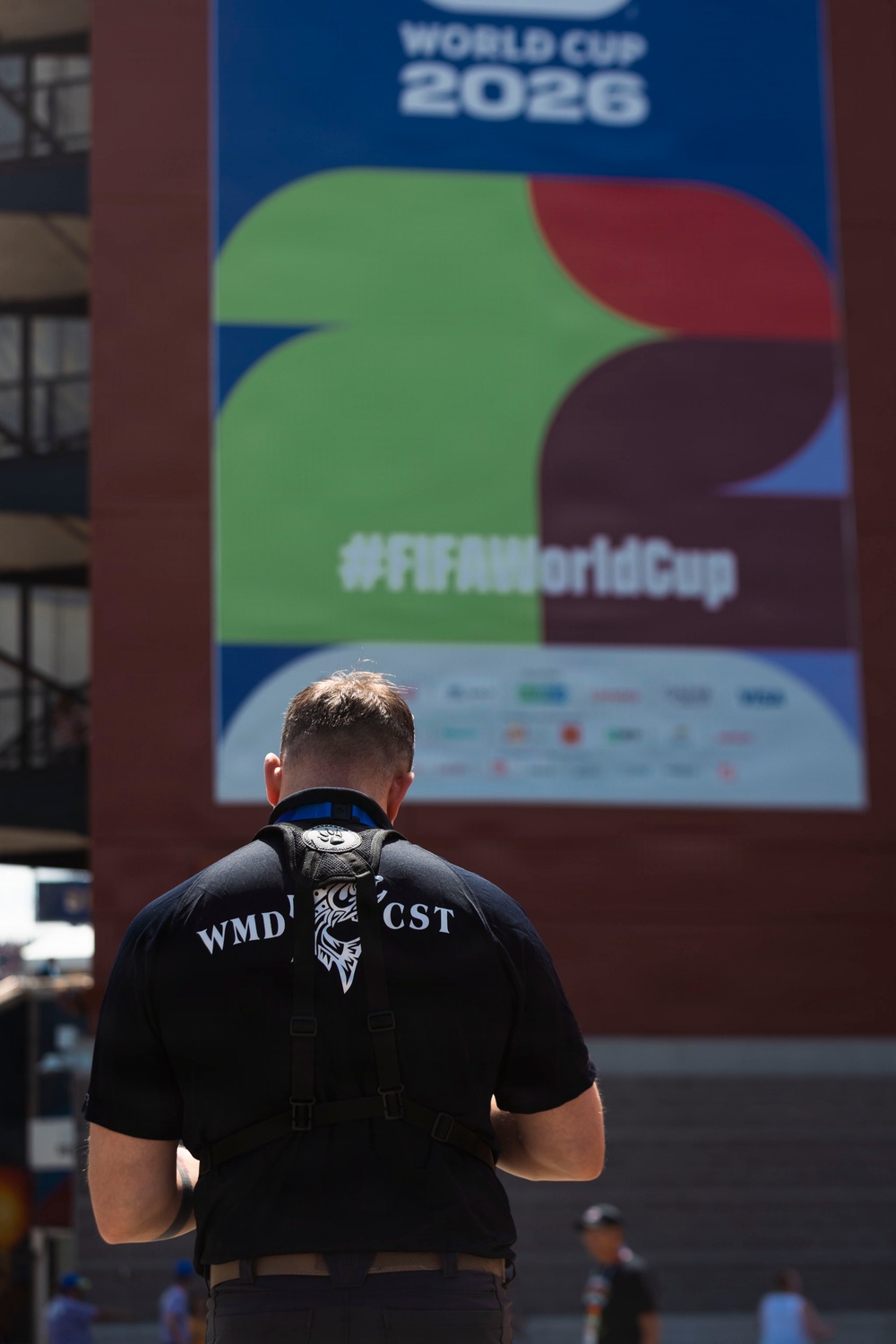
Photo By Joseph Siemandel | Guardsmen from the 10th Civil Support Team, Washington National Guard support first...... read more read more
 Subscribe
Temperatures soared while hopes plummeted in Seattle on Monday, as the curtain fell on another history-making sporting event. Over the course of the last few weeks, Seattle hosted six FIFA World Cup matches — including two that helped determine the future of Team USA.
Seattle was one of 11 American cities chosen to host World Cup matches, and it was only fitting that another local team was chosen to help local agencies protect the thousands of fans, athletes and visitors who came to the Emerald City.
Behind the scenes throughout the tournament, members of the Washington National Guard’s 10th Civil Support Team worked alongside federal, state and local public safety agencies to help detect, identify and assess potential chemical, biological, radiological, nuclear and explosive threats.
The 10th CST is accustomed to working with multiple agencies at large events in Seattle and across the country. The team works behind the scenes at every Seattle Seahawks home game and has supported events ranging from Major League Baseball’s All-Star festivities to multiple Super Bowls. However, the size, duration and international profile of the World Cup presented an entirely different challenge.
“The 10th CST regularly supports major NFL, MLB and large-scale public events, but the World Cup is in a league of its own,” said Maj. Ryan Dykes, commander of the 10th CST. “We aren't just talking about a single weekend; this was a sustained, months-long event with a global threat profile. The sheer volume of international visitors, the presence of dignitaries, and the continuous, high-tempo operations required a level of endurance and interagency coordination that dwarfs anything we’ve done before. It was a marathon run at a sprint pace.”
During each match, 10th CST personnel integrated into Joint Hazard Assessment Teams, or JHATs, specialized groups composed of experts from multiple public safety agencies who work together to identify and respond to potential hazardous materials and CBRNE threats.
Working throughout the stadium and surrounding areas, JHAT personnel conducted mobile assessments while other team members operated sensors and monitoring equipment designed to provide early warning of potential hazards. The layered approach allowed specialists to quickly assess anything unusual and determine whether additional resources or response measures were necessary.
For fans in the stands, much of that work was intentionally invisible.
“We put together a very comprehensive plan to help protect the stadium, participants and attendees,” said Lt. Ryan Nash, Seattle Fire Department Special Events lead. “This was a culmination of two years’ worth of work, and it went off without a hitch.”
That preparation required agencies with different missions, capabilities and authorities to operate as a single team. For the 10th CST, years of working alongside many of the same regional public safety partners provided an established foundation for the World Cup mission.
The scale of the tournament, however, tested that partnership in ways few previous events had.
“Every single match required 100 percent focus, but the USMNT match versus Belgium was undoubtedly our most demanding operational period,” said Dykes. “We were dealing with maximum stadium capacity, high-profile VIP movements, and massive crowds flooding the surrounding city footprint. We had to push our sensor networks and joint personnel to their absolute limits to ensure the venue remained secure. The challenge was there, but our operators and partner agencies executed flawlessly.”
While the 10th CST’s primary responsibility centered on identifying potential CBRNE hazards, its participation was part of a much larger network of local, state and federal agencies working throughout Seattle during the tournament.
That network reflected one of the central lessons of major-event security: no single agency can do it alone. For the Washington National Guard, supporting the World Cup also demonstrated how specialized military capabilities can complement civilian public safety agencies without replacing their authorities or responsibilities. CST members brought technical expertise, specialized detection equipment and years of experience operating in complex environments while remaining integrated with the civilian agencies responsible for protecting the event.
The mission was also an opportunity to apply capabilities developed through years of training and real-world missions. Whether supporting a major sporting event, responding to a hazardous materials incident or assisting during another domestic emergency, the team's purpose remains the same — provide specialized capabilities when local, state and federal partners need them.
For Maj. Gen. Gent Welsh, the adjutant general of Washington, the significance of the World Cup extended beyond the security operation itself. Against a backdrop of conflict and uncertainty around the world, he said events like the World Cup provide a reminder of what can happen when people and organizations continue working toward something larger than themselves.
“I think the real story here is that despite the chaos that we see in the world, and despite, in some ways, the chaos in the country, there are still people that go to work every day trying to move things forward, trying to move the country forward, trying to continue,” said Welsh.
For six matches in Seattle, that work took place largely out of sight — in command posts, among crowds, alongside sensors and monitoring equipment, and through countless conversations between partner agencies. Fans saw the goals, saves, celebrations and heartbreak that made Seattle part of World Cup history.
Behind them stood hundreds of public safety professionals, including members of the Washington National Guard, quietly working to make sure the world could focus on the game.
| Date Taken: | 07.13.2026 |
| Date Posted: | 08.07.2026 15:29 |
| Story ID: | 571875 |
| Location: | CAMP MURRAY, WASHINGTON, US |
| Web Views: | 13 |
| Downloads: | 0 |

This work, Washington National civil support team Guard at the heart of World Cup 2026 security, by SFC Adeline Witherspoon, identified by DVIDS, must comply with the restrictions shown on https://www.dvidshub.net/about/copyright.


No keywords found.




