
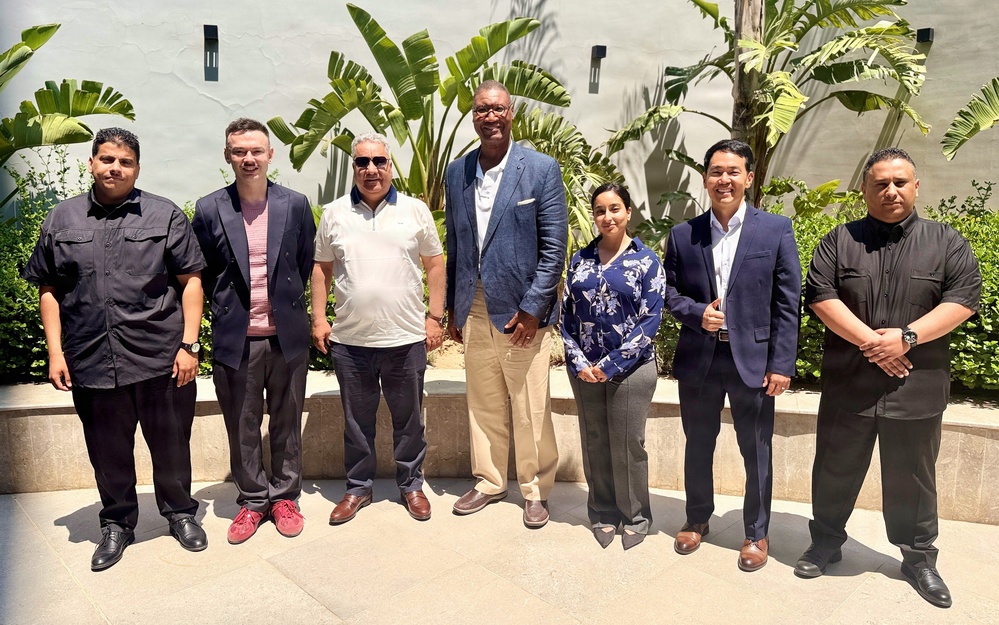
Photo By Kirk Frady | TUNIS, Tunisia — Military representatives from Landstuhl Regional Medical Center...... read more read more
 Subscribe
TUNIS, Tunisia – A team of U.S. military medical experts from various commands across Europe travelled to Tunis, Tunisia July 28-30 where they took part in an AFRICOM-led military medical subject matter expert exchange with members of the Libyan Armed Forces Medical Services.
The U.S. medical contingent, led by U.S. Army Col. (Dr.) Claude Burnett, Director of Global Health Engagements for Landstuhl Regional Medical Center, included medical experts from Landstuhl Regional Medical Center, U.S. Africa Command, and Special Operations Command Africa.
“The purpose of the exchange was to reestablish a professional dialogue, exchange information on U.S. and Libyan military medical capabilities, gain a better understanding of how the Libyan casualty-care system currently functions, and explore realistic areas for future cooperation,” said Burnett. “We approached the engagement as more of an open and collaborative discussion, not an inspection or assessment. It was essentially a learning opportunity for both sides.”
According to U.S. military officials, engagements like this are part of a broader theater security cooperation framework routinely coordinated with the respective U.S. Embassy and country team.
“Our most important takeaway from this engagement was that Libya’s primary need is in human-capital development, not simply additional equipment,” added Burnett. “The Libyan leaders repeatedly emphasized their desire to increase the number and proficiency of their combat medics, nurses, paramedical personnel, trauma clinicians, and instructors. They also highlighted rehabilitation and prosthetics, behavioral health, medical logistics, a military blood bank, and the development of a geographically distributed military hospital system as their top priorities. At the same time, the Libyans referenced existing field medical elements, hospital infrastructure, surgical and specialty capabilities, and civil-military referral relationships on which future cooperation could be built.”
According to government sources, the Libyan Military Medical Corps is both a domestic healthcare provider for the armed forces and a key player in international military medical cooperation, working with allies to build sustainable medical capabilities in Libya.
“The other important takeaway from this engagement was the importance of sequencing and prioritizing future efforts,” Burnett added. “Before recommending a specific medical training package, medical equipment solution, or clinical program, it requires additional information and an in-country, multidisciplinary assessment to validate the host-nation facilities, workforce, casualty pathways, and training requirements. A phased approach involving data exchange, virtual technical discussions, a collaborative site assessment, and a focused pilot activity, is the most viable option to producing sustainable results.”
According to senior military medical officials, medical engagements like this one provide a practical and often trusted avenue for building relationships with partner nations.
“For the Army, these discussions improve our understanding of regional medical systems, infrastructure, and partner capabilities that may affect future operations,” said Burnett. “They also help our medical personnel learn how care is delivered under different operational, geographic, and resource constraints while strengthening the professional relationships necessary for future coordination, interoperability, and medical support.”
According to individuals involved in this engagement, the Libyan military medical contingent communicated a strong desire to arrange a future visit to Landstuhl Regional Medical Center and the European Medical Simulation Center to learn how the U.S. Army conducts medical care, especially trauma and emergency care.
“This medical engagement provided us an opportunity to reopen communication, listen directly to our Libyan military medical counterparts, and begin building a practical relationship based on their actual priorities rather than based strictly on our assumptions," said Burnett.
| Date Taken: | 08.06.2026 |
| Date Posted: | 08.07.2026 05:53 |
| Story ID: | 571830 |
| Location: | DE |
| Web Views: | 21 |
| Downloads: | 0 |

This work, Building Bridges through Medicine - U.S. and Libyan Military Teams Strengthen Ties, by Kirk Frady, identified by DVIDS, must comply with the restrictions shown on https://www.dvidshub.net/about/copyright.

No keywords found.




